AAWSAP DIRD, Technological Approaches to Controlling External Devices, March 2010
DOW-UAP-D130 · page 7 of 36
Text
This text came with the file. It may have mistakes. When the text and the image disagree, the image is right.
UNCLASSIFIED/ /POR: err1e1At l:191!! er•t I
Direct Neural Signals
The human nervous system has two classes of cells, neurons and glia. Based on all
research to date, it is believed that signals within the network of neurons constitute the
whole of information processing, with glial cells playing a purely supporting role. This
neural doctrine has dominated research in BMI until recently and still constitutes the
only major research path in direct technologies. Furthermore, all technologies directly
measuring human neuronal action rely on detecting or influencing electrical activity of
these cells; no current in situ research selectively affects neurotransmitter activity
between local cells for the purpose of information exchange . Therefore, the focus for
the foreseeable future will be on the electrical activity of neurons as the primary target
of BMI.
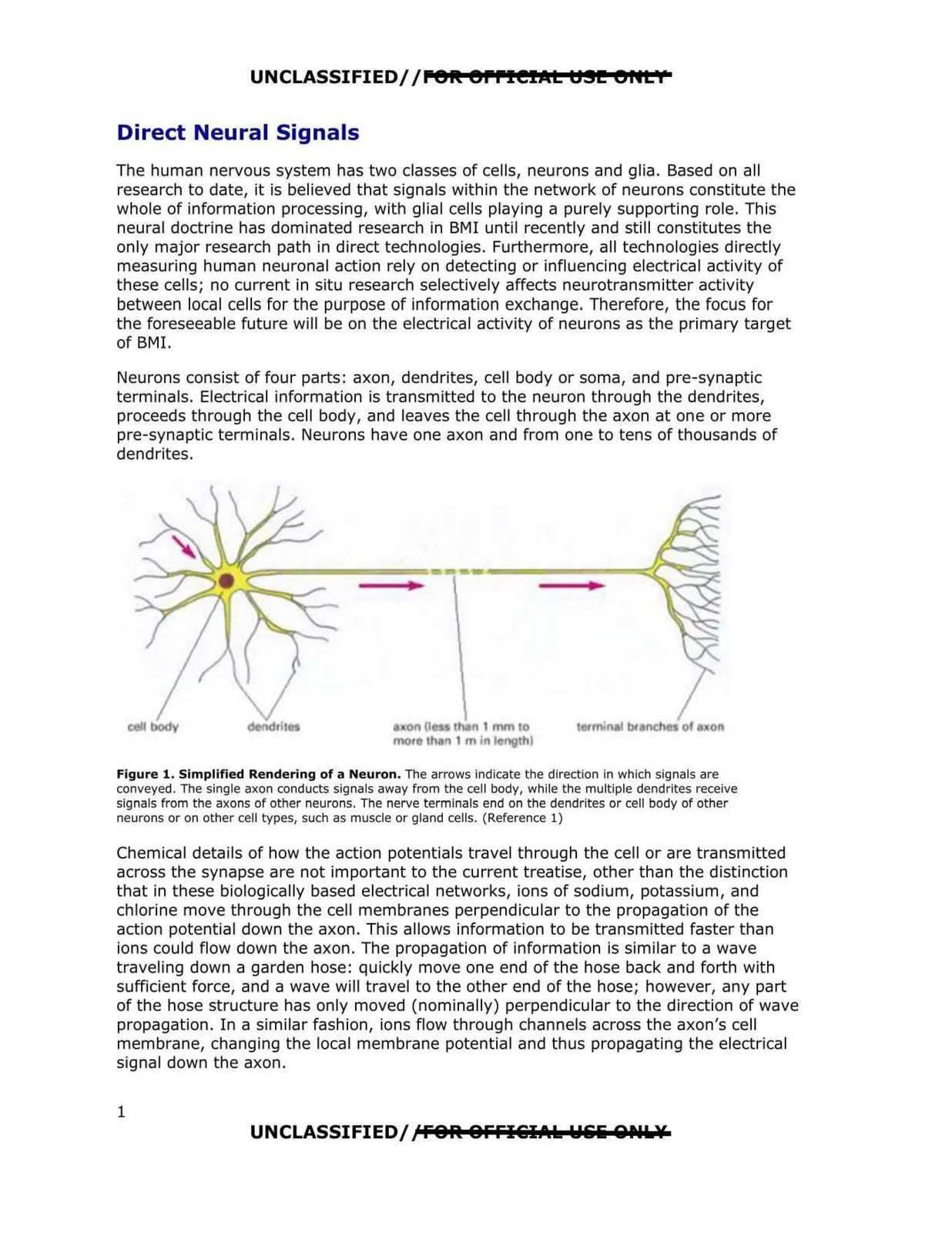
Neurons consist of four parts: axon, dendrites, cell body or soma, and pre-synaptic
terminals. Electrical information is transmitted to the neuron through the dendrites,
proceeds through the cell body, and leaves the cell through the axon at one or more
pre-synaptic terminals. Neurons have one axon and from one to tens of thousands of
dendrites.
Figure 1. Simplified Rendering of a Neuron. The arrows indicate t he direction in which signals are
conveyed. The single axon conducts signals away from the cell body, while the multiple dendrites receive
signals from the axons of other neurons. The nerve terminals end on the dendrites or cell body of other
neurons or on other cell types, such as muscle or gland cells. (Reference 1)
Chemical details of how the action potentials travel through the cell or are transmitted
across the synapse are not important to the current treatise, other than the distinction
that in these biologically based electrical networks, ions of sodium, potassium, and
chlorine move through the cell membranes perpendicular to the propagation of the
action potential down the axon. This allows information to be transmitted faster than
ions could flow down the axon. The propagation of information is similar to a wave
traveling down a garden hose: quickly move one end of the hose back and forth with
sufficient force, and a wave will travel to the other end of the hose; however, any part
of the hose structure has only moved (nominally) perpendicular to the direction of wave
propagation. In a similar fashion, ions flow through channels across the axon's cell
membrane, changing the local membrane potential and thus propagating the electrical
signal down the axon.
UNCLASSIFIED/;'FOR OFFI&I.t.k Wliliii 8fslk¥
1