AAWSAP DIRD, The Space Communication Implications of Quantum Entanglement and Nonlocality, March 2010
DOW-UAP-D133 · page 23 of 32
Text
This text came with the file. It may have mistakes. When the text and the image disagree, the image is right.
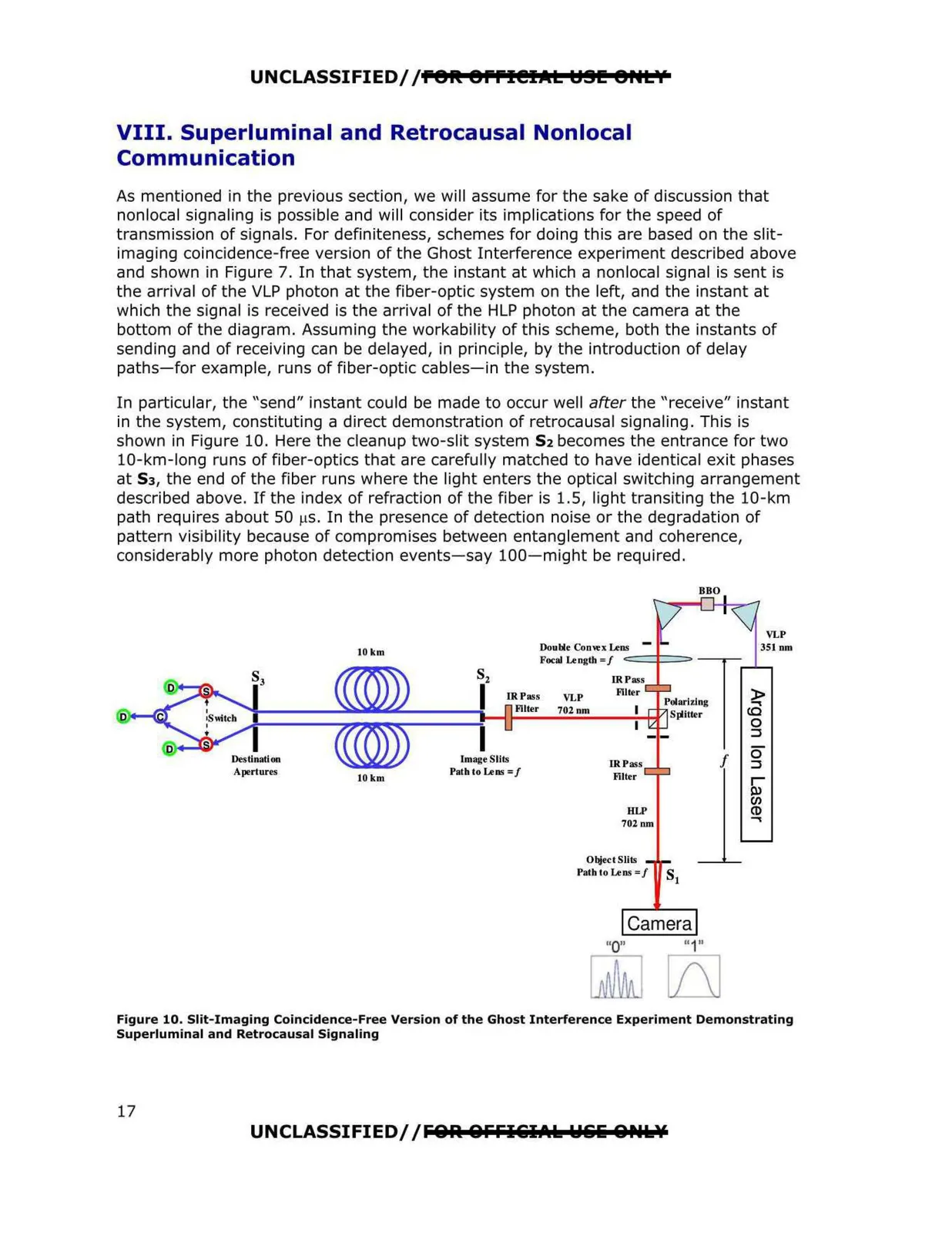
UNCLASSIFIED//P81t errl@IAL ~SI! 8HL'I VIII. Superluminal and Retrocausal Nonlocal Communication As mentioned in the previous section, we will assume for the sake of discussion that nonlocal signaling is possible and will consider its implications for the speed of transmission of signals. For definiteness, schemes for doing this are based on the slit imaging coincidence-free version of the Ghost Interference experiment described above and shown in Figure 7. In that system, the instant at which a nonlocal signal is sent is the arrival of the VLP photon at the fiber-optic system on the left, and the instant at which the signal is received is the arrival of the HLP photon at the camera at the bottom of the diagram. Assuming the workability of this scheme, both the instants of sending and of receiving can be delayed, in principle, by the introduction of delay paths-for example, runs of fiber-optic cables-in the system. In particular, the "send" instant could be made to occur well after the "receive" instant in the system, constituting a direct demonstration of retrocausal signaling. This is shown in Figure 10. Here the cleanup two-slit system S2 becomes the entrance for two 10-km-long runs of fiber-optics that are carefully matched to have identical exit phases at SJ, the end of the fiber runs where the light enters the optical switching arrangement described above. If the index of refraction of the fiber is 1.5, light transiting the 10-km path requires about 50 µs. In the presence of detection noise or the degradation of pattern visibility because of compromises between entanglement and coherence, considerably more photon detection events-say 100-might be required. 10km Apertures 10km Image Slits Path lo Lens =f IR Pass Filler HIJ> 702 nm 0!¥ctSlits BBO VLP JSI nm Path to Lens= f S1 Camera u 1 n [/SJ Figure 10. Slit-Imaging Coincidence-Free Version of the Ghost Interference Experiment Demonstrating Superluminal and Retrocausal Signaling UNCLASSIFIED//FOlil OFFI&il.t.k W&lii 8Nk¥ 17