AAWSAP DIRD, The Space Communication Implications of Quantum Entanglement and Nonlocality, March 2010
DOW-UAP-D133 · page 8 of 32
Text
This text came with the file. It may have mistakes. When the text and the image disagree, the image is right.
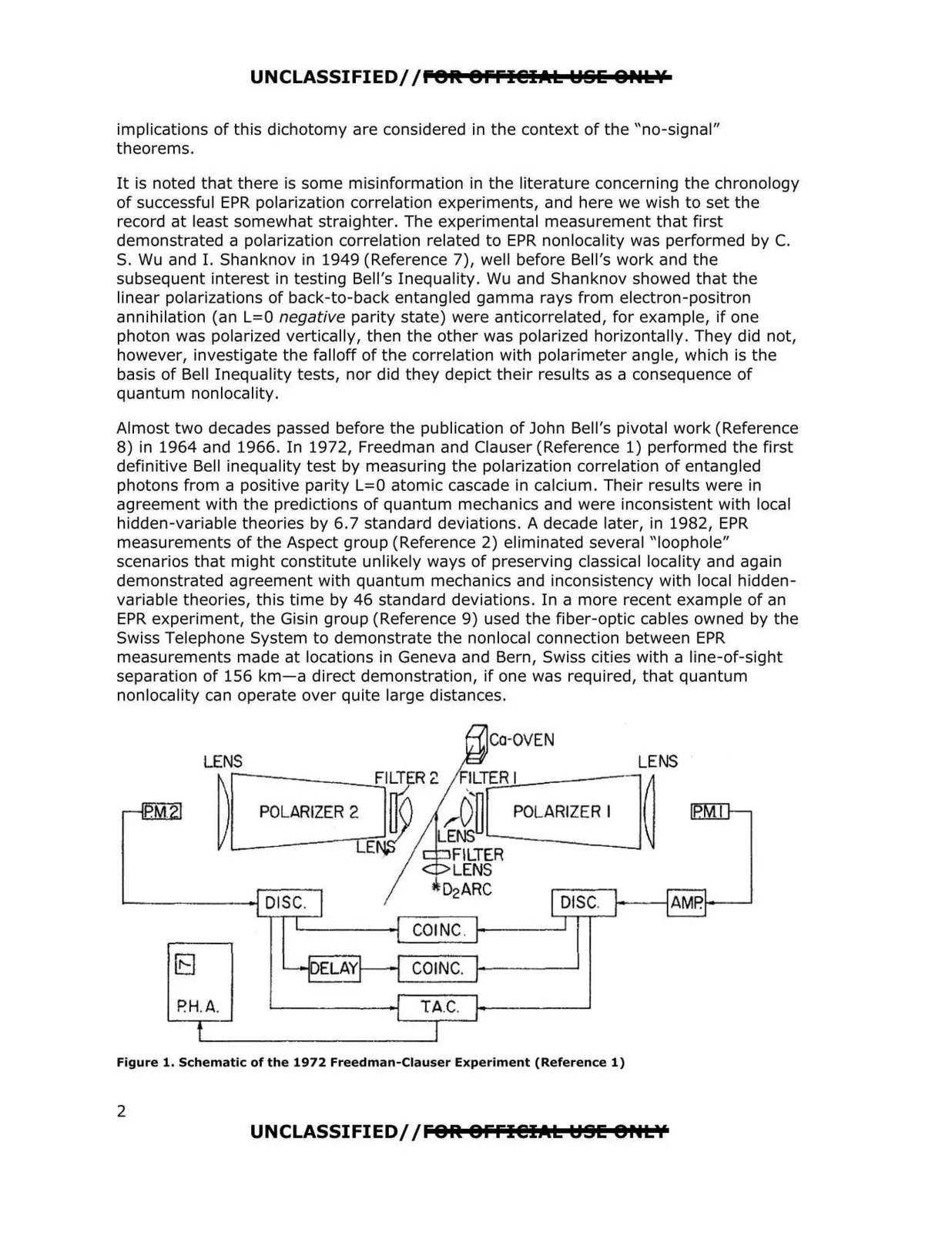
UNCLASSIFIED//P91t 9ffl@IAL WSE &P•Llf implications of this dichotomy are considered in the context of the "no-signal" theorems. It is noted that there is some misinformation in the literature concerning the chronology of successful EPR polarization correlation experiments, and here we wish to set the record at least somewhat straighter. The experimental measurement that first demonstrated a polarization correlation related to EPR nonlocality was performed by C. S. Wu and I. Shanknov in 1949 (Reference 7), well before Bell's work and the subsequent interest in testing Bell's Inequality. Wu and Shanknov showed that the linear polarizations of back-to-back entangled gamma rays from electron-positron annihilation (an L=O negative parity state) were anticorrelated, for example, if one photon was polarized vertically, then the other was polarized horizontally. They did not, however, investigate the falloff of the correlation with polarimeter angle, which is the basis of Bell Inequality tests, nor did they depict their results as a consequence of quantum nonlocality. Almost two decades passed before the publication of John Bell's pivotal work (Reference 8) in 1964 and 1966. In 1972, Freedman and Clauser (Reference 1) performed the first definitive Bell inequality test by measuring the polarization correlation of entangled photons from a positive parity L=O atomic cascade in calcium. Their results were in agreement with the predictions of quantum mechanics and were inconsistent with local hidden-variable theories by 6. 7 standard deviations. A decade later, in 1982, EPR measurements of the Aspect group (Reference 2) eliminated several "loophole" scenarios that might constitute unlikely ways of preserving classical locality and again demonstrated agreement with quantum mechanics and inconsistency with local hidden variable theories, this time by 46 standard deviations. In a more recent example of an EPR experiment, the Gisin group (Reference 9) used the fiber-optic cables owned by the Swiss Telephone System to demonstrate the nonlocal connection between EPR measurements made at locations in Geneva and Bern, Swiss cities with a line-of-sight separation of 156 km-a direct demonstration, if one was required, that quantum nonlocality can operate over quite large distances. LENS ~ FILTER POLARIZER 2 ~LE , .....__ _ __-..i DISC. f8 P.H.A. ELAY COINC . COINC. TA.C. Ca-OVEN LENS RI ~ '~ POLARIZER I =--------i Figure 1. Schematic of the 1972 Freedman-Clauser Experiment (Reference 1) UNCLASSIFIED//FOil OFFl@IAL W!H! 9HL1/ 2