AAWSAP DIRD, Maverick Inventor Versus Corporate Inventor: Where Will the Next Major Innovations Arise, March 2010
DOW-UAP-D134 · page 8 of 19
Text
This text came with the file. It may have mistakes. When the text and the image disagree, the image is right.
UNCLASSIFIED/}FOA OFFI&IAb W&& 8PtbY
Table 1. Types and Examples of Think Tanks
Universities
Government
Type
Examples
Radlab, MIT, Cambridge, MA
Sandia National Laboratories,
Albuquerque, NM
Lawrence Livermore National Laboratory,
Livermore, CA
Brookhaven National Laboratory, Upton,
NY
Quasi-Government/Military
Corporate
NASA (for example, Glenn Research
Center, Brook Park, OH)
DARPA, Arlinqton, VA
GM Research Laboratory, Warren, MI
Alcatel/Lucent - Bell Labs, Murray Hill, NJ
Privately Funded
Skunk Works, Palmdale, CA
Perimeter Institute for Theoretica I Physics,
Waterloo, Canada
Institute for Advanced Studies, Austin , TX
Independent, Nonprofit
SARA (Scientific Applications & Research
Associates) Cypress, CA
Battelle, Columbus, OH
SRI International, Menlo Park, CA
EPRI (Electric Power Research Institute),
Palo Alto, CA
Austrian Research Centers, Sei bersdorf,
Austria
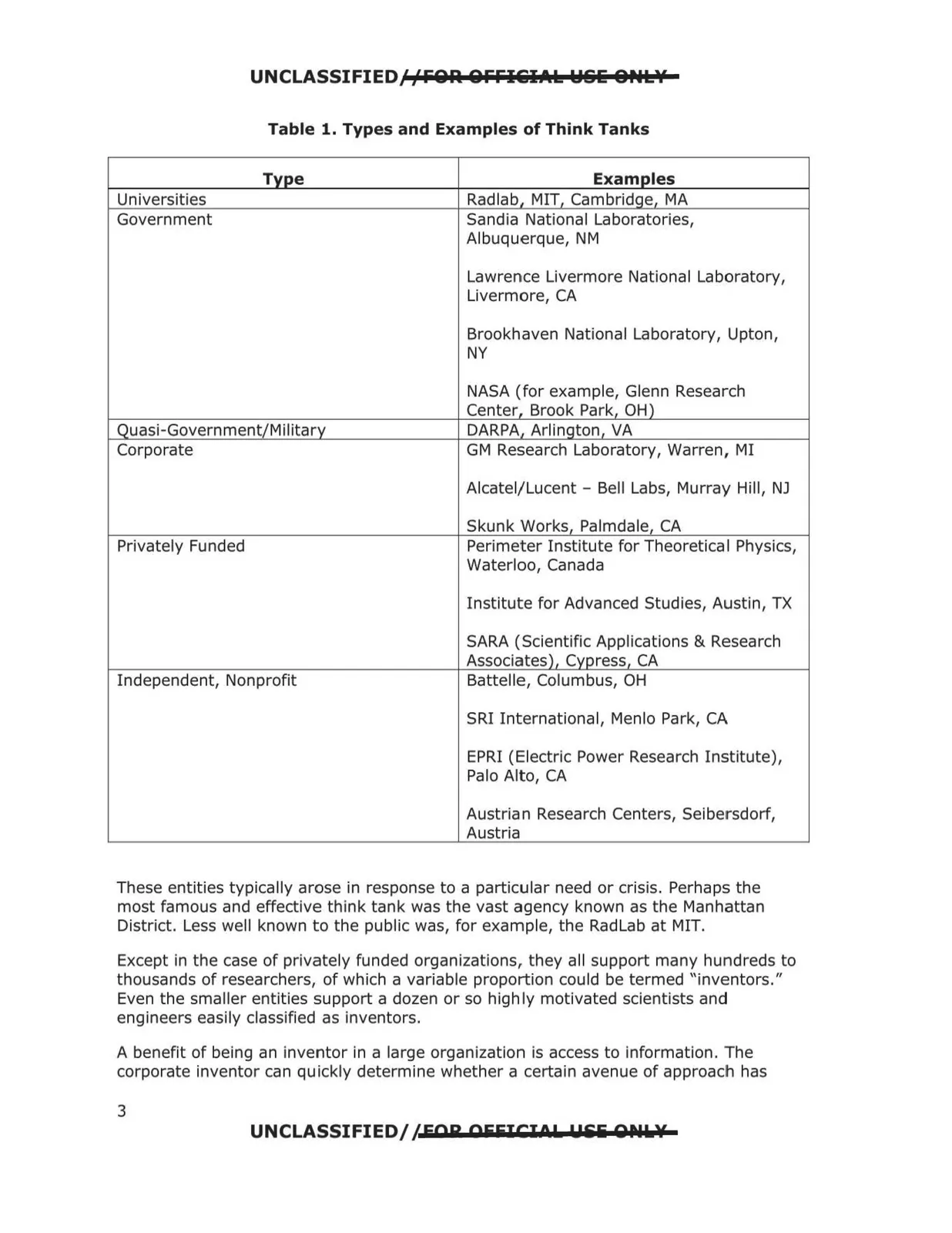
These entities typically arose in response to a particular need or crisis. Perhaps the
most famous and effective think tank was the vast agency known as the Manhattan
District. Less well known to the public was, for example, the RadLab at MIT.
Except in the case of privately funded organizations, they all support many hundreds to
thousands of researchers, of which a variable proportion could be termed "inventors."
Even the smaller entities support a dozen or so highly motivated scientists and
engineers easily classified as inventors.
A benefit of being an inventor in a large organization is access to information. The
corporate inventor can quickly determine whether a certain avenue of approach has
UNCLASSIFIED/ /EAR OFFICI0L !l&li Ql'lls¥
3