AAWSAP DIRD, Antigravity for Aerospace Applications, March 2010
DOW-UAP-D135 · page 27 of 44
Text
This text came with the file. It may have mistakes. When the text and the image disagree, the image is right.
UNCLASSIFIED/fFOA OFFIEIAk W&i 0Pilk¥
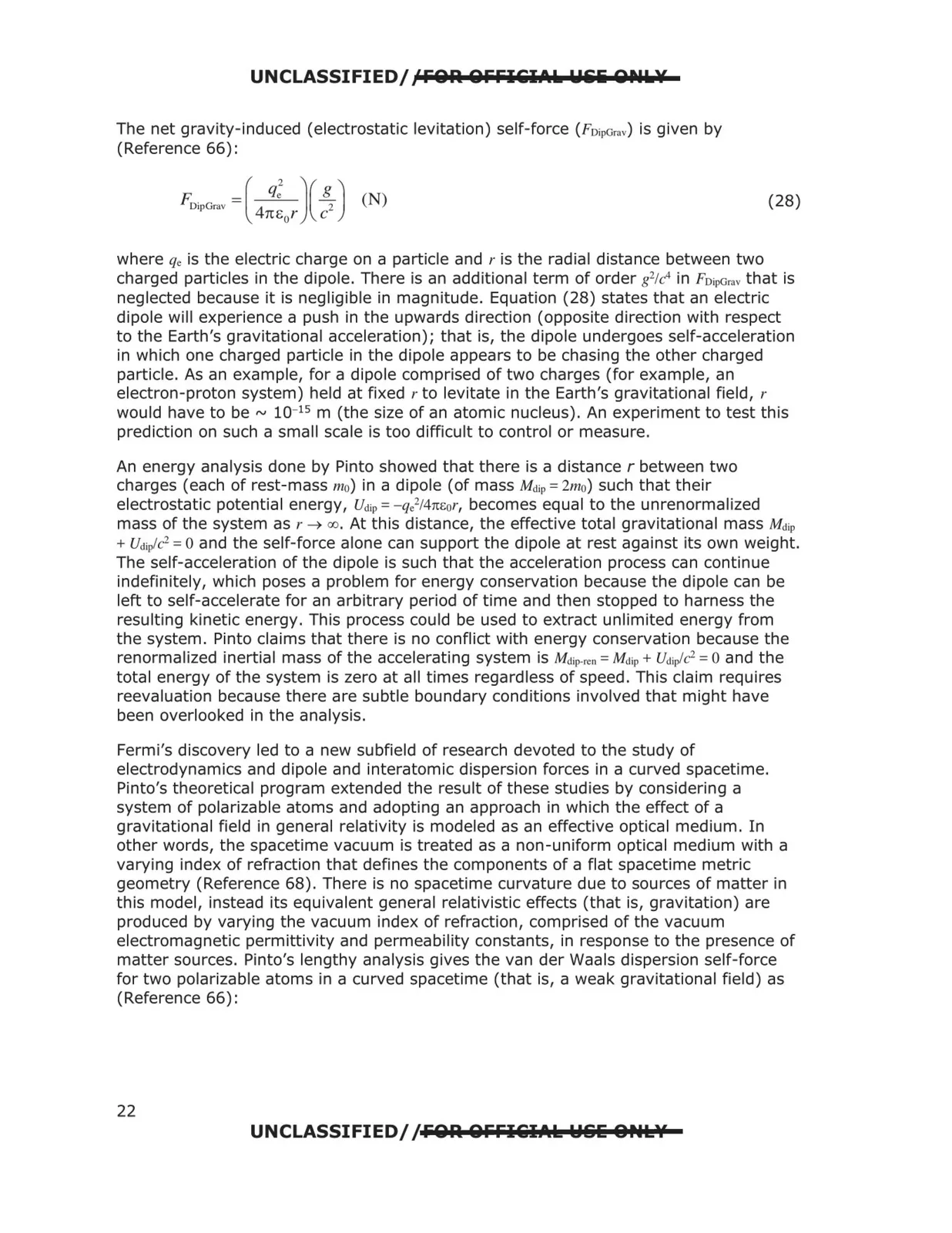
The net gravity-induced (electrostatic levitation) self-force (Fo;pGrav) is given by
(Reference 66):
(28)
where qe is the electric charge on a particle and r is the radial distance between two
charged particles in the dipole. There is an additional term of order g2/c4 in Fo;porav that is
neglected because it is negligible in magnitude. Equation (28) states that an electric
dipole will experience a push in the upwards direction (opposite direction with respect
to the Earth's gravitational acceleration); that is, the dipole undergoes self-acceleration
in which one charged particle in the dipole appears to be chasing the other charged
particle. As an example, for a dipole comprised of two charges (for example, an
electron-proton system) held at fixed r to levitate in the Earth's gravitational field, r
would have to be ~ 10-15 m (the size of an atomic nucleus). An experiment to test this
prediction on such a small scale is too difficult to control or measure.
An energy analysis done by Pinto showed that there is a distance r between two
charges (each of rest-mass mo) in a dipole (of mass Mdip = 2mo) such that their
electrostatic potential energy, U d;p = - qe2/4rcEor, becomes equal to the unrenormalized
mass of the system as r ➔ oo . At this distance, the effective total gravitational mass Mct;p
+ Ud;p/c2= O and the self-force alone can support the dipole at rest against its own weight.
The self-acceleration of the dipole is such that the acceleration process can continue
indefinitely, which poses a problem for energy conservation because the dipole can be
left to self-accelerate for an arbitrary period of time and then stopped to harness the
resulting kinetic energy. This process could be used to extract unlimited energy from
the system. Pinto claims that there is no conflict with energy conservation because the
renormalized inertial mass of the accelerating system is Mdip-ren =M dir + U ct;p/c2 =0 and the
total energy of the system is zero at all times regardless of speed. This claim requires
reevaluation because there are subtle boundary conditions involved that might have
been overlooked in the analysis.
Fermi's discovery led to a new subfield of research devoted to the study of
electrodynamics and dipole and interatomic dispersion forces in a curved spacetime.
Pinto's theoretical program extended the result of these studies by considering a
system of polarizable atoms and adopting an approach in which the effect of a
gravitational field in general relativity is modeled as an effective optical medium. In
other words, the spacetime vacuum is treated as a non-uniform optical medium with a
varying index of refraction that defines the components of a flat spacetime metric
geometry (Reference 68). There is no spacetime curvature due to sources of matter in
this model, instead its equivalent general relativistic effects (that is, gravitation) are
produced by varying the vacuum index of refraction, comprised of the vacuum
electromagnetic permittivity and permeability constants, in response to the presence of
matter sources. Pinto's lengthy analysis gives the van der Waals dispersion self-force
for two polarizable atoms in a curved spacetime (that is, a weak gravitational field) as
(Reference 66):
UNCLASSIFIED//FOA OFFI&IAb Yi&: 8,.bY
22