AAWSAP DIRD, Antigravity for Aerospace Applications, March 2010
DOW-UAP-D135 · page 7 of 44
Text
This text came with the file. It may have mistakes. When the text and the image disagree, the image is right.
UNCLASSIFIED/ fFOA OFFIEIA~ W&li QPI~¥
theoretical possibility of antigravity also appears in quantum gravity theories,
cosmological vacuum or dark energy, and quantum field theory. This report reviews all
of these topics. The report will also review the topics of gravity control that include the
production of antigravity (self-lifting) forces induced by quantum vacuum zero-point
energy and by nonretarded quantum interatomic dispersion forces in a curved
spacetime (that is, in a background gravitational field). The reader should bear in mind
that many of these concepts are nowhere near having any form of practicable
engineering implementation. However, the report will provide theoretical estimates to
guide the way toward technologica l implementation of antigravity.
II. Concepts for Antigravity Within Newtonian Physics
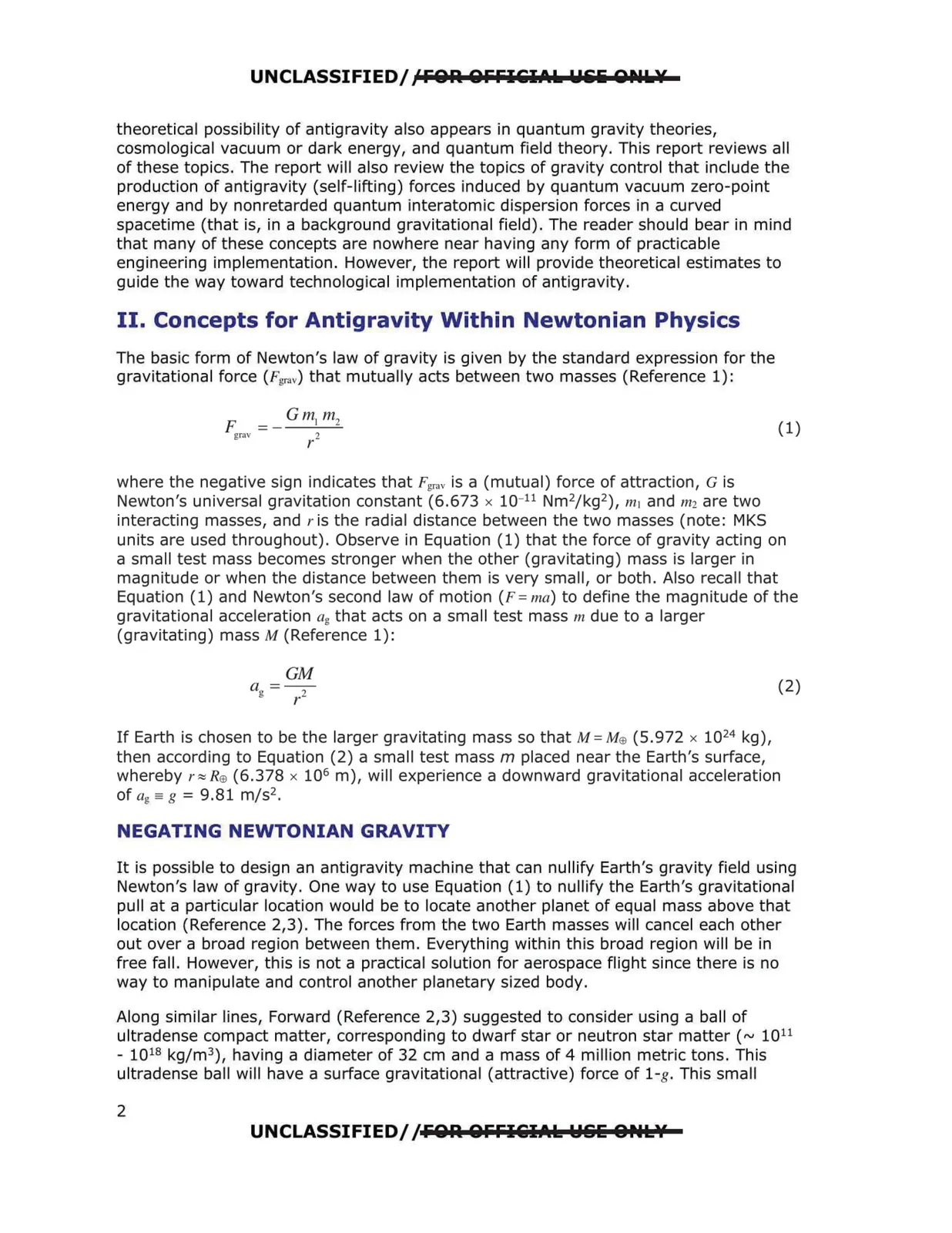
The basic form of Newton's law of gravity is given by the standard expression for the
gravitational force {Fgrav) that mutually acts between two masses (Reference 1):
(1)
where the negative sign indicates that Fgrn" is a (mutual) force of attraction, G is
Newton's universal gravitation constant (6.673 x 10⁻¹¹ Nm2/kg 2), m 1 and m 2 are two
interacting masses, and r is the radial distance between the two masses (note: MKS
units are used throughout). Observe in Equation (1) that the force of gravity acting on
a small test mass becomes stronger when the other (gravitating) mass is larger in
magnitude or when the distance between them is very small, or both. Also recall that
Equation (1) and Newton's second law of motion (F = ma) to define the magnitude of the
gravitational acceleration a8 that acts on a small test mass m due to a larger
(gravitating) mass M (Reference 1):
GM
a g =
-
?
(2)
r-
If Earth is chosen to be the larger gravitating mass so that M = M@ (5.972 x 1024 kg),
then according to Equation (2) a small test mass m placed near the Earth's surface,
whereby r~ R @ (6.378 x 10⁶ m), will experience a downward gravitational acceleration
of a g = g = 9.81 m/s2.
NEGATING NEWTONIAN GRAVITY
It is possible to design an antigravity machine that can nullify Earth's gravity field using
Newton's law of gravity. One way to use Equation (1) to nullify the Earth's gravitational
pull at a particular location would be to locate another planet of equal mass above that
location (Reference 2,3). The forces from the two Earth masses will cancel each other
out over a broad region between them . Everything within this broad region will be in
free fall. However, this is not a practical solution for aerospace flight since there is no
way to manipulate and control another planetary sized body.
Along similar lines, Forward (Reference 2,3) suggested to consider using a ball of
ultradense compact matter, corresponding to dwarf star or neutron star matter (~ 1011
- 1018 kg/m 3), having a diameter of 32 cm and a mass of 4 million metric tons. This
ultradense ball will have a surface gravitational (attractive) force of 1-g. This small
UNCLASSIFIED/ /FOA OFFI&il.t.k Y&li 8,.LY
2