AAWSAP DIRD, Biosensors and BioMEMS: A Survey of the Present Field, March 2010
DOW-UAP-D136 · page 44 of 45
Text
This text came with the file. It may have mistakes. When the text and the image disagree, the image is right.
UNCLASSIFIED//P'OR: OP'Pl@IAL WS& 0NI.¥
Thus the trend has been to employ
MEMS technology to reduce the size of
the cantilever beams to microscopic
proportions. In such cases, even the
mass of cells or virus particles can be
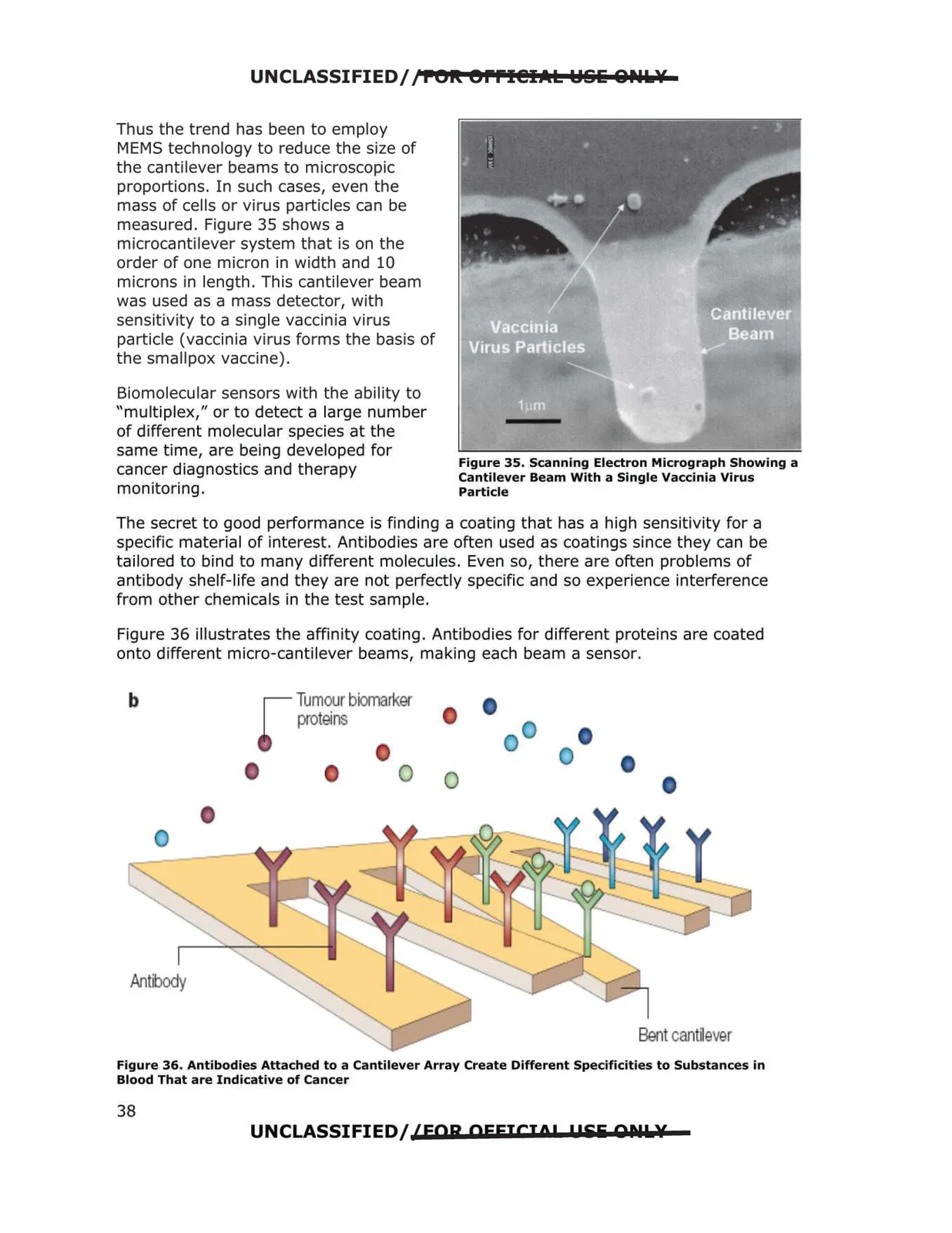
measured. Figure 35 shows a
microcantilever system that is on the
order of one micron in width and 10
microns in length. This cantilever beam
was used as a mass detector, with
sensitivity to a single vaccinia virus
particle (vaccinia virus forms the basis of
the smallpox vaccine).
Biomolecular sensors with the ability to
"multiplex," or to detect a large number
of different molecular species at the
same time, are being developed for
cancer diagnostics and therapy
monitoring.
The secret to good performance is finding a coating that has a high sensitivity for a
specific material of interest. Antibodies are often used as coatings since they can be
tailored to bind to many different molecules. Even so, there are olten problems of
antibody shelf-life and they are not perfectly specific and so experience interference
from other chemicals in the test sample.
Figure 36 illustrates the affinity coating. Antibodies for different proteins are coated
onto different micro-cantilever beams, making each beam a sensor.
b
r
Tumour biomarker
proteins
0
Figure 35. Scanning Electron Micrograph Showing a
Cantilever Beam With a Single Vaccinia Virus
Particle
Anti ody
Figure 36. Antibodies Attached to a Cantilever Array Create Different Specificities to Substances in
Blood That are Indicative of Cancer
UNCLASSIFIED/ (EAR OFFICIO! !Pfli 0111.¥
38