AAWSAP DIRD, Biosensors and BioMEMS: A Survey of the Present Field, March 2010
DOW-UAP-D136 · page 8 of 45
Text
This text came with the file. It may have mistakes. When the text and the image disagree, the image is right.
UNCLASSIFIED//P'OR: OP'P'l@IAL WS& 0Nk¥
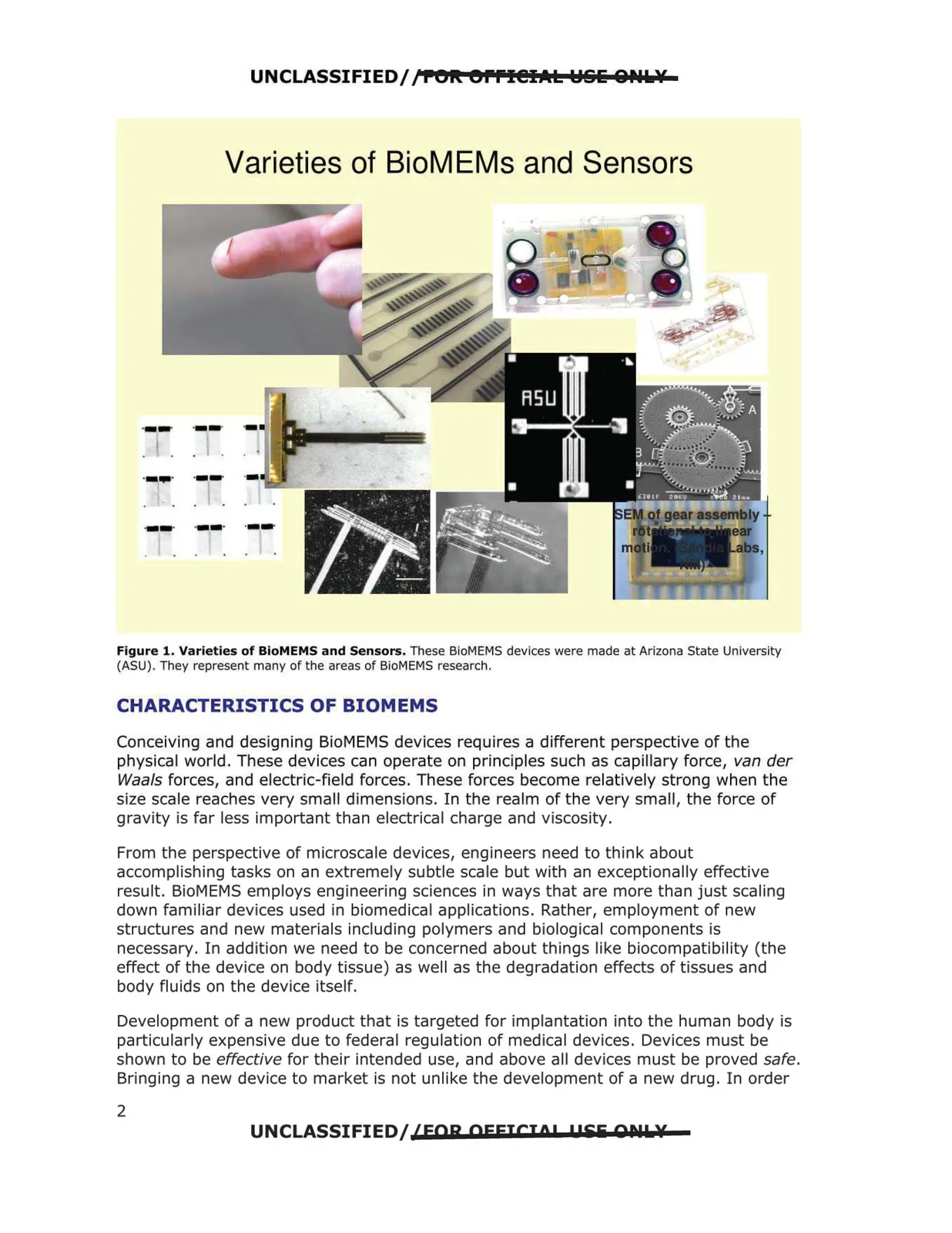
Varieties of BioMEMs and Sensors
---
- -·
·-•·
- -
. I . . I .
- -· - -· ---·
Figure 1. Varietie.s of BioMEMS and Sensors. These BioMEMS devices were made at Arizona State University
(ASU). They represent many of the areas of BioMEMS research.
CHARACTERISTICS OF BIOMEMS
Conceiving and designing BioMEMS devices requires a different perspective of the
physical world. These devices can operate on principles such as capillary force, van der
Waals forces, and electric-field forces. These forces become relatively strong when the
size scale reaches very small dimensions. In the realm of the very small, the force of
gravity is far less important than electrical charge and viscosity.
From the perspective of microscale devices, engineers need to think about
accomplishing tasks on an extremely subtle scale but with an exceptionally effective
result. BioMEMS employs engineering sciences in ways that are more than just scaling
down familiar devices used in biomedical applications. Rather, employment of new
structures and new materials including polymers and biological components is
necessary. In addition we need to be concerned about things like biocompatibility (the
effect of the device on body tissue) as well as the degradation effects of tissues and
body fluids on the device itself.
Development of a new product that is targeted for implantation into the human body is
particularly expensive due to federal regulation of medical devices. Devices must be
shown to be effective for their intended use, and above all devices must be proved safe.
Bringing a new device to market is not unlike the development of a new drug. In order
UNCLASSIFIED/ {FOR OFFICIO! !PEii QDlk¥
2