AAWSAP DIRD, State of the Art and Evolution of High-Energy Lasers, March 2010
DOW-UAP-D137 · page 30 of 31
Text
This text came with the file. It may have mistakes. When the text and the image disagree, the image is right.
UNCLASSIFIED/ fFOA. OFFI€il.t.L YSE er•tv
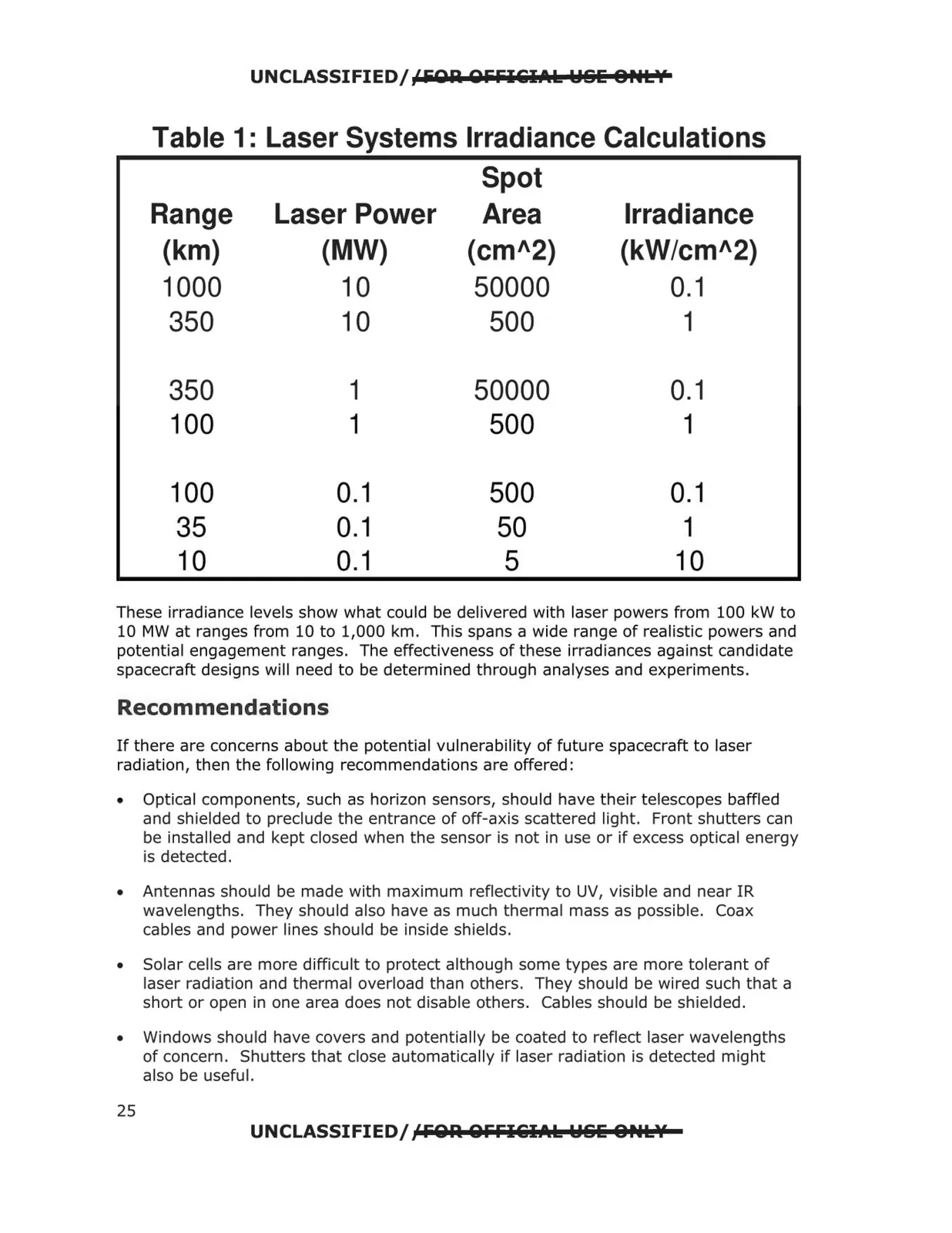
Table 1: Laser Systems lrradiance Calculations
Spot
Range
Laser Power
Area
lrradiance
(km)
(MW)
(cmA2)
(kW/cmA2)
1000
10
50000
0.1
350
10
500
1
350
1
50000
0.1
100
1
500
1
100
0.1
500
0.1
35
0.1
50
1
10
0.1
5
10
These irradiance levels show what could be delivered with laser powers from 100 kW to
10 MW at ranges from 10 to 1,000 km. This spans a wide range of realistic powers and
potential engagement ranges. The effectiveness of these irradiances against candidate
spacecraft designs will need to be determined through analyses and experiments.
Recommendations
If there are concerns about the potential vulnerability of future spacecraft to laser
radiation, then the following recommendations are offered:
•
Optical components, such as horizon sensors, should have their telescopes baffled
and shielded to preclude the entrance of off-axis scattered light. Front shutters can
be installed and kept closed when the sensor is not in use or if excess optical energy
is detected.
•
Antennas should be made with maximum reflectivity to UV, visible and near IR
wavelengths. They should also have as much thermal mass as possible. Coax
cables and power lines should be inside shields.
•
Solar cells are more difficult to protect although some types are more tolerant of
laser radiation and thermal overload than others. They should be wired such that a
short or open in one area does not disable others. Cables should be shielded.
•
Windows should have covers and potentially be coated to reflect laser wavelengths
of concern. Shutters that close automatically if laser radiation is detected might
also be useful.
UNCLASSIFIED/ fFOA QFFI€il.t.L YSE 8,.L\f
25