AAWSAP DIRD, State of the Art and Evolution of High-Energy Lasers, March 2010
DOW-UAP-D137 · page 7 of 31
Text
This text came with the file. It may have mistakes. When the text and the image disagree, the image is right.
----------------------------------------------
----------------------------------------------
----------------------------------------------
UNCLASSIFIED/fFOA OFFl&I.t.k YSE &P•tv
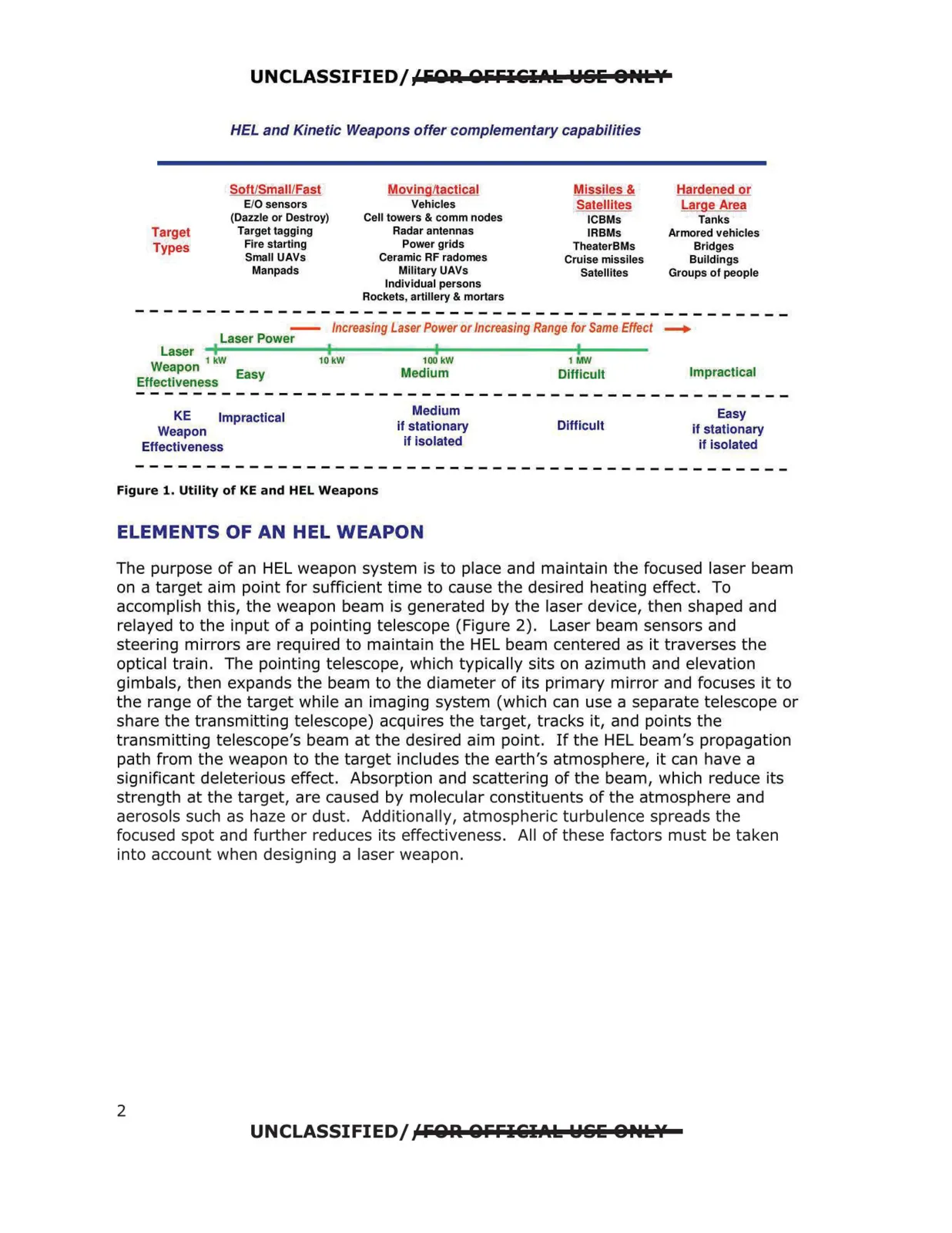
HEL and Kinetic Weapons offer complementary capabilities
Soft/Small/Fast
Moving/tactical
Missiles &
Hardened or
E/O sensors
Vehicles
Satellites
Large Area
(Dazzle or Destroy)
Cell towers & comm nodes
ICBMs
Tanks
Target
Types
Target tagging
Fire starting
Small UAVs
Radar antennas
Power grids
Ceramic RF radornes
IRBMs
TheaterBMs
Cruise missiles
Armored vehicles
Bridges
Buildings
Manpads
MilitaryUAVs
Individual persons
Satellites
Groups of people
Rockets, artillery & mortars
-
Laser Power
Increasing Laser Power or Increasing Range for Same Effect ---+
Laser
1 kW
Weapon
Effectiveness
E
asy
10kW
100kW
Medium
111Ni
Difficult
Impractical
Medium
Easy
KE
Impractical
Weapon
if stationary
Difficult
If stationary
if isolated
Effectiveness
if isolated
Figure 1. Utility of KE and HEL Weapons
ELEMENTS OF AN HEL WEAPON
The purpose of an HEL weapon system is to place and maintain the focused laser beam
on a target aim point for sufficient time to cause the desired heating effect. To
accomplish this, the weapon beam is generated by the laser device, then shaped and
relayed to the input of a pointing telescope (Figure 2). Laser beam sensors and
steering mirrors are required to maintain the HEL beam centered as it traverses the
optical train. The pointing telescope, which typical ly sits on azimuth and elevation
gimbals, then expands the beam to the diameter of its primary mirror and focuses it to
the range of the target while an imaging system (which can use a separate telescope or
share the transmitting telescope) acquires the target, tracks it, and points the
transmitting telescope's beam at the desired aim point. If the HEL beam's propagation
path from the weapon to the target includes the earth's atmosphere, it can have a
significant deleterious effect. Absorption and scattering of the beam, which reduce its
strength at the target, are caused by molecular constituents of the atmosphere and
aerosols such as haze or dust. Additionally, atmospheric turbulence spreads the
focused spot and further reduces its effectiveness. All of these factors must be taken
into account when designing a laser weapon.
UNCLASSIFIED/fFOA QFFI&I.t.k YSE 8,.L\f
2