AAWSAP DIRD, Warp Drive, Dark Energy, and the Manipulation of Extra Dimensions, April 2010
DOW-UAP-D138 · page 20 of 33
Text
This text came with the file. It may have mistakes. When the text and the image disagree, the image is right.
UNCLASSIFIED//F8R 8FFl@IJIIL tt!I! 6HLY
quantum fields is divergent, as is the infinite summation over the extra-dimensional KK
modes; however, as mentioned earlier, dimensional regularization (a form of
renormalization) can be used to extract a finite result. This equation differs from
Equation (4.1) in that the quantum field that we consider has both mass and a degree
of freedom in the higher dimension. Working with a scalar field, the result can later be
extended simply for the case of more phenomenologically viable fields (fermions, for
example).
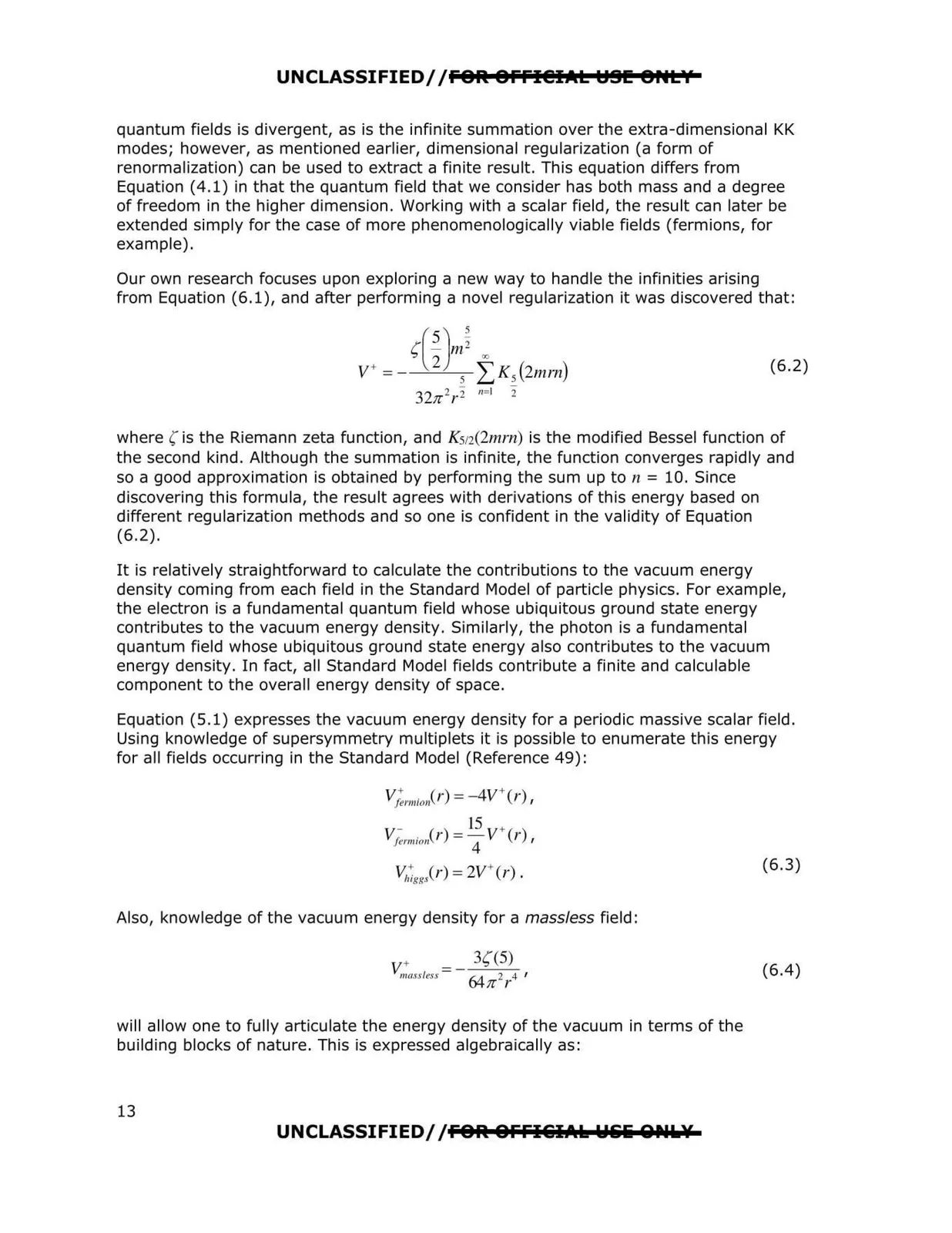
Our own research focuses upon exploring a new way to handle the infinities arising
from Equation (6.1), and after performing a novel regularization it was discovered that:
(6.2)
where ( is the Riemann zeta function, and Ks12(2mrn) is the modified Bessel function of
the second kind. Although the summation is infinite, the function converges rapidly and
so a good approximation is obtained by performing the sum up to n = 10. Since
discovering this formula, the result agrees with derivations of this energy based on
different regularization methods and so one is confident in the validity of Equation
(6.2).
It is relatively straightforward to calculate the contributions to the vacuum energy
density coming from each field in the Standard Model of particle physics. For example,
the electron is a fundamental quantum field whose ubiquitous ground state energy
contributes to the vacuum energy density. Similarly, the photon is a fundamental
quantum field whose ubiquitous ground state energy also contributes to the vacuum
energy density. In fact, all Standard Model fields contribute a finite and calculable
component to the overall energy density of space.
Equation (5.1) expresses the vacuum energy density for a periodic massive scalar field .
Using knowledge of supersymmetry multiplets it is possible to enumerate this energy
for all fields occurring in the Standard Model (Reference 49) :
vf:rmioil r) = -4V+(r) I
15
v ;,,,mion(r) = -v+(r) ,
,,
4
(6 .3)
v;,:gg,(r ) = 2v +(r ) .
Also, knowledge of the vacuum energy density for a massless field :
+
3((5)
V,iwssless = -
2 4 t
(6.4)
64 1t r
will allow one to fully articulate the energy density of the vacuum in terms of the
building blocks of nature. This is expressed algebraically as:
UNCLASSIFIED//FOR 9FFl611.tL W&i O~lkY
13