AAWSAP DIRD, Warp Drive, Dark Energy, and the Manipulation of Extra Dimensions, April 2010
DOW-UAP-D138 · page 6 of 33
Text
This text came with the file. It may have mistakes. When the text and the image disagree, the image is right.
UNCLASSIFIED//F0R 0FFIOIAL WSli a••tv
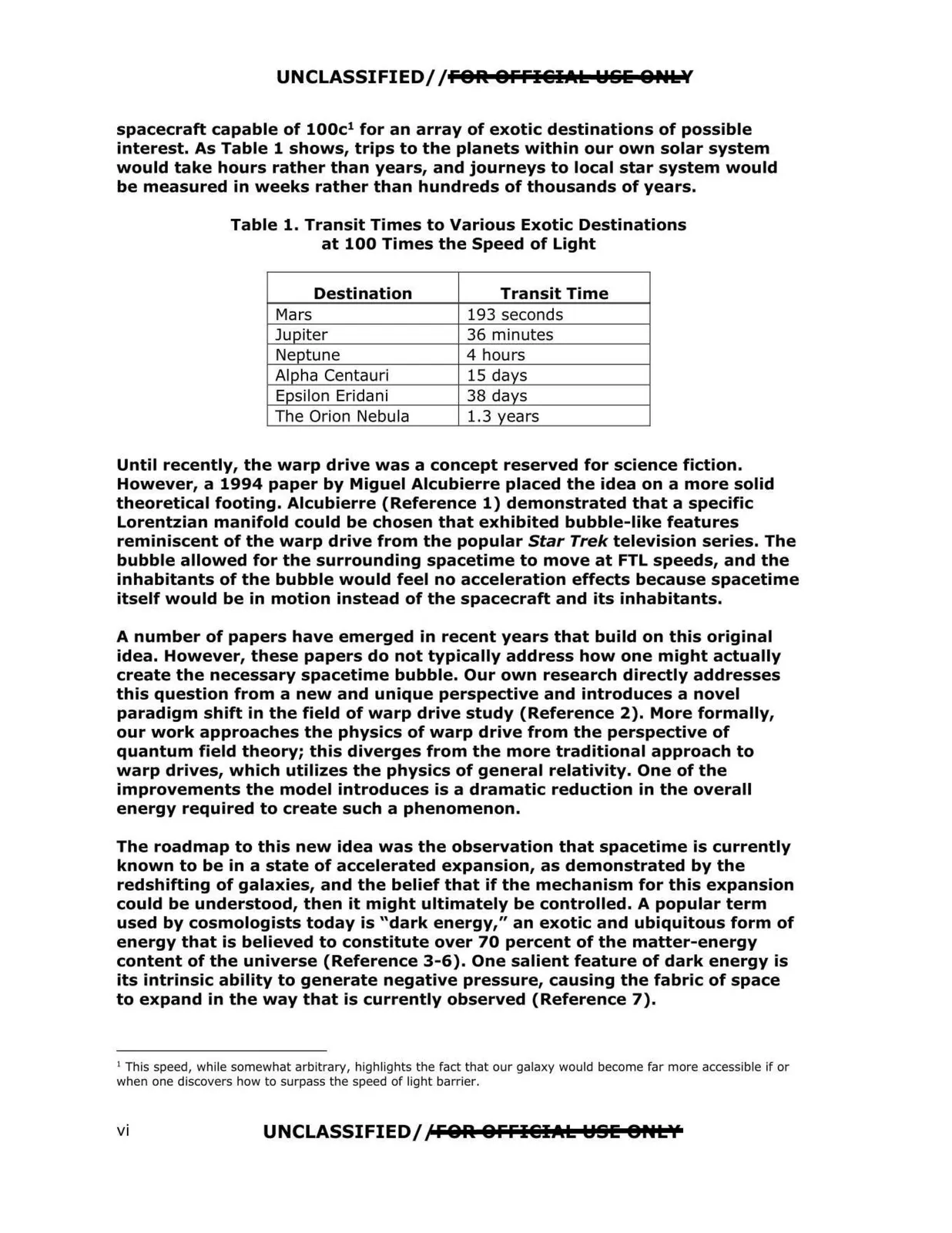
spacecraft capable of 100c1 for an array of exotic destinations of possible
interest. As Table 1 shows, trips to the planets within our own solar system
would take hours rather than years, and journeys to local star system would
be measured in weeks rather than hundreds of thousands of years.
Table 1. Transit Times to Various Exotic Destinations
at 100 Times the Speed of Light
Destination
Transit Time
Mars
193 seconds
Jupiter
36 minutes
Neptune
4 hours
Alpha Centauri
15 days
Epsilon Eridani
38 days
The Orion Nebula
1.3 years
Until recently, the warp drive was a concept reserved for science fiction.
However, a 1994 paper by Miguel Alcubierre placed the idea on a more solid
theoretical footing. Alcubierre (Reference 1) demonstrated that a specific
Lorentzian manifold could be chosen that exhibited bubble-like features
reminiscent of the warp drive from the popular Star Trek television series. The
bubble allowed for the surrounding spacetime to move at FTL speeds, and the
inhabitants of the bubble would feel no acceleration effects because spacetime
itself would be in motion instead of the spacecraft and its inhabitants.
A number of papers have emerged in recent years that build on this original
idea. However, these papers do not typically address how one might actually
create the necessary spacetime bubble. Our own research directly addresses
this question from a new and unique perspective and introduces a novel
paradigm shift in the field of warp drive study (Reference 2). More formally,
our work approaches the physics of warp drive from the perspective of
quantum field theory; this diverges from the more traditional approach to
warp drives, which utilizes the physics of general relativity. One of the
improvements the model introduces is a dramatic reduction in the overall
energy required to create such a phenomenon.
The roadmap to this new idea was the observation that spacetime is currently
known to be in a state of accelerated expansion, as demonstrated by the
redshifting of galaxies, and the belief that if the mechanism for this expansion
could be understood, then it might ultimately be controlled. A popular term
used by cosmologists today is "dark energy," an exotic and ubiquitous form of
energy that is believed to constitute over 70 percent of the matter-energy
content of the universe (Reference 3-6). One salient feature of dark energy is
its intrinsic ability to generate negative pressure, causing the fabric of space
to expand in the way that is currently observed (Reference 7).
1 This speed, while somewhat arbitrary, highlights the fact that our galaxy would become far more accessible if or
when one discovers how to surpass the speed of light barrier.
UNCLASSIFIED/,'FQR. QFFIOIAL WSI: OHL\'
vi