AAWSAP DIRD, Warp Drive, Dark Energy, and the Manipulation of Extra Dimensions, April 2010
DOW-UAP-D138 · page 8 of 33
Text
This text came with the file. It may have mistakes. When the text and the image disagree, the image is right.
UNCLASSIFIED/i'F8R 8FFIOlsllL WSli (U•LY
2. General Relativistic Warp Drives
Alcubierre (Reference 1) derived a spacetime metric motivated by cosmological inflation
that would allow arbitrarily short travel times between two distant points in space. The
"warp drive" metric uses coordinates (t, x, y, z) and curve (or worldline) x = Xsh(t), y =
0, z = 0, lying in the t-x plane passing through the origin. Note that Xsh is the x-axis
coordinate position of the moving spaceship (or warp bubble) frame. The metric1
specifying this particular spacetime geometry is (Reference 1):
(2.1)
where c is the speed of light, Vsh(t) is the speed associated with the curve (or warp
bubble speed), and Tsh(t) is the Euclidean distance from the curve. The warp bubble
shape function f (rsh) is any smooth positive function that satisfies f (0) = 1 and
decreases away from the origin to vanish when Tsh > R for some distance R. The
geometry of each spatial slice is flat, and spacetime is flat where f (rsh) vanishes but is
curved where it does not vanish.
The driving mechanism of Equation (2.1) is the York extrinsic time, 9. This quantity is
defined as ( Reference 1):
S= v," x," df .
(2.2)
C
~h d,;"
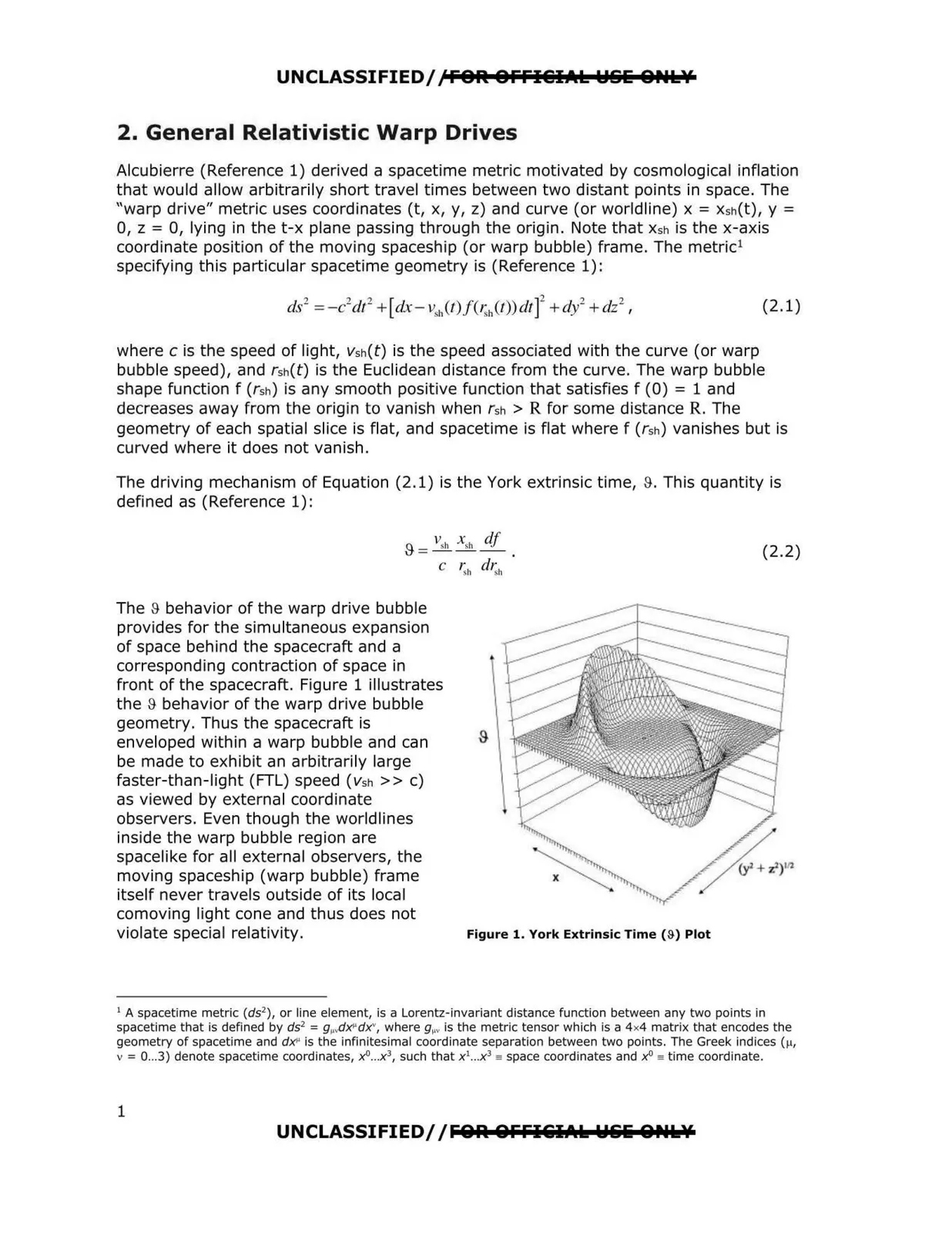
The 9 behavior of the warp drive bubble
provides for the simultaneous expansion
of space behind the spacecraft and a
corresponding contraction of space in
front of the spacecraft. Figure 1 illustrates
the 9 behavior of the warp drive bubble
geometry. Thus the spacecraft is
enveloped within a warp bubble and can
be made to exhibit an arbitrarily large
faster-than-light {FTL) speed (Vsh >> c)
as viewed by external coordinate
observers. Even though the worldlines
inside the warp bubble reg ion are
spacelike for all external observers, the
moving spaceship (warp bubble) frame
itself never travels outside of its local
comoving lig ht cone and thus does not
violate special relativity.
Figure 1. York Extrinsic Time (S.} Plot
1 A spacetime metric (ds2), or line element, is a Lorentz-invariant distance function between any two points in
spacetime that is defined by ds2 = 9a,-d><" dx'', where g,"' is the metric tensor which is a 4 x4 matrix that encodes the
geometry of spacetime and dX" is the infinitesimal coordinate separation between two points. The Greek indices (µ,
v = 0... 3) denote spacetime coordinates, x0...x3, such that x1...x3= space coordinates and xD = time coordinate.
UNCLASSIFIED//FOR OFFIGl,1L W&i &~•LY
1