AAWSAP DIRD, Traversable Wormholes, Stargates, and Negative Energy, April 2010
DOW-UAP-D139 · page 11 of 42
Text
This text came with the file. It may have mistakes. When the text and the image disagree, the image is right.
UNCLASSIFIED/fFOA OFFI&il.t..k Y&& 8Ptk\f
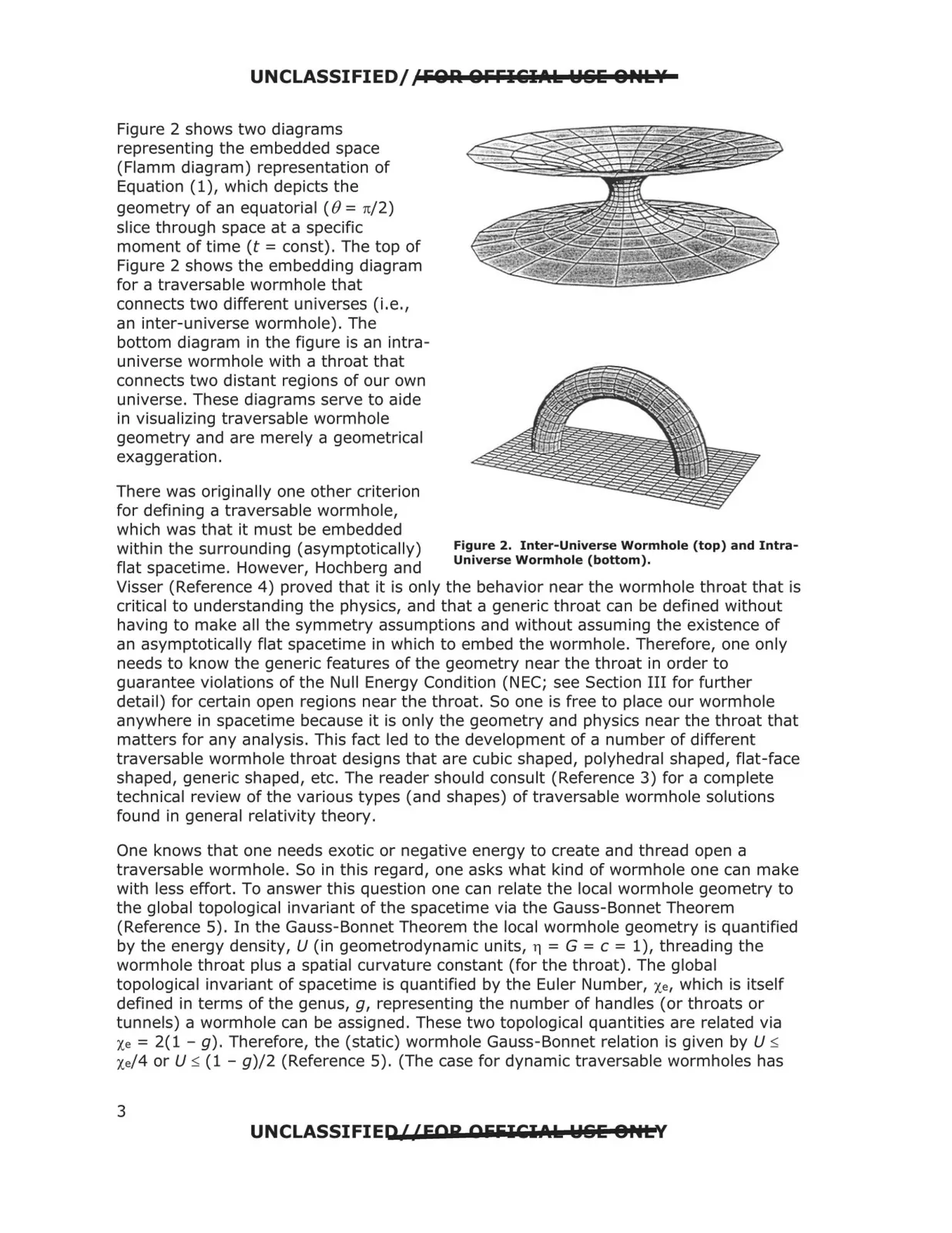
Figure 2 shows two diagrams
representing the embedded space
(Flamm diagram) representation of
Equation (1), which depicts the
geometry of an equatorial ( 0 = rc/2)
slice through space at a specific
moment of time (t = const). The top of
Figure 2 shows the embedding diagram
for a traversable wormhole that
connects two different universes (i.e.,
an inter-universe wormhole). The
bottom diagram in the figure is an intra-
universe wormhole with a throat that
connects two distant regions of our own
universe. These diagrams serve to aide
in visualizing traversable wormhole
geometry and are merely a geometrical
exaggeration.
There was originally one other criterion
for defining a traversable wormhole,
which was that it must be embedded
Figure 2. Inter-Universe Wormhole (top) and Intra
within the surrounding (asymptotically)
Universe Wormhole (bottom).
flat spacetime. However, Hochberg and
Visser (Reference 4) proved that it is only the behavior near the wormhole throat that is
critical to understanding the physics, and that a generic throat can be defined without
having to make all the symmetry assumptions and without assuming the existence of
an asymptotically flat spacetime in which to embed the wormhole. Therefore, one only
needs to know the generic features of the geometry near the throat in order to
guarantee violations of the Null Energy Condition (NEC; see Section III for further
detail) for certain open regions near the throat. So one is free to place our wormhole
anywhere in spacetime because it is only the geometry and physics near the throat that
matters for any analysis. This fact led to the development of a number of different
traversable wormhole throat designs that are cubic shaped, polyhedral shaped, flat-face
shaped, generic shaped, etc. The reader should consult (Reference 3) for a complete
technical review of the various types (and shapes) of traversable wormhole solutions
found in general relativity theory.
One knows that one needs exotic or negative energy to create and thread open a
traversable wormhole. So in this regard, one asks what kind of wormhole one can make
with less effort. To answer this question one can relate the local wormhole geometry to
the global topological invariant of the spacetime via the Gauss-Bonnet Theorem
(Reference 5). In the Gauss-Bonnet Theorem the local wormhole geometry is quantified
by the energy density, U (in geometrodynamic units, TJ = G = c = 1), threading the
wormhole throat plus a spatial curvature constant (for the throat). The global
topological invariant of spacetime is quantified by the Euler Number, xe, which is itself
defined in terms of the genus, g, representing the number of handles (or throats or
tunnels) a wormhole can be assigned. These two topological quantities are related via
xe = 2(1 - g). Therefore, the (static) wormhole Gauss-Bonnet relation is given by U :;;
xe/4 or U :;; (1 - g)/2 (Reference 5). (The case for dynamic traversable wormholes has
UNCLASSIFIEQ { {FOR OFFICIAL Y&& 8HLY
3