AAWSAP DIRD, Traversable Wormholes, Stargates, and Negative Energy, April 2010
DOW-UAP-D139 · page 21 of 42
Text
This text came with the file. It may have mistakes. When the text and the image disagree, the image is right.
UNCLASSIFIED/fFOA OFFI&il.t..k Y&& 8Ptk\f
exploit quantum squeezing to extract energy from one place in the ordinary vacuum at
the expense of accumulating excess energy elsewhere (Reference 1).
The squeezed state of the electromagnetic field is a primary example of a quantum field
that has negative energy density and negative energy flux. Such a state became a
physical reality in the laboratory as a result of the nonlinear-optics technique of
"squeezing," i.e., of moving some of the quantum-fluctuations of laser light out of the
cos[co(t - z/c)] part of the beam and into the sin[co(t - z/c)] part (Reference 20, 40
44). 7 The observable that gets squeezed will have its fluctuations reduced below the
vacuum ZPF. The act of squeezing transforms the phase space circular noise profile
characteristic of the vacuum into an ellipse, whose semimajor and semiminor axes are
given by unequal quadrature uncertainties (of the quantized electromagnetic field
harmonic oscillator operators). This applies to coherent states in general, and the usual
vacuum is also a coherent state with eigenvalue zero. As this ellipse rotates about the
origin with angular frequency ro, these unequal quadrature uncertainties manifest
themselves in the electromagnetic field oscillator energy by periodic occurrences, which
are separated by one quarter cycle, of both smaller and larger fluctuations compared to
the unsqueezed vacuum.
Morris and Thorne (Reference 1) and Caves (Reference 45) point out that if one
squeezes the vacuum, i.e., if one puts vacuum rather than laser light into the input port
of a squeezing device, then one gets at the output an electromagnetic field with weaker
fluctuations and thus less energy density than the vacuum at locations where cos 2[co(t
z/c)] =1 and sin 2[co(t - z/c)] < < 1; but with greater fluctuations and thus greater
energy density than the vacuum at locations where cos2[co(t - z/c)J < < 1 and sin 2[co(t
z/c)] =1. Since the vacuum is defined to have vanishing energy density, any region
with less energy density than the vacuum actually has a negative (renormalized)
expectation value for the energy density. Therefore, a squeezed vacuum state consists
of a traveling electromagnetic wave that oscillates back and forth between negative
energy density and positive energy density, but has positive time-averaged energy
density.
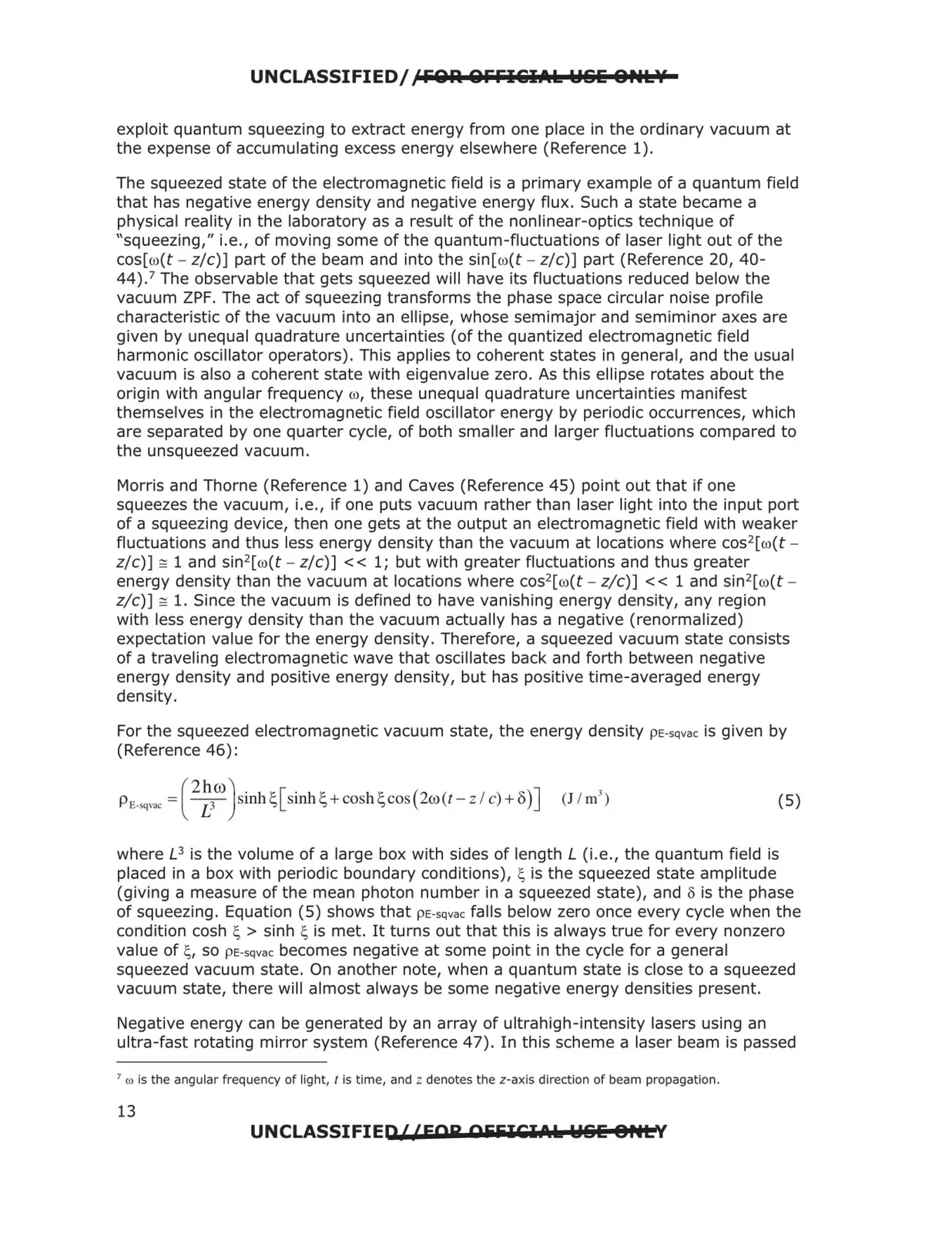
For the squeezed electromagnetic vacuum state, the energy density pE-sqvac is given by
(Reference 46):
PE-sqvac = ( 21/"} inh s[sinh s + cosh scos ( 2w(t- z I c) + 8)]
(J / m3)
(5)
where L3 is the volume of a large box with sides of length L (i.e., the quantum field is
placed in a box with periodic boundary conditions), 1; is the squeezed state amplitude
(giving a measure of the mean photon number in a squeezed state), and 8 is the phase
of squeezing. Equation (5) shows that pE-sqvac falls below zero once every cycle when the
condition cash 1; > sinh I; is met. It turns out that this is always true for every nonzero
value of I;, so pE-sqvac becomes negative at some point in the cycle for a general
squeezed vacuum state. On another note, when a quantum state is close to a squeezed
vacuum state, there will almost always be some negative energy densities present.
Negative energy can be generated by an array of ultrahigh-intensity lasers using an
ultra-fast rotating mirror system (Reference 47). In this scheme a laser beam is passed
7 w is the angular frequency of light, I is time, and z denotes the z-axis direction of beam propagation.
UNCLASSIFIEQ { {FOR OFFICIAL W&& 8HLY
13