AAWSAP DIRD, High-Frequency Gravitational Wave Communications, April 2010
DOW-UAP-D140 · page 24 of 57
Text
This text came with the file. It may have mistakes. When the text and the image disagree, the image is right.
UNCLASSIFIED//EOR OEEICI0L Llili QI\IL¥
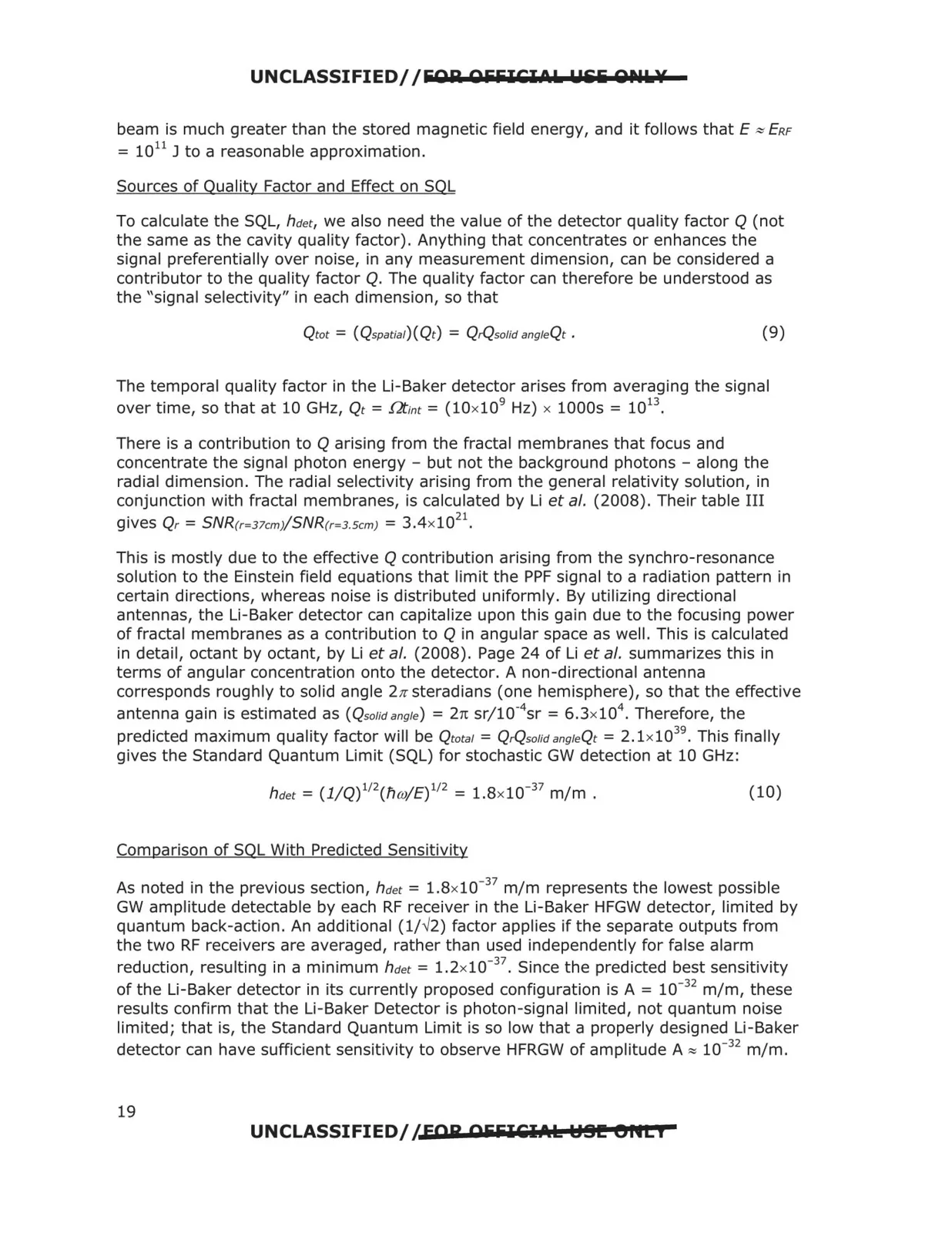
beam is much greater than the stored magnetic field energy, and it follows that E::; ERF
= 1011 J to a reasonable approximation.
Sources of Quality Factor and Effect on SOL
To calculate the SQL, hdet, we also need the value of the detector quality factor Q (not
the same as the cavity quality factor). Anything that concentrates or enhances the
signal preferentially over noise, in any measurement dimension, can be considered a
contributor to the quality factor Q. The quality factor can therefore be understood as
the "signal selectivity" in each dimension, so that
Qtot = (Qspatial) (Qt) = QrQsolid angle Qt .
(9)
The temporal quality factor in the Li-Baker detector arises from averaging the signal
over time, so that at 10 GHz, Qt= nt;nt = (10x109 Hz) x 1000s = 1013.
There is a contribution to Q arising from the fractal membranes that focus and
concentrate the signal photon energy - but not the background photons - along the
radial dimension. The radial selectivity arising from the general relativity solution, in
conjunction with fractal membranes, is calculated by Li et al. (2008). Their table III
gives Qr= SNRrr=J7cmJ/SNRrr=J.scmJ = 3.4x10²¹ .
This is mostly due to the effective Q contribution arising from the synchro-resonance
solution to the Einstein field equations that limit the PPF signal to a radiation pattern in
certain directions, whereas noise is distributed uniformly. By utilizing directional
antennas, the Li-Baker detector can capitalize upon this gain due to the focusing power
of fractal membranes as a contribution to Q in angular space as well. This is calculated
in detail, octant by octant, by Li et al. (2008). Page 24 of Li et al. summarizes this in
terms of angular concentration onto the detector. A non-directional antenna
corresponds roughly to solid angle 21r steradians (one hemisphere), so that the effective
antenna gain is estimated as (Qsolidangle) = 2n sr/10-4sr = 6.3x10⁴ . Therefore, the
predicted maximum quality factor will be Qtotal = QrQsolidang1eQt = 2.1x1039 . This finally
gives the Standard Quantum Limit (SQL) for stochastic GW detection at 10 GHz:
hdet = (1/Q) 112cncv/E) 112 = 1.Sxl0-37 m/m .
(10)
Comparison of SOL With Predicted Sensitivity
As noted in the previous section, hdet = 1.Sxl0-37 m/m represents the lowest possible
GW amplitude detectable by each RF receiver in the Li-Baker HFGW detector, limited by
quantum back-action. An additional (1/ ✓ 2) factor applies if the separate outputs from
the two RF receivers are averaged, rather than used independently for false alarm
reduction, resulting in a minimum hdet = 1.2x10-37 . Since the predicted best sensitivity
of the Li-Baker detector in its currently proposed configuration is A = 10-32 m/m, these
results confirm that the Li-Baker Detector is photon-signal limited, not quantum noise
limited; that is, the Standard Quantum Limit is so low that a properly designed Li-Baker
detector can have sufficient sensitivity to observe HFRGW of amplitude A ~ 10-32 m/m.
UNCLASSIFIED//FOR OEEICIJ.b HSI!! Dflti
19