AAWSAP DIRD, High-Frequency Gravitational Wave Communications, April 2010
DOW-UAP-D140 · page 36 of 57
Text
This text came with the file. It may have mistakes. When the text and the image disagree, the image is right.
L3: Highly uns able
due to gravlta 1onal
pull of other planets
LS: Stable. May contain
STEREO AORBIT
(Due
L2•
UNCLASSIFIED//&OR Oii&ICI0L Ll&li QPIL¥
3.4.1 Propagating Signals From Optical Lattice Clocks for Timing
The 1 part in 1018 measurement precision of optical lattice clocks will be affected by
general relativity effects, in other words propagation delays due to gravitational field
gradients will be readily measureable. "It will make us think a little harder about what
we really mean by time," Kleppner (2008). In effect, measuring the propagation delays
at this level allows very fine measurement of the "geoids," or surfaces of constant
gravity, surrounding planets and inhabiting interplanetary and interstellar space. The
delay experienced by RF waves could therefore be precisely compared with the
propagation delay experienced by gravitational waves, which are not as strongly
affected by the presence of mass. Such a differential propagation delay comparison
(between RF & GW) could lead to an important new technology in the mapping of
geoids, which could for instance be applied to the problem of mapping the positions of
the Lagrangian points, which vary slightly over time.
3.4.2 In Navigating and Mapping Interplanetary Geoids
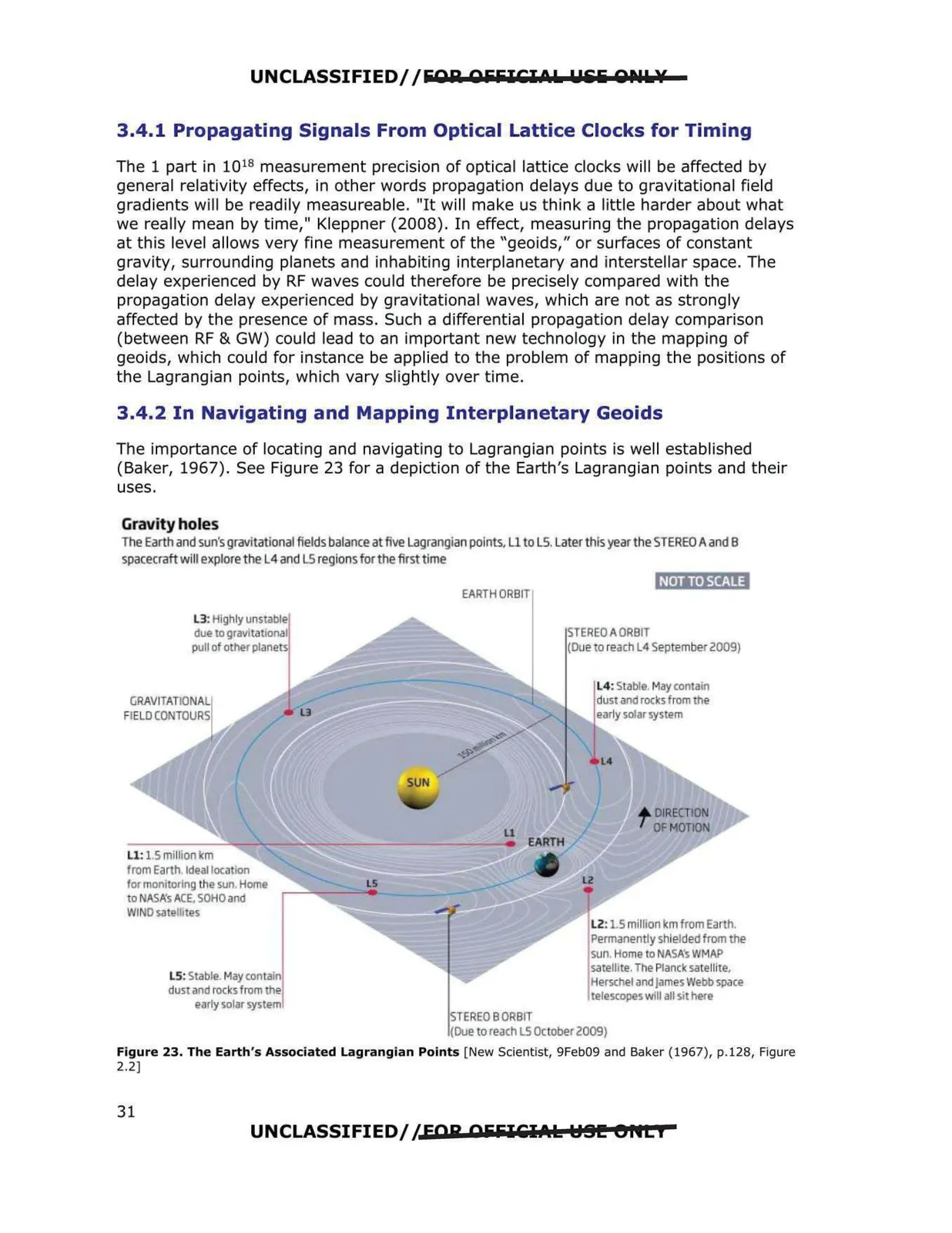
The importance of locating and navigating to Lagrangian points is well established
(Baker, 1967). See Figure 23 for a depiction of the Earth's Lagrangian points and their
uses.
Gravity holes
TheEarth and sun's gravitational fields balance at five Lagrangian points, U to LS. Later this year the STEREO Aand B
spacecraft will explore the L4 and LS regions for the first time
EARTH ORBIT
o reach L4 September 2009)
L4: Stable. May contain
dus and rocks rom the
e.irly solar sys em
L4
Ll: 1.5 million m
rom Earth Ideal location
for monitoring Lhesun Home
co NASA5 ACE, SOHO and
WINOsatelhtes
L2: 1.5 million km from Earth.
Permanently shielded from the
sun Home to NASA's WMAP
satellite. The Planck satellite,
Herschel and James Webb space
dus and rocks from the
elescopes will all sit here
early solar system
(Due to reach LS October 2009)
Figure 23. The Earth's Associated Lagrangian Points (New Scientist, 9Feb09 and Baker (1967), p.128, Figure
2.2]
UNCLASSIFIED//FOP OiiiilCl.t.k l!ISI!!! l>flti
STEREO BORBIT
31