AAWSAP DIRD, High-Frequency Gravitational Wave Communications, April 2010
DOW-UAP-D140 · page 39 of 57
Text
This text came with the file. It may have mistakes. When the text and the image disagree, the image is right.
UNCLASSIFIED//&OR Oii&ICI0L Ll&li QPIL¥
4.3 INTERPLANETARY NAVIGATION AND GEOID MAPPING TO 2050
While there is no doubt that stellar tracking will remain the primary source of
navigation for space missions in the foreseeable future, as introduced in Section 3.4.2,
HFGW may also prove useful in conjunction with RF in providing a navigation aid for
interplanetary missions (with no planetary shielding) by mapping geoids in
interplanetary space via long baseline navigation. For instance, if there were one GW
source on Earth, and one GW source on the Moon, such a pair of GW sources would
provide relative beacons for missions to Mars that could serve multiple roles as
navigation beacons, communication relays, and in conjunction with RF signals, map
geoids via relative time difference of arrival signals. Very Long Baseline Navigation
could be achieved by placing a source on Earth and one GW source on Mars for a
baseline that would most often be very widely spread with respect to the outer planets,
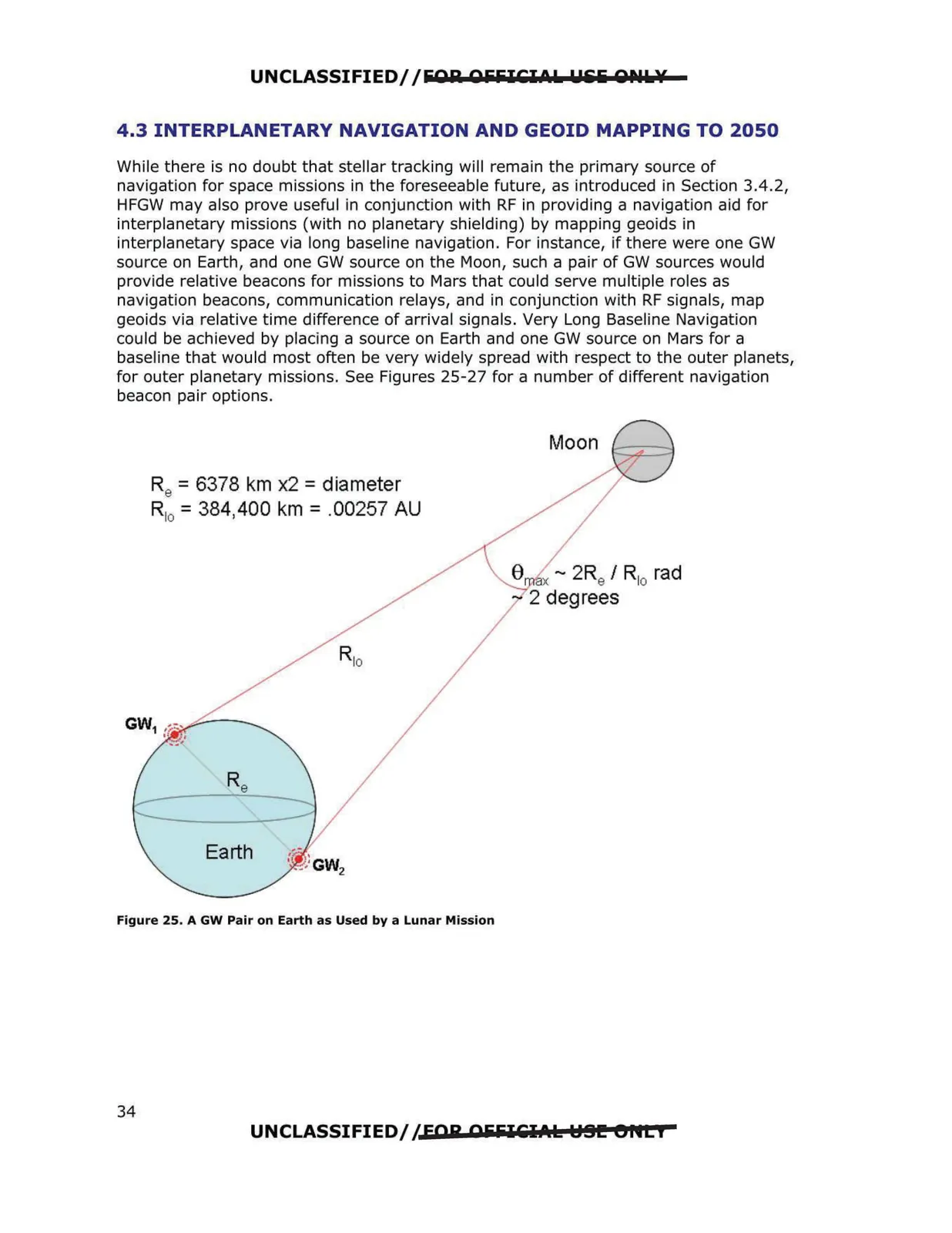
for outer planetary missions. See Figures 25-27 for a number of different navigation
beacon pair options.
R0 = 6378 km x2 = diameter
R10 = 384,400 km = .00257 AU
Moon
0
x ~ 2Re / Rio rad
2 degrees
Earth
Figure 25. A GW Pair on Earth as Used by a Lunar Mission
UNCLASSIFIED//FOP OiiiilCl.t.k l!ISI!!! l>flti
34