AAWSAP DIRD, High-Frequency Gravitational Wave Communications, April 2010
DOW-UAP-D140 · page 8 of 57
Text
This text came with the file. It may have mistakes. When the text and the image disagree, the image is right.
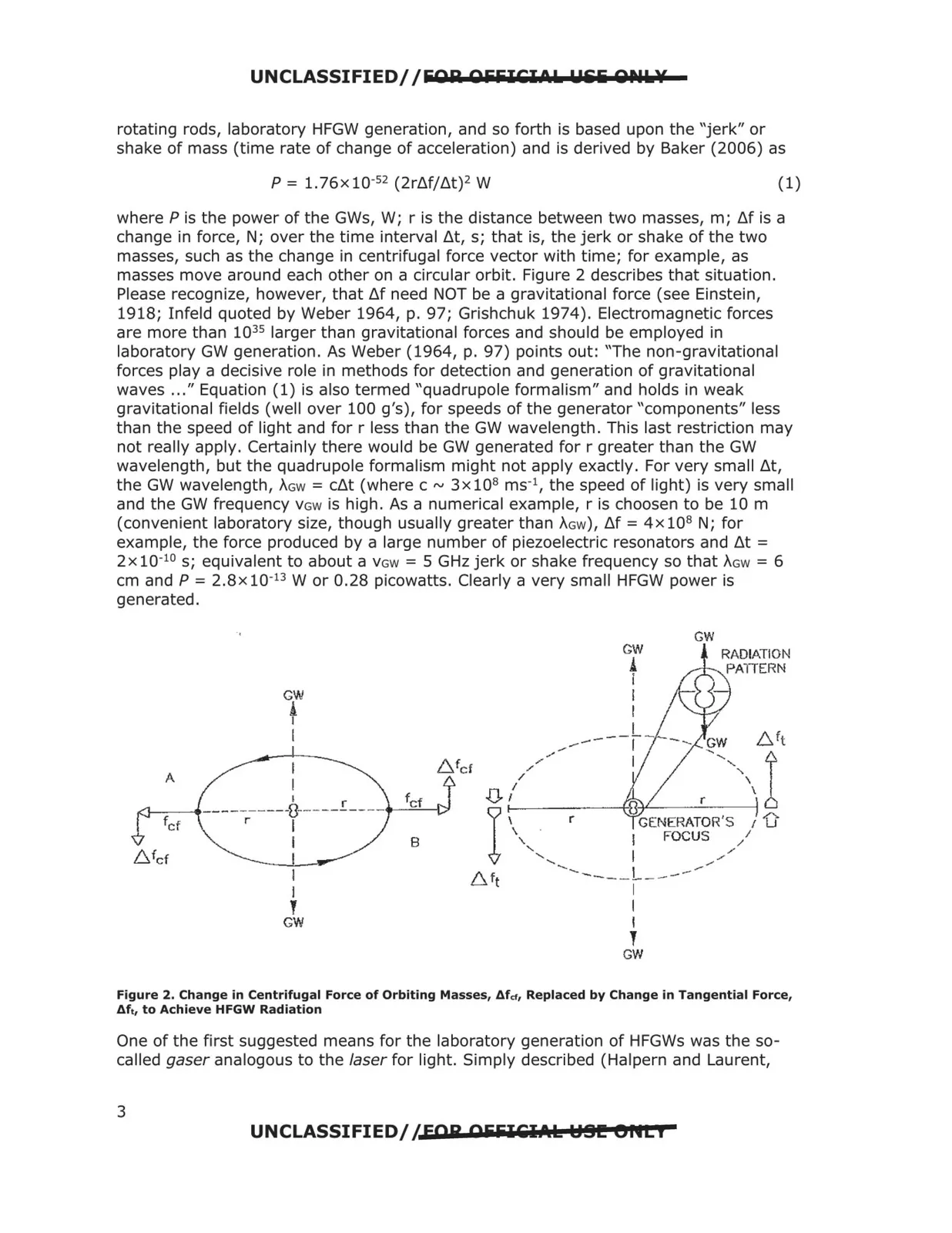
UNCLASSIFIED//EOR OEEICI0L Llili QI\IL¥ rotating rods, laboratory HFGW generation, and so forth is based upon the "jerk" or shake of mass (time rate of change of acceleration) and is derived by Baker (2006) as P = 1.76x1Q-52 (2r.M/6t)2 W (1) where Pis the power of the GWs, W; r is the distance between two masses, m; Mis a change in force, N; over the time interval 6t, s; that is, the jerk or shake of the two masses, such as the change in centrifugal force vector with time; for example, as masses move around each other on a circular orbit. Figure 2 describes that situation. Please recognize, however, that M need NOT be a gravitational force (see Einstein, 1918; Infeld quoted by Weber 1964, p. 97; Grishchuk 1974). Electromagnetic forces are more than 1035 larger than gravitational forces and should be employed in laboratory GW generation. As Weber (1964, p. 97) points out: "The non-gravitational forces play a decisive role in methods for detection and generation of gravitational waves ... " Equation (1) is also termed "quadrupole formalism" and holds in weak gravitational fields (well over 100 g's), for speeds of the generator "components" less than the speed of light and for r less than the GW wavelength. This last restriction may not really apply. Certainly there would be GW generated for r greater than the GW wavelength, but the quadrupole formalism might not apply exactly. For very small 6t, the GW wavelength, AGw = c6t (where c ~ 3x 10⁸ ms-1, the speed of light) is very small and the GW frequency VGw is high. As a numerical example, r is choosen to be 10 m (convenient laboratory size, though usually greater than AGw), M = 4x 10⁸ N; for example, the force produced by a large number of piezoelectric resonators and M = 2x 10⁻¹⁰ s; equivalent to about a VGw = 5 GHz jerk or shake frequency so that AGw = 6 cm and P = 2.8x 10⁻¹³ W or 0.28 picowatts. Clearly a very small HFGW power is generated. GW GW A I [ A ~~----------8 ___ ! __ __._f...=Cf"---!Y fct r I I 8 I l ' I I I GW I T GW Figure 2. Change in Centrifugal Force of Orbiting Masses, dfct, Replaced by Change in Tangential Force, df,, to Achieve HFGW Radiation One of the first suggested means for the laboratory generation of HFGWs was the so called gaser analogous to the laser for light. Simply described (Halpern and Laurent, UNCLASSIFIED//FOR OEEICIJ.b HSI!! Dflti 3