AAWSAP DIRD, Metamaterials for Aerospace Applications, April 2010
DOW-UAP-D141 · page 11 of 38
Text
This text came with the file. It may have mistakes. When the text and the image disagree, the image is right.
UNCLASSIFIED/ (fQR OFFIClt.k YSE 8HLI
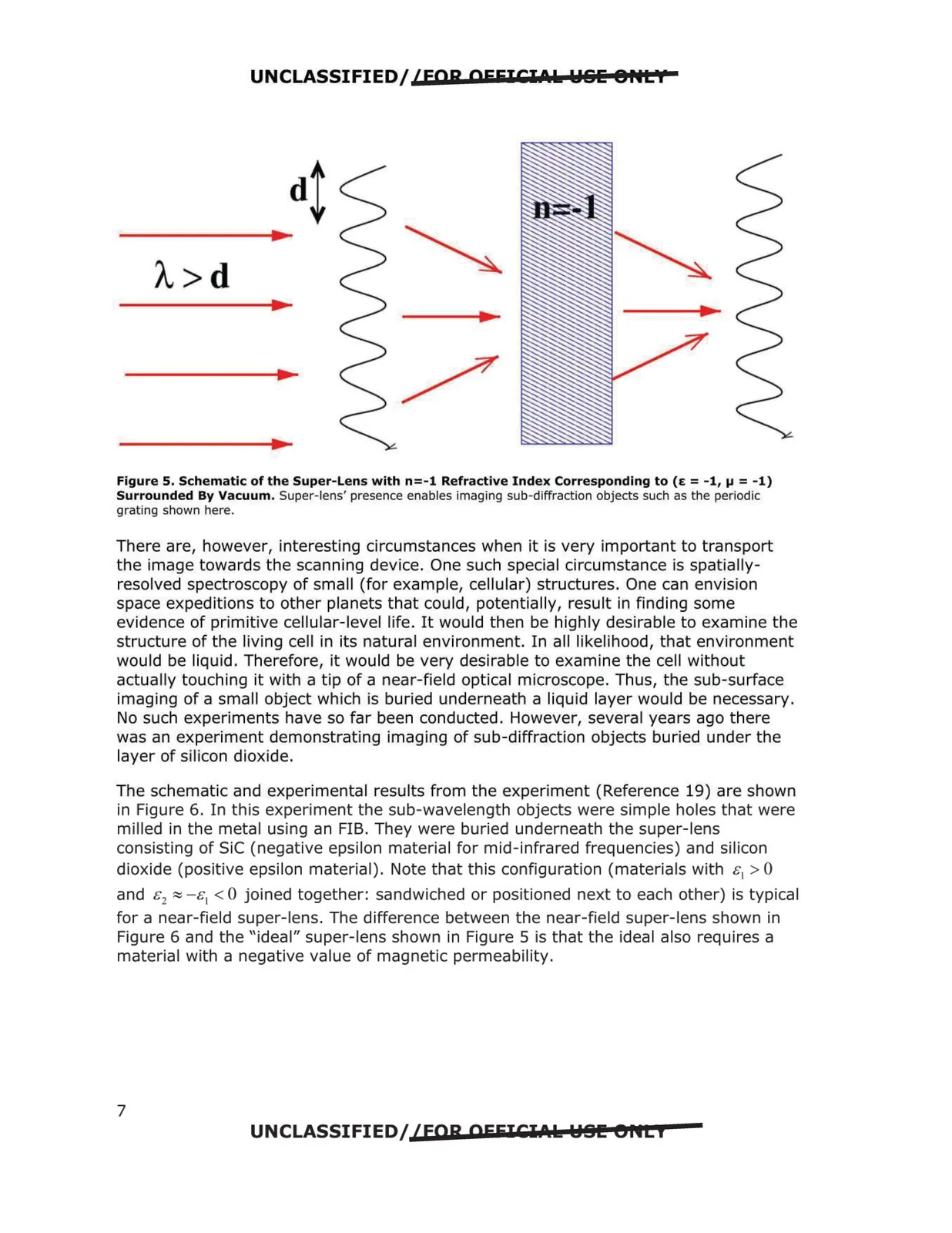
A>d
..
Figures. Schematic of the Super-Lens with n=-1 Refractive Index Corresponding to(£= -1, µ =-1)
Surrounded By Vacuum. Super-lens' presence enables imaging sub-diffraction objects such as the periodic
grating shown here.
There are, however, interesting circumstances when it is very important to transport
the image towards the scanning device. One such special circumstance is spatially
resolved spectroscopy of small (for example, cellular) structures. One can envision
space expeditions to other planets that could, potentially, result in finding some
evidence of primitive cellular-level life. It would then be highly desirable to examine the
structure of the living cell in its natural environment. In all likelihood, that environment
would be liquid. Therefore, it would be very desirable to examine the cell without
actually touching it with a tip of a near-field optical microscope. Thus, the sub-surface
imaging of a small object which is buried underneath a liquid layer would be necessary.
No such experiments have so far been conducted. However, several years ago there
was an experiment demonstrating imaging of sub-diffraction objects buried under the
layer of silicon dioxide.
The schematic and experimental results from the experiment (Reference 19) are shown
in Figure 6. In this experiment the sub-wavelength objects were simple holes that were
milled in the metal using an FIB. They were buried underneath the super-lens
consisting of SiC (negative epsilon material for mid-infrared frequencies) and silicon
dioxide (positive epsilon material). Note that this configuration (materials with 6 1 > 0
and 62 ~ - 61< 0 joined together: sandwiched or positioned next to each other) is typical
for a near-field super-lens. The difference between the near-field super-lens shown in
Figure 6 and the "ideal" super-lens shown in Figure 5 is that the ideal also requires a
material with a negative value of magnetic permeability.
UNCLASSIFIED/ {fQR OFEICl.t.ls: W81!! 8flti
7