AAWSAP DIRD, Metamaterials for Aerospace Applications, April 2010
DOW-UAP-D141 · page 31 of 38
Text
This text came with the file. It may have mistakes. When the text and the image disagree, the image is right.
UNCLASSIFIED//fOR. Offl@IAL WS& 9Nk¥
Nonlinear Non-Reciprocal Chiral Metamaterials: For
Developing Novel Optical Isolators and "One-Way"
Microwave Mirrors
Optical isolators play a pivotal role in fiber-optic communication systems by protecting
their active components ( for example, optical amplifiers) from unwanted reflected
signals that could potentially destabilize them. Such protection is especially important in
the context of advanced aerospace platforms, where repairs must be avoided at all
costs. At the core of isolator design is an element which provides non-reciprocity by
breaking time reversal symmetry. Non-reciprocity can only be caused by magnetic
fields or nonlinearities. The most common approach using magnetic Faraday rotators
results in a rather bulky implementation of an isolator. It is believed that metamaterials
are uniquely positioned to enhance the other approach of breaking non-reciprocity: use
of nonlinear effects. It is very natural to use metamaterial in the context of enhancing
nonlinearity. As was explained previously, metamaterials can be used to slow down
light and, therefore, compress electromagnetic energy. Any intensity enhancement
increases nonlinear effects, and larger nonlinear effects translate into more compact
devices. Another aspect that makes metamaterials very appealing for non-reciprocal
applications is the ability to make their properties tunable to almost any frequency
range.
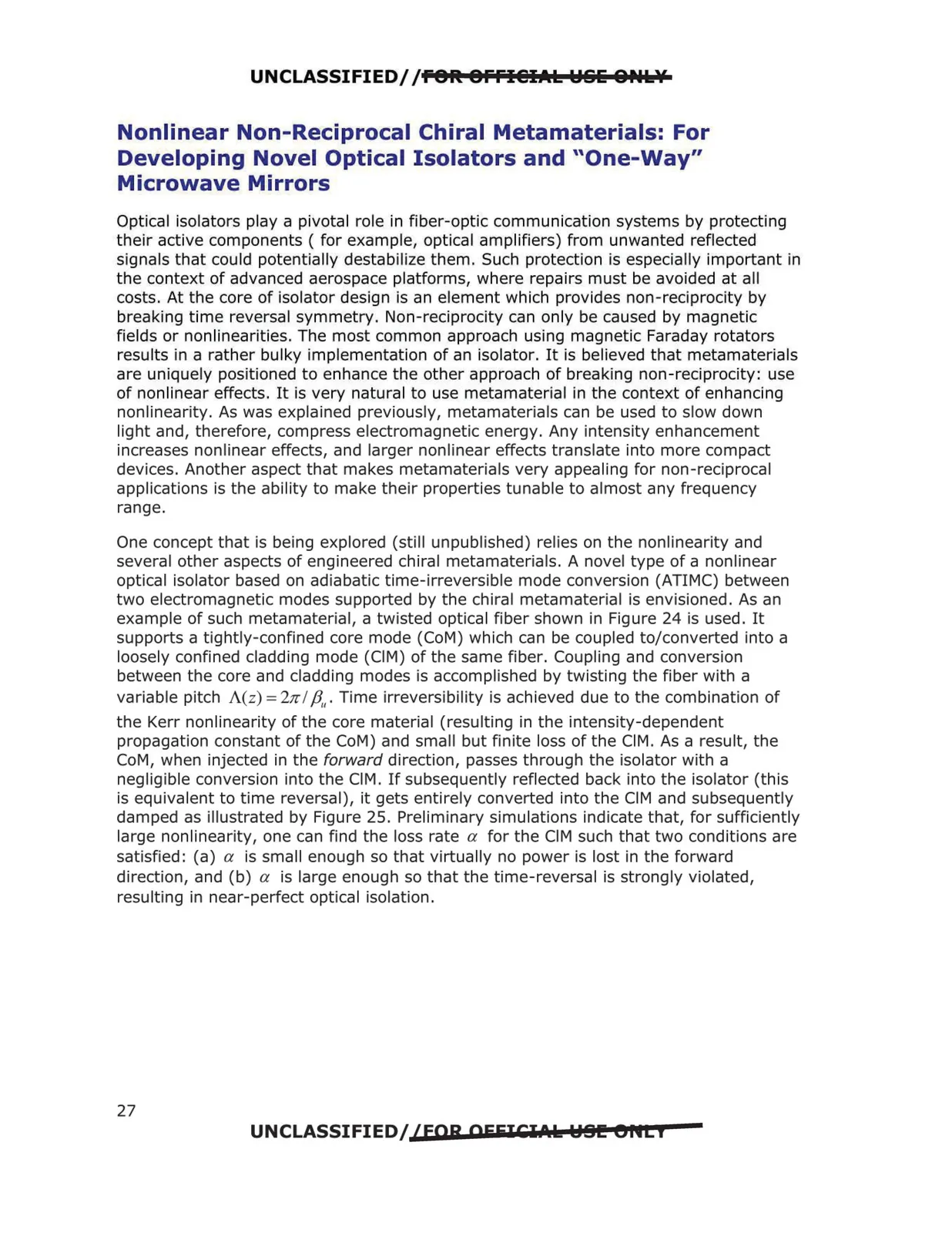
One concept that is being explored (still unpublished) relies on the nonlinearity and
several other aspects of engineered chiral metamaterials. A novel type of a nonlinear
optical isolator based on adiabatic time-irreversible mode conversion (ATIMC) between
two electromagnetic modes supported by the chiral metamaterial is envisioned. As an
example of such metamaterial, a twisted optical fiber shown in Figure 24 is used. It
supports a tightly-confined core mode (CoM) which can be coupled to/converted into a
loosely confined cladding mode (CIM) of the same fiber. Coupling and conversion
between the core and cladding modes is accomplished by twisting the fiber with a
variable pitch A(z) =2,r/ /3,,. Time irreversibility is achieved due to the combination of
the Kerr nonlinearity of the core material (resulting in the intensity-dependent
propagation constant of the CoM) and small but finite loss of the CIM. As a result, the
CoM, when injected in the forward direction, passes through the isolator with a
negligible conversion into the CIM. If subsequently reflected back into the isolator (this
is equivalent to time reversal), it gets entirely converted into the CIM and subsequently
damped as illustrated by Figure 25. Preliminary simulations indicate that, for sufficiently
large nonlinearity, one can find the loss rate a for the CIM such that two conditions are
satisfied: (a) a is small enough so that virtually no power is lost in the forward
direction, and (b) a is large enough so that the time-reversal is strongly violated,
resulting in near-perfect optical isolation.
UNCLASSIFIED/ {EAR OFEICl.t.k W81!! 8flti
27