AAWSAP DIRD, Metamaterials for Aerospace Applications, April 2010
DOW-UAP-D141 · page 33 of 38
Text
This text came with the file. It may have mistakes. When the text and the image disagree, the image is right.
UNCLASSIFIED/ (fQR OFFIClt.k YSE 8HLI
1.------r----"T""---11111111111:r-------r-----,
0.8
0.6
0.4
0.2
, ...
, '
,.
'
,-
'
.,.
, ,
., '
1,
I
'
100
I
~
' , '
•
I
'•'
200
300
400
500
Fiber length [1n1n]
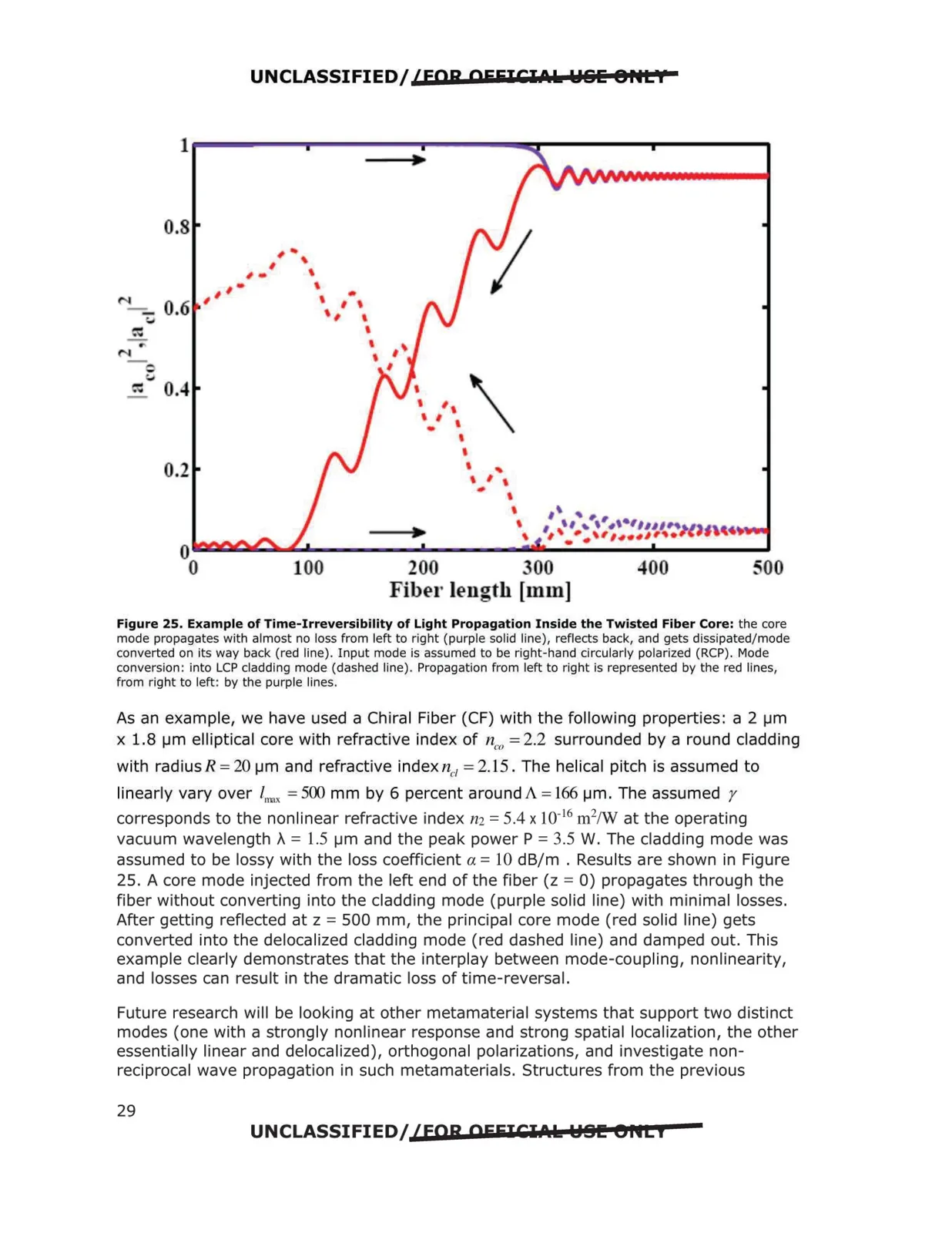
Figure 25. Example of Time-Irreversibility of Light Propagation Inside the Twisted Fiber Core: the core
mode propagates with almost no loss from left to right (purple solid line), reflects back, and gets dissipated/mode
converted on its way back (red line). Input mode is assumed to be right-hand circularly polarized (RCP). Mode
conversion: into LCP cladding mode (dashed line). Propagation from left to right is represented by the red lines,
from right to left: by the purple lines.
As an example, we have used a Chiral Fiber (CF) with the following properties: a 2 µm
x 1.8 µm elliptical core with refractive index of nco =2.2 surrounded by a round cladding
with radius R =20 µm and refractive index nc1 =2.15. The helical pitch is assumed to
linearly vary over /,mx = 500 mm by 6 percent around A= 166 µm. The assumed r
corresponds to the nonlinear refractive index m = 5.4 x10⁻¹⁶ m2/W at the operating
vacuum wavelength>-. = 1.5 µm and the peak power P = 3.5 W. The cladding mode was
assumed to be lossy with the loss coefficient a= 10 dB/m . Results are shown in Figure
25. A core mode injected from the left end of the fiber (z = 0) propagates through the
fiber without converting into the cladding mode (purple solid line) with minimal losses.
After getting reflected at z = 500 mm, the principal core mode (red solid line) gets
converted into the delocalized cladding mode (red dashed line) and damped out. This
example clearly demonstrates that the interplay between mode-coupling, nonlinearity,
and losses can result in the dramatic loss of time-reversal.
Future research will be looking at other metamaterial systems that support two distinct
modes (one with a strongly nonlinear response and strong spatial localization, the other
essentially linear and delocalized), orthogonal polarizations, and investigate non
reciprocal wave propagation in such metamaterials. Structures from the previous
UNCLASSIFIED/ {fQR OFEICl.t.ls: W81!! 8flti
29