AAWSAP DIRD, Metamaterials for Aerospace Applications, April 2010
DOW-UAP-D141 · page 35 of 38
Text
This text came with the file. It may have mistakes. When the text and the image disagree, the image is right.
UNCLASSIFIED/ (EOR OFFICit.k W&E 8Htt
a
C
e
Ohmic
Schottky
d
Split gap
Transmitted
L
SI-GaAs
L
--,
I
'>,f
, ,~ Rd
I
I
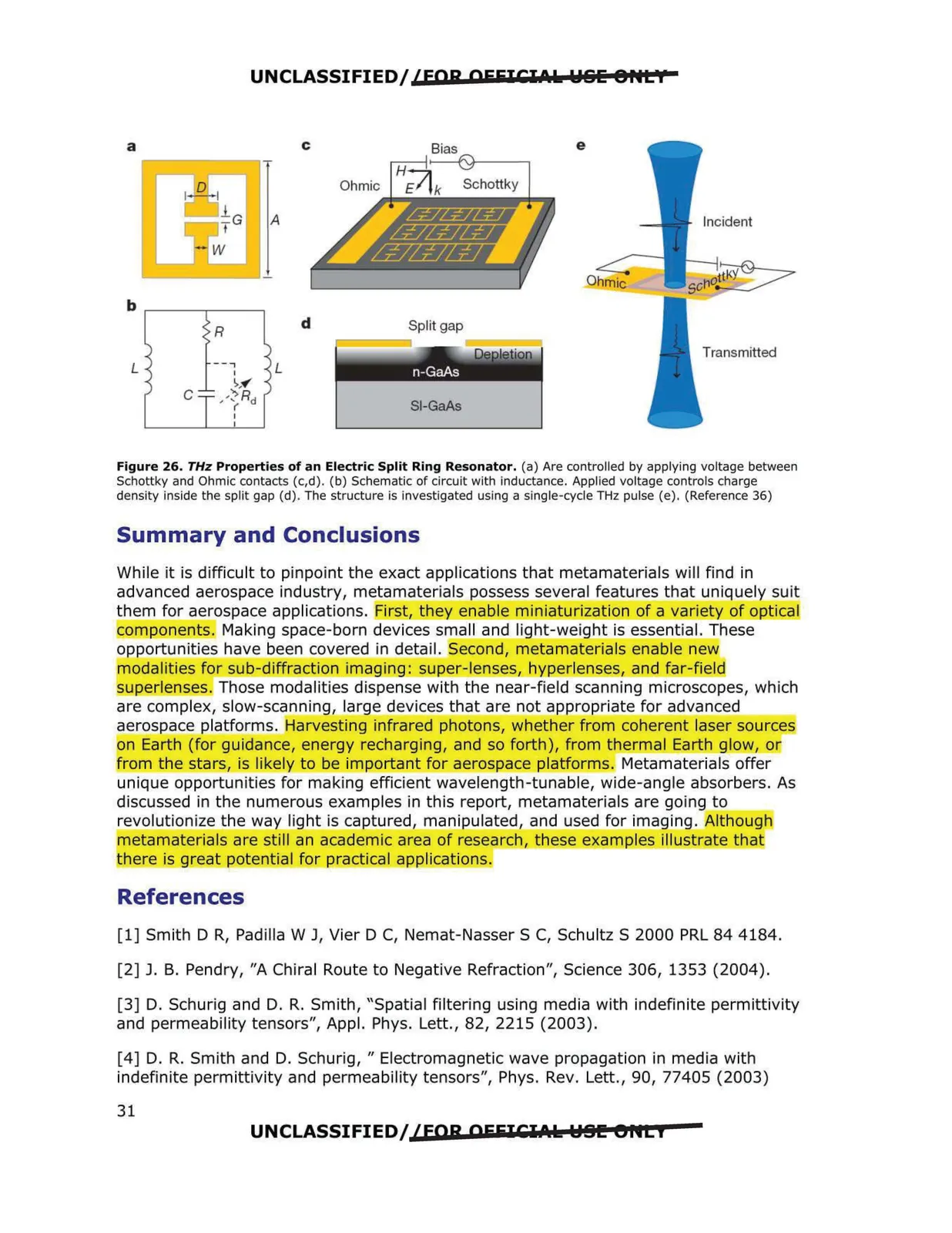
Figure 26. THz Properties of an Electric Split Ring Resonator. (a) Are controlled by applying voltage between
Schottky and Ohmic contacts (c,d). (b) Schematic of circuit with inductance. Applied voltage controls charge
density inside the split gap (d). The structure is investigated using a single-cycle THz pulse (e). (Reference 36)
Summary and Conclusions
While it is difficult to pinpoint the exact applications that metamaterials will find in
advanced aerospace industry, metamaterials possess several features that uniquely suit
them for aerospace applications. First, the enable miniaturization of a variety of o tical
components. Making space-born devices small and light-weight is essential. These
opportunities have been covered in detail. Second, metamaterials enable new
modalities for sub-diffraction imaging: super-lenses, hyperlenses, and far-field
superlenses. Those modalities dispense with the near-field scanning microscopes, which
are complex, slow-scanning, large devices that are not appropriate for advanced
aerospace platforms. Harvesting infrared photons, whether from coherent laser sources
on Earth (for guidance, energy recharging, and so forth), from thermal Earth glow, or
from the stars, is likely to be important for aerospace platforms. Metamaterials offer
unique opportunities for making efficient wavelength-tunable, wide-angle absorbers. As
discussed in the numerous examples in this report, metamaterials are going to
revolutionize the way light is captured, manipulated, and used for imaging. Although
metamaterials are still an academic area of research, these examples illustrate that
there is great potential for practical applications.
References
[1] Smith D R, Padilla W J, Vier DC, Nemat-Nasser SC, Schultz S 2000 PRL 84 4184.
[2] J. B. Pendry, "A Chiral Route to Negative Refraction", Science 306, 1353 (2004).
[3] D. Schurig and D. R. Smith, "Spatial filtering using media with indefinite permittivity
and permeability tensors", Appl. Phys. Lett., 82, 2215 (2003).
[4) D. R. Smith and D. Schurig, "Electromagnetic wave propagation in media with
indefinite permittivity and permeability tensors", Phys. Rev. Lett., 90, 77405 (2003)
UNCLASSIFIED/ {EAR OFFICIAk W81!!! Bflti
31