AAWSAP DIRD, Metamaterials for Aerospace Applications, April 2010
DOW-UAP-D141 · page 5 of 38
Text
This text came with the file. It may have mistakes. When the text and the image disagree, the image is right.
UNCLASSIFIED/ (FOR OFFIClt.k YSE 8Htt
Definition of Metamaterials
A metamaterial is defined as an artificial medium whose properties (mechanical, optical,
magnetic, or other) cannot be found in naturally-occurring materials. The emphasis of
this study will be on electromagnetic and optical metamaterials. Such metamaterials
can exhibit rather extreme properties, such as negative refractive index, which implies
that both electric permittivity and magnetic permeability must be negative
( £ < 0 µ < 0) (Reference 1). Such meta materials used to be called "left-handed"
I
because of the unusual phase relationship between the electric and magnetic fields.
Specifically, in most (positive index, including vacuum) media one uses the right-hand
rule to define the relationsh[p between electric field ( E) magnetic field ( H), and the
propagation wavenumber ( f ). The physical basis of the right-hand rule is that the
direction of energy propagation defined by the Poynting vector S=cEx HI 47Z' and the
direction of the phase velocity (defined by the wavenumber k) must coincide. That
does not hold true for negative index metamaterials where the two directions are
opposite, therefore, the left-handed relationship must hold for the three vectors.
Nevertheless, the "left-handed" designation did not withstand the test of time because
it was causing confusion and creating irrelevant allusions to helical (a.k.a. chiral)
structures. Although chiral structures can indeed exhibit negative index behavior
(Reference 2), chirality is not necessary.
A typical metamaterial consists of resonant elements such as Split Ring Resonators
(SRR). An example of an SRR is shown in Figure 1. The main function of the SRR is to
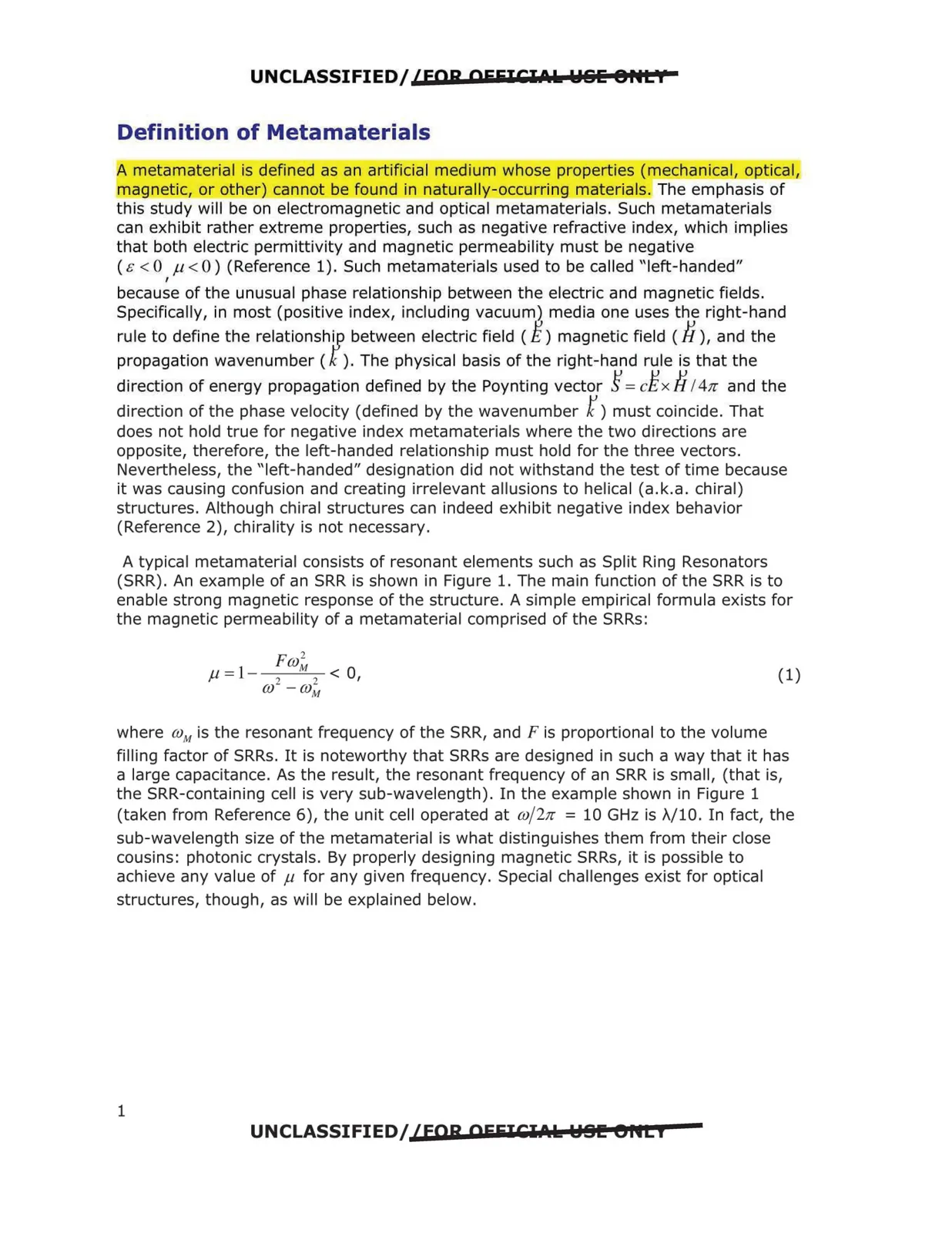
enable strong magnetic response of the structure. A simple empirical formula exists for
the magnetic permeability of a metamaterial comprised of the SRRs:
(1)
where {J)M is the resonant frequency of the SRR, and F is proportional to the volume
filling factor of SRRs. It is noteworthy that SRRs are designed in such a way that it has
a large capacitance. As the result, the resonant frequency of an SRR is small, (that is,
the SRR-containing cell is very sub-wavelength). In the example shown in Figure 1
(taken from Reference 6), the unit cell operated at {J)j27Z" = 10 GHz is A/10. I n fact, the
sub-wavelength size of the meta material is what distinguishes them from their close
cousins: photonic crystals. By properly designing magnetic SRRs, it is possible to
achieve any value of µ for any given frequency. Special challenges exist for optical
structures, though, as will be explained below.
UNCLASSIFIED/ {fQR OFEICl.t.ls: W81!! 8flti
1