AAWSAP DIRD, Metamaterials for Aerospace Applications, April 2010
DOW-UAP-D141 · page 7 of 38
Text
This text came with the file. It may have mistakes. When the text and the image disagree, the image is right.
UNCLASSIFIED//POR. Offl@IAL YS! OP~LV
The electric response of such (or similar) metamaterial is given by
(2)
where w R is the resonant frequency and r is the loss coefficient.
Negative index metamaterials are by no means the only potentially useful metamedia.
Several new concepts such as Indefinite Permittivity Metamaterials (1PM) (References
3, 4) and Epsilon-Near-Zero (ENZ) metamaterials (Reference 5) have recently emerged
and found some exciting applications that will be reviewed below. IPMs can be used as
ultra-compact spatial filters (both high-pass and low-pass) whereas ENR metamaterials
can be used for making sub-wavelength waveguides capable of coupling close to 100
percent of the incident radiation (Reference 8), as well as directing it around tight
bends with negligible bending losses. Yet another class of planar metamaterials,
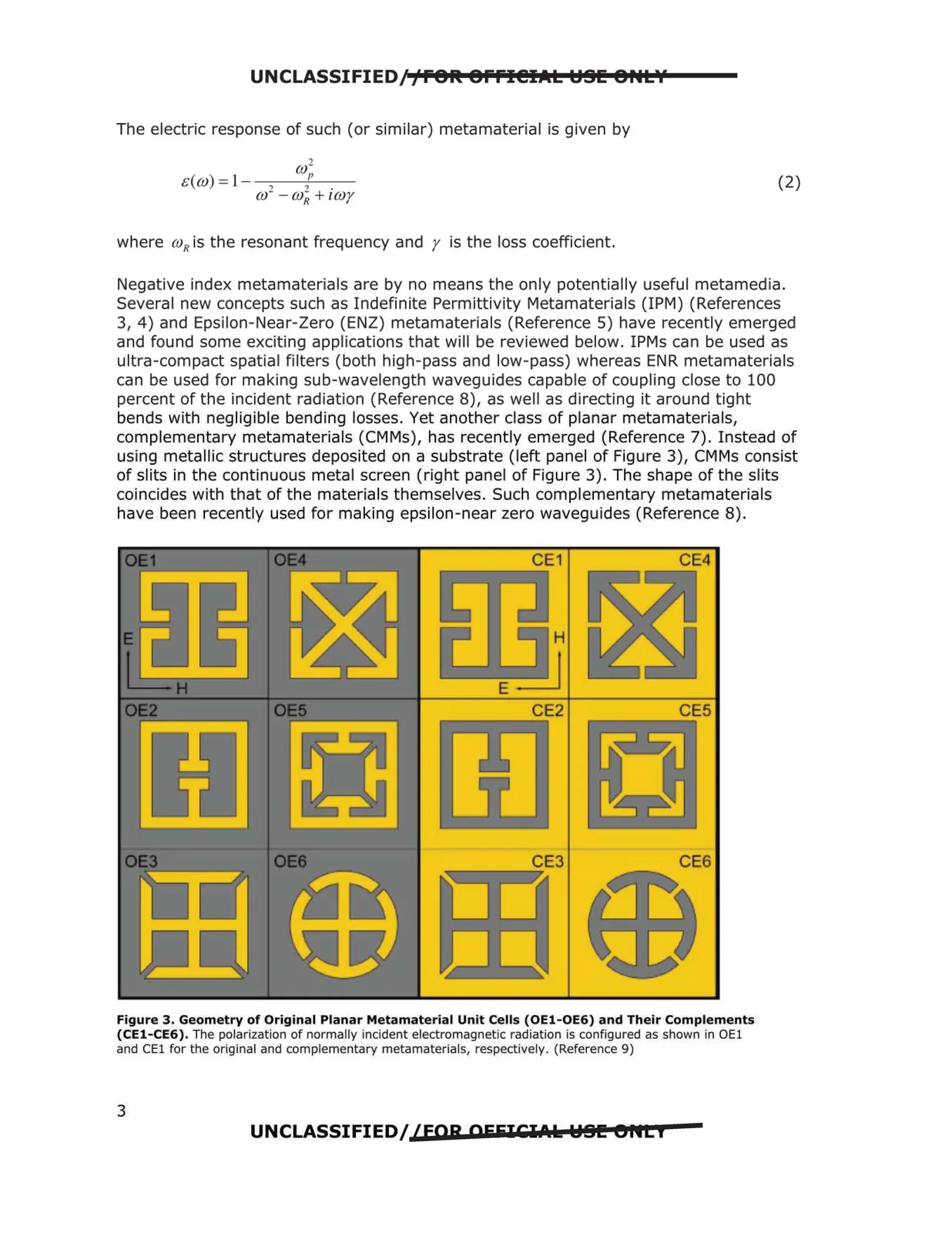
complementary metamaterials (CMMs), has recently emerged (Reference 7). Instead of
using metallic structures deposited on a substrate (left panel of Figure 3), CMMs consist
of slits in the continuous metal screen (right panel of Figure 3). The shape of the slits
coincides with that of the materials themselves. Such complementary metamaterials
have been recently used for making epsilon-near zero waveguides (Reference 8).
CE1
CE4
CE2
CE5
CE3
CE6
Figure 3. Geometry of Original Planar Metamaterial Unit Cells (OE1-0E6) and Their Complements
(CE1-CE6}. The polarization of normally incident electromagnetic rad iation is configured as shown in OEl
and CEl for the original and complementary metamaterials, respectively. (Reference 9)
UNCLASSIFIED/ {EAR OFFICI.IJ.k WSI!!! tJflti
3