AAWSAP DIRD, Concepts for Extracting Energy from the Quantum Vacuum, April 2010
DOW-UAP-D142 · page 11 of 57
Text
This text came with the file. It may have mistakes. When the text and the image disagree, the image is right.
UNCLASSIFIED//FOR OFFIEIAk WS& OPtkY
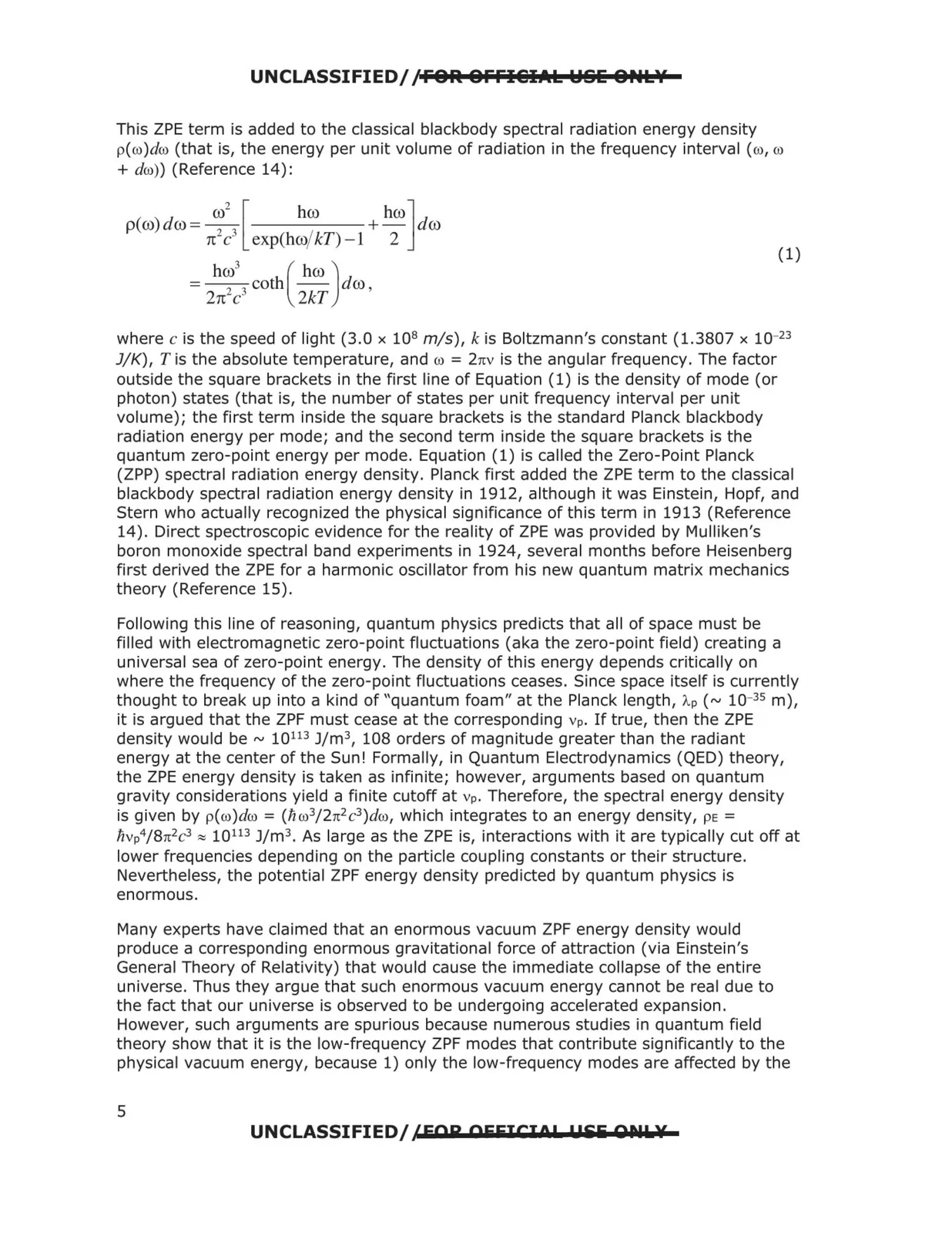
This ZPE term is added to the classical blackbody spectral radiation energy density
p(w)dro (that is, the energy per unit volume of radiation in the frequency interval (w, w
+ dw)) (Reference 14):
al [
hw
hw]
p(w)dw=- -----+- dw
n2c3 exp(hw/ kT) - 1
2
(1)
hw3
= -
-
3 coth ( --
hw)dw,
2
21t c
2kT
where c is the speed of light (3.0 x 10⁸ m/s), k is Boltzmann's constant (1.3807 x 10⁻²³
J/K), T is the absolute temperature, and ro = 2nv is the angular frequency. The factor
outside the square brackets in the first line of Equation (1) is the density of mode (or
photon) states (that is, the number of states per unit frequency interval per unit
volume); the first term inside the square brackets is the standard Planck blackbody
radiation energy per mode; and the second term inside the square brackets is the
quantum zero-point energy per mode. Equation ( 1) is called the Zero-Point Planck
(ZPP) spectral radiation energy density. Planck first added the ZPE term to the classical
blackbody spectral radiation energy density in 1912, although it was Einstein, Hopf, and
Stern who actually recognized the physical significance of this term in 1913 (Reference
14). Direct spectroscopic evidence for the reality of ZPE was provided by Mulliken's
boron monoxide spectral band experiments in 1924, several months before Heisenberg
first derived the ZPE for a harmonic oscillator from his new quantum matrix mechanics
theory (Reference 15).
Following this line of reasoning, quantum physics predicts that all of space must be
filled with electromagnetic zero-point fluctuations (aka the zero-point field) creating a
universal sea of zero-point energy. The density of this energy depends critically on
where the frequency of the zero-point fluctuations ceases. Since space itself is currently
thought to break up into a kind of "quantum foam" at the Planck length, Ap (~ 10-35 m),
it is argued that the ZPF must cease at the corresponding vp. If true, then the ZPE
density would be ~10113 J/m3, 108 orders of magnitude greater than the radiant
energy at the center of the Sun! Formally, in Quantum Electrodynamics (QED) theory,
the ZPE energy density is taken as infinite; however, arguments based on quantum
gravity considerations yield a finite cutoff at vp . Therefore, the spectral energy density
is given by p(w)dw = (nw3/2n2c3)dw, which integrates to an energy density, pE =
nvp4/8n2c3 ~ 10113 J/m3. As large as the ZPE is, interactions with it are typically cut off at
lower frequencies depending on the particle coupling constants or their structure.
Nevertheless, the potential ZPF energy density predicted by quantum physics is
enormous.
Many experts have claimed that an enormous vacuum ZPF energy density would
produce a corresponding enormous gravitational force of attraction (via Einstein's
General Theory of Relativity) that would cause the immediate collapse of the entire
universe. Thus they argue that such enormous vacuum energy cannot be real due to
the fact that our universe is observed to be undergoing accelerated expansion.
However, such arguments are spurious because numerous studies in quantum field
theory show that it is the low-frequency ZPF modes that contribute significantly to the
physical vacuum energy, because 1) only the low-frequency modes are affected by the
UNCLASSIFIED//FOR OFFICIO! P!ili QIU.,¥
5