AAWSAP DIRD, Concepts for Extracting Energy from the Quantum Vacuum, April 2010
DOW-UAP-D142 · page 17 of 57
Text
This text came with the file. It may have mistakes. When the text and the image disagree, the image is right.
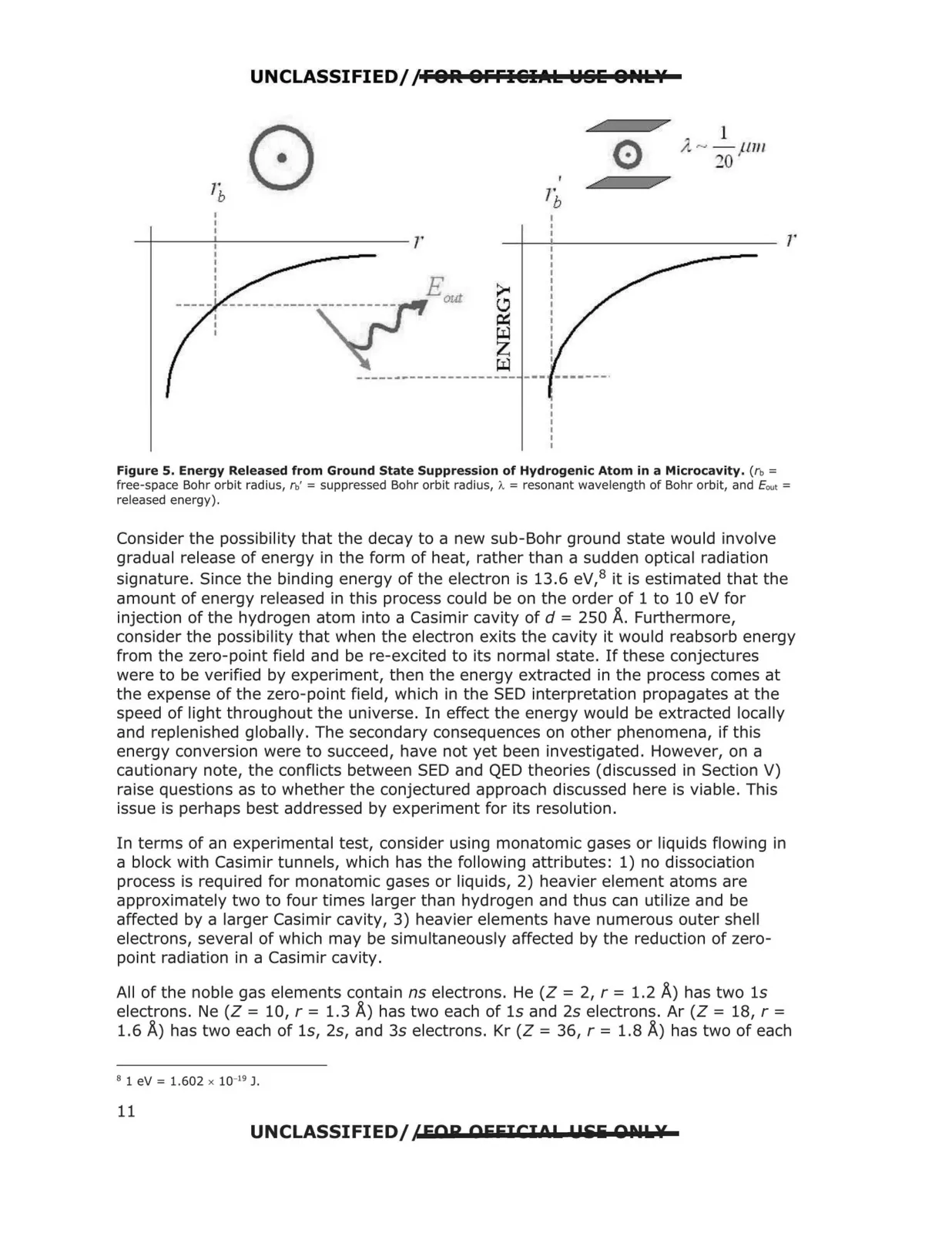
UNCLASSIFIED/ /FOR OFFI@IAL WSE QptLY J., ~ -11111 0 _o ,. 0 ]' 1 b b ______,___________ 1· ---+---~--------- 7· E out Figure S. Energy Released from Ground State Suppression of Hydrogenic Atom in a Microcavity. (rb = free-space Bohr orbit radius, fb' = suppressed Bohr orbit radius, ,, = resonant wavelength of Bohr orbit, and E out = released energy). Consider the possibility that the decay to a new sub-Bohr ground state would involve gradual release of energy in the form of heat, rather than a sudden optical radiation signature. Since the binding energy of the electron is 13.6 eV, 8 it is estimated that the amount of energy released in this process could be on the order of 1 to 10 eV for injection of the hydrogen atom into a Casimir cavity of d = 250 A. Furthermore, consider the possibility that when the electron exits the cavity it would reabsorb energy from the zero-point field and be re-excited to its normal state. If these conjectures were to be verified by experiment, then the energy extracted in the process comes at the expense of the zero-point field, which in the SEO interpretation propagates at the speed of light throughout the universe. In effect the energy would be extracted locally and replenished globally. The secondary consequences on other phenomena, if this energy conversion were to succeed, have not yet been investigated. However, on a cautionary note, the conflicts between SEO and QED theories (discussed in Section V) raise questions as to whether the conjectured approach discussed here is viable. This issue is perhaps best addressed by experiment for its resolution. In terms of an experimental test, consider using monatomic gases or liquids flowing in a block with Casimir tunnels, which has the following attributes: 1) no dissociation process is required for monatomic gases or liquids, 2) heavier element atoms are approximately two to four times larger than hydrogen and thus can utilize and be affected by a larger Casimir cavity, 3) heavier elements have numerous outer shell electrons, several of which may be simultaneously affected by the reduction of zero point radiation in a Casimir cavity. All of the noble gas elements contain ns electrons. He (Z = 2, r = 1.2 A) has two ls electrons. Ne (Z = 10, r = 1.3 A) has two each of ls and 2s electrons. Ar (Z = 18, r = 1.6 A) has two each of ls, 2s, and 3s electrons. Kr (Z = 36, r = 1.8 A) has two of each 8 1 eV = 1.602 x 10⁻¹⁹ J. UNCLASSIFIED/ /FOR OFFICI0L: 11ili QIU.,¥ 11