AAWSAP DIRD, Concepts for Extracting Energy from the Quantum Vacuum, April 2010
DOW-UAP-D142 · page 22 of 57
Text
This text came with the file. It may have mistakes. When the text and the image disagree, the image is right.
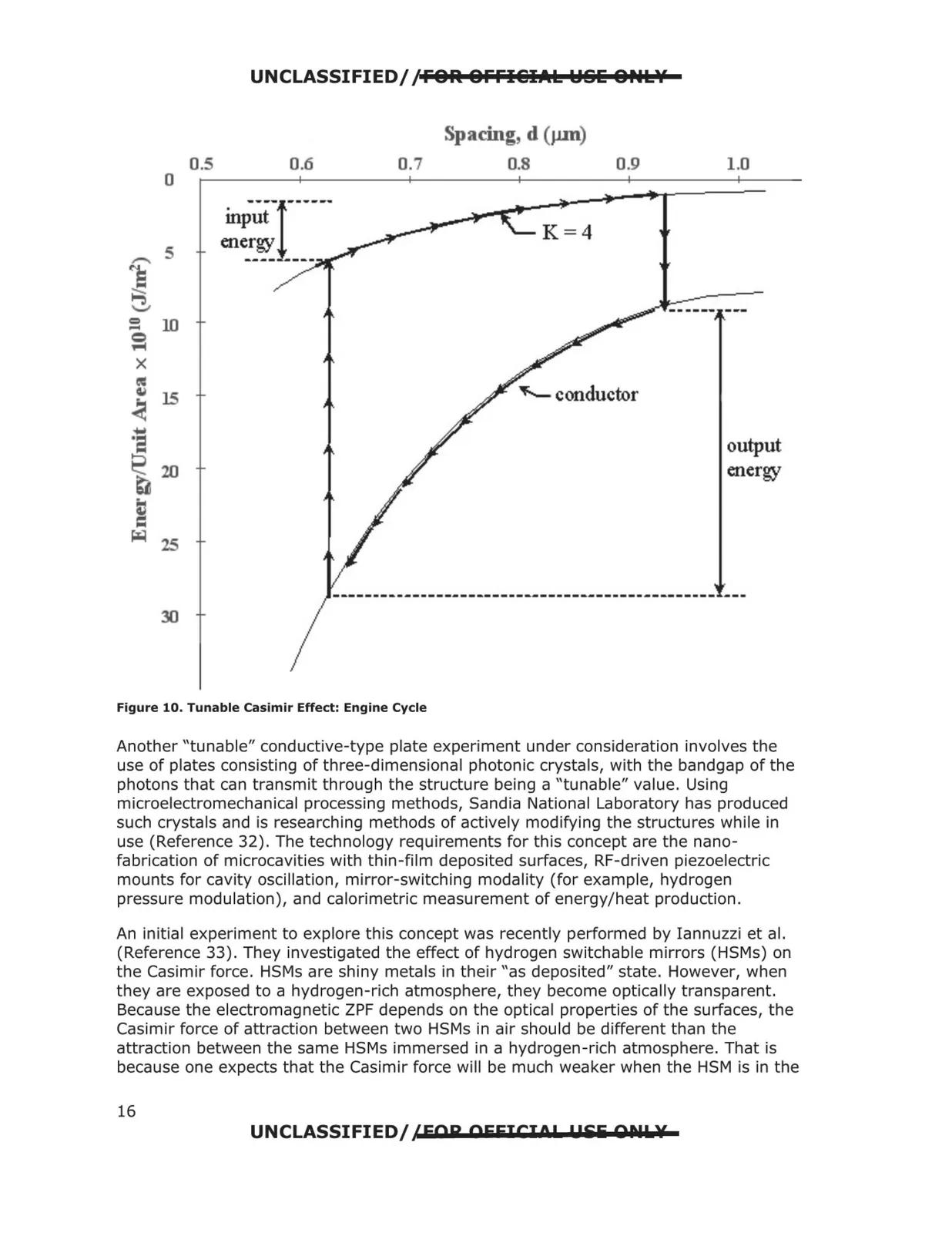
UNCLASSIFIED/ /FOR OFFIEIAk WS& OPtkY Spacing, d (µm) 0.5 0.6 0.7 0.8 0.9 1.0 0 - 5 l i=;;_; ......,-= 10 ~ X ~ G,l 15 .:e ..... ·= e 20 ~ ~ ~ ~ 25 30 . ----1-·---· mput K=4 energy ---- ---- output energy Figure 10. Tunable Casimir Effect: Engine Cycle Another "tunable" conductive-type plate experiment under consideration involves the use of plates consisting of three-dimensional photonic crystals, with the bandgap of the photons that can transmit through the structure being a "tunable" value. Using microelectromechanical processing methods, Sandia National Laboratory has produced such crystals and is researching methods of actively modifying the structures while in use (Reference 32). The technology requirements for this concept are the nano fabrication of microcavities with thin-film deposited surfaces, RF-driven piezoelectric mounts for cavity oscillation, mirror-switching modality (for example, hydrogen pressure modulation), and calorimetric measurement of energy/heat production. An initial experiment to explore this concept was recently performed by Iannuzzi et al. (Reference 33). They investigated the effect of hydrogen switchable mirrors (HSMs) on the Casimir force. HSMs are shiny metals in their "as deposited" state. However, when they are exposed to a hydrogen-rich atmosphere, they become optically transparent. Because the electromagnetic ZPF depends on the optical properties of the surfaces, the Casimir force of attraction between two HSMs in air should be different than the attraction between the same HSMs immersed in a hydrogen-rich atmosphere. That is because one expects that the Casimir force will be much weaker when the HSM is in the UNCLASSIFIED/ /FOR OFFICIO! P!ili QIU.,¥ 16