AAWSAP DIRD, Concepts for Extracting Energy from the Quantum Vacuum, April 2010
DOW-UAP-D142 · page 24 of 57
Text
This text came with the file. It may have mistakes. When the text and the image disagree, the image is right.
UNCLASSIFIED/ /FOR OFFIEIAk WS& OPtkY
created impact craters or holes in the materials. Piestrup et al. (Reference 46)
performed more recent experiments to investigate this unusual phenomenon. This
discovery inspired Shoulders to consider vortex filaments as a potential new source of
energy, and hence he named them electromagnetic vortices or "EVs." However, given
that he could not experimentally verify the vortex nature of the phenomenon, he later
redefined EV to mean Electrum Validum (roughly translated as strong electron).
Bostick and Shoulders began collaborating and realized that EVs were much easier to
generate and observe using micro-arc discharge devices because they are usually
obscured by surrounding plasma in large high-power plasma machines. This led
Shoulders to design a series of low-voltage, low-power micro-arc discharge (or
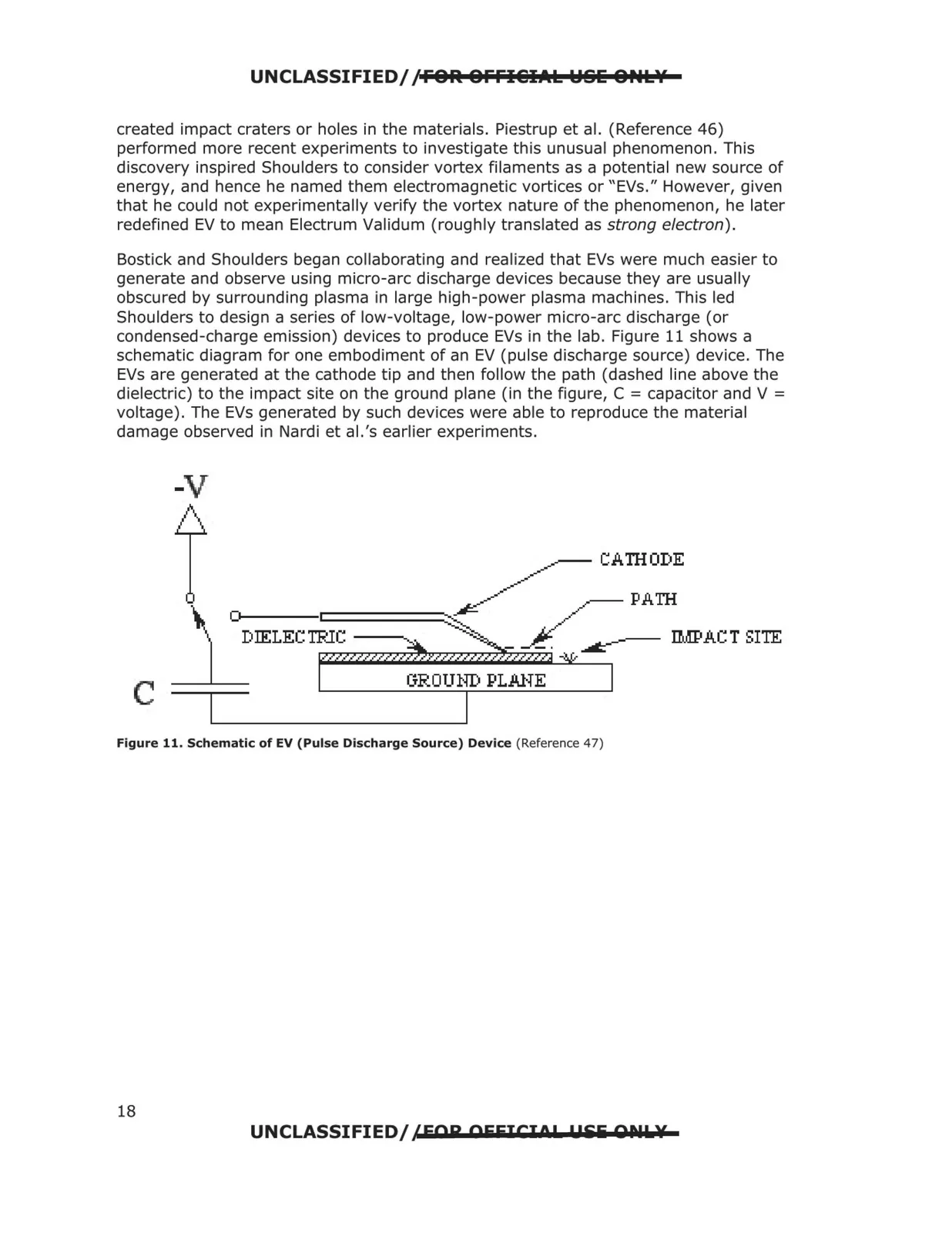
condensed-charge emission) devices to produce EVs in the lab. Figure 11 shows a
schematic diagram for one embodiment of an EV (pulse discharge source) device. The
EVs are generated at the cathode tip and then follow the path (dashed line above the
dielectric) to the impact site on the ground plane (in the figure, C = capacitor and V =
voltage). The EVs generated by such devices were able to reproduce the material
damage observed in Nardi et al. 's earlier experiments.
-V
Figure 11. Schematic of EV (Pulse Discharge Source) Device (Reference 47)
UNCLASSIFIED/ /FOR OFFICIO! P!ili QIU.,¥
18