AAWSAP DIRD, Concepts for Extracting Energy from the Quantum Vacuum, April 2010
DOW-UAP-D142 · page 27 of 57
Text
This text came with the file. It may have mistakes. When the text and the image disagree, the image is right.
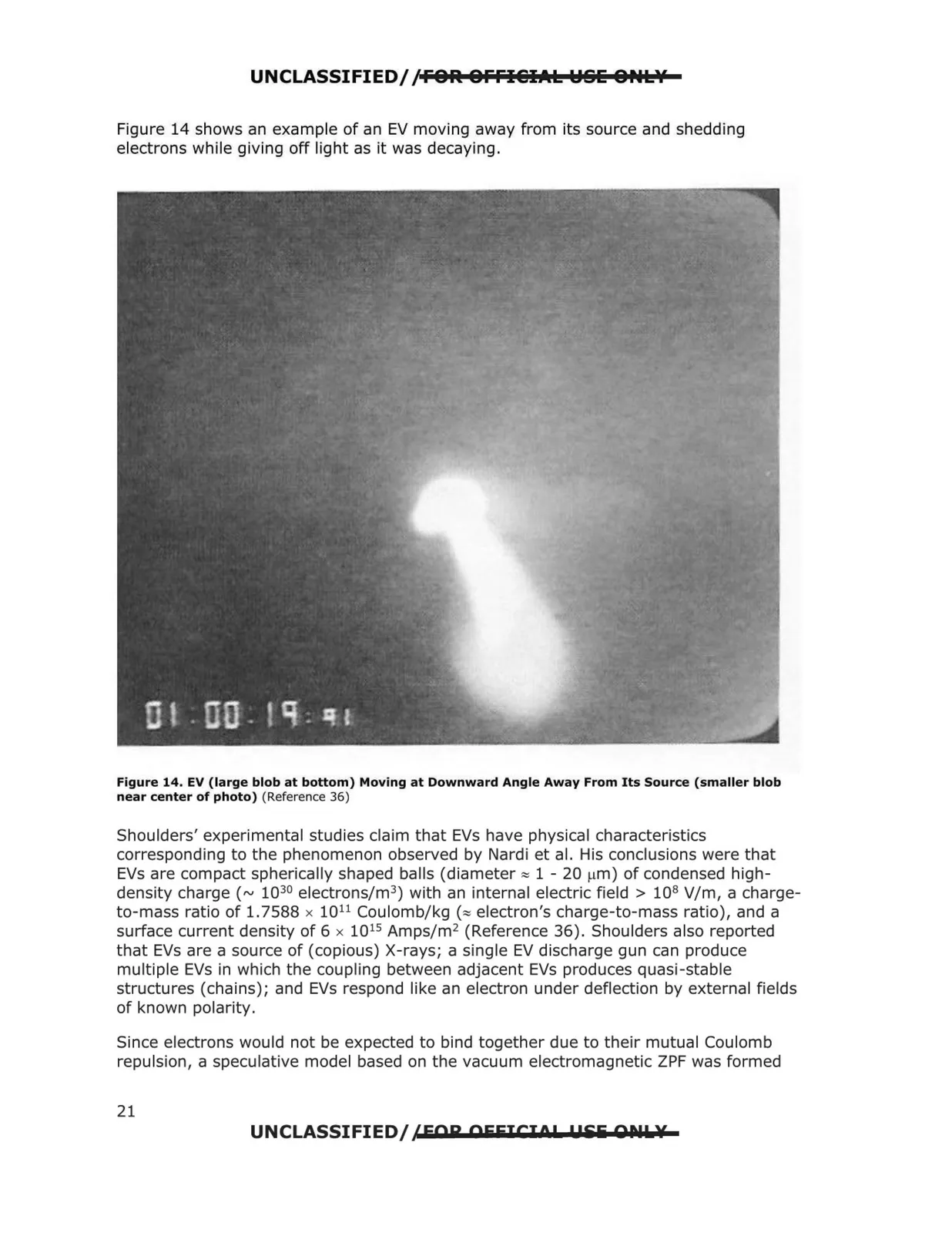
UNCLASSIFIED/ /FOR OFFI@IAk WSE 9Ptk\f Figure 14 shows an example of an EV moving away from its source and shedding electrons while giving off light as it was decaying . Figure 14. EV (large blob at bottom) Moving at Downward Angle Away From Its Source (smaller blob near center of photo) (Reference 36) Shoulders' experimental studies claim that EVs have physical characteristics corresponding to the phenomenon observed by Nardi et al. His conclusions were that EVs are compact spherically shaped balls (diameter"" 1 - 20 µm) of condensed high density charge ( ~ 1030 electrons/m3) with an internal electric field > 108 V/m, a charge to-mass ratio of 1.7588 x 10¹¹ Coulomb/kg (:::o electron's charge-to-mass ratio), and a surface current density of 6 x 10¹⁵ Amps/m 2 (Reference 36). Shoulders also reported that EVs are a source of (copious) X-rays; a single EV discharge gun can produce multiple EVs in which the coupling between adjacent EVs produces quasi-stable structures (chains); and EVs respond like an electron under deflection by external fields of known polarity. Since electrons would not be expected to bind together due to their mutual Coulomb repulsion, a speculative model based on the vacuum electromagnetic ZPF was formed UNCLASSIFIED/ /FOR OFFICI0L: 11ili QIU.,¥ 21