AAWSAP DIRD, Concepts for Extracting Energy from the Quantum Vacuum, April 2010
DOW-UAP-D142 · page 39 of 57
Text
This text came with the file. It may have mistakes. When the text and the image disagree, the image is right.
UNCLASSIFIED//FOR OFFIEIAk WS&i OPtkY
defined to have vanishing energy density, any region with less energy density than the
vacuum actually has a negative (renormalized) expectation value for the energy density
- hence, this is a degradable vacuum. Therefore, a squeezed vacuum state consists of a
traveling electromagnetic wave that oscillates back and forth between negative energy
density and positive energy density, but has positive time-averaged energy density.
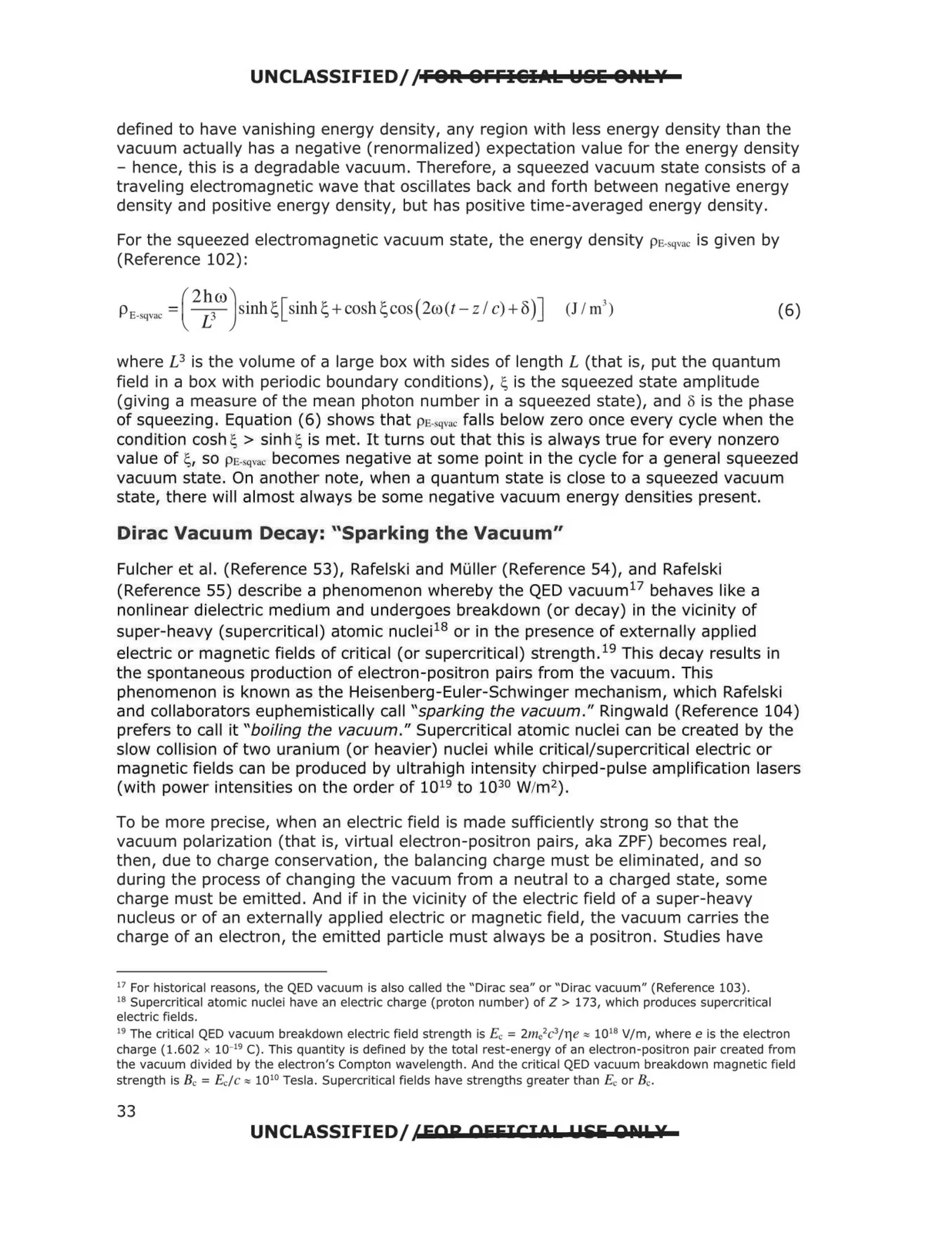
For the squeezed electromagnetic vacuum state, the energy density PE-sqvac is given by
(Reference 102):
P E-sqvac = ( 21 3(0 } inh ~[sinh ~+ cash ~cos( 2ro(t - zI c) + o)]
(J / m3 )
(6)
where L3 is the volume of a large box with sides of length L (that is, put the quantum
field in a box with periodic boundary conditions), sis the squeezed state amplitude
(giving a measure of the mean photon number in a squeezed state), and 8 is the phase
of squeezing. Equation ( 6) shows that PE-sqvac falls below zero once every cycle when the
condition cosh s > sinh sis met. It turns out that this is always true for every nonzero
value of s, so P E-sqvac becomes negative at some point in the cycle for a general squeezed
vacuum state. On another note, when a quantum state is close to a squeezed vacuum
state, there will almost always be some negative vacuum energy densities present.
Dirac Vacuum Decay: "Sparking the Vacuum"
Fulcher et al. (Reference 53), Rafelski and MOiier (Reference 54 ), and Rafelski
(Reference 55) describe a phenomenon whereby the QED vacuum 17 behaves like a
nonlinear dielectric medium and undergoes breakdown (or decay) in the vicinity of
super-heavy (supercritical) atomic nuclei18 or in the presence of externally applied
electric or magnetic fields of critical (or supercritical) strength. 19 This decay results in
the spontaneous production of electron-positron pairs from the vacuum. This
phenomenon is known as the Heisenberg-Euler-Schwinger mechanism, which Rafelski
and collaborators euphemistically call "sparking the vacuum." Ringwald (Reference 104)
prefers to call it "boiling the vacuum." Supercritical atomic nuclei can be created by the
slow collision of two uranium (or heavier) nuclei while critical/supercritical electric or
magnetic fields can be produced by ultrahigh intensity chirped-pulse amplification lasers
(with power intensities on the order of 1019 to 1030 W/m2).
To be more precise, when an electric field is made sufficiently strong so that the
vacuum polarization (that is, virtual electron-positron pairs, aka ZPF) becomes real,
then, due to charge conservation, the balancing charge must be eliminated, and so
during the process of changing the vacuum from a neutral to a charged state, some
charge must be emitted. And if in the vicinity of the electric field of a super-heavy
nucleus or of an externally applied electric or magnetic field, the vacuum carries the
charge of an electron, the emitted particle must always be a positron. Studies have
17 For historical reasons, the QED vacuum is also ca lled the "Dirac sea" or "Dirac vacuum" (Reference 103).
18 Supercritical atomic nuclei have an electric charge (proton number) of Z > 173, wh ich produces supercritical
electric fields.
19 The critical QED vacuum breakdown electric field strength is Ee = 2m,,2c3/T]e"' 1018 V/m, where e is the electron
charge (1.602 x 10⁻¹⁹ C) . This quantity is defined by the total rest-energy of an electron-positron pair created from
the vacuum divided by the electron's Compton wavelength. And the critical QED vacuum breakdown magnetic field
strength is Be = Ec/c "' 1010 Tesla. Supercritica l fields have strengths greater than Ee or Be-
UNCLASSIFIED//FOR OFFICI0L: 11ili QIU.,¥
33