AAWSAP DIRD, Laser Lightcraft Nanosatellites, November 2010
DOW-UAP-D143 · page 24 of 77
Text
This text came with the file. It may have mistakes. When the text and the image disagree, the image is right.
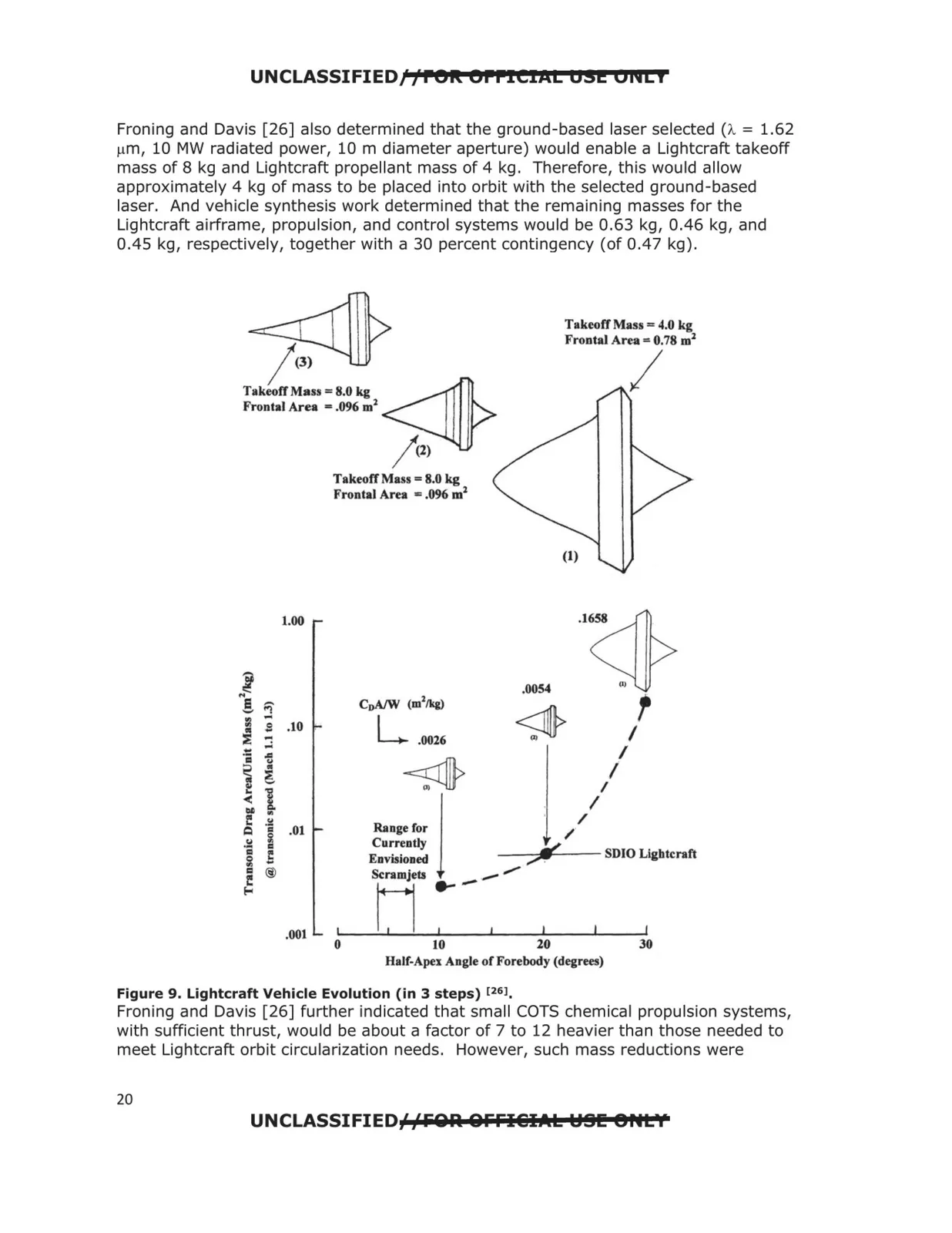
UNCLASSIFIED/;'POR: OPPICIAE USE O14Lf Froning and Davis [26] also determined that the ground-based laser selected (). = 1.62 µm, 10 MW radiated power, 10 m diameter aperture) would enable a Lightcraft takeoff mass of 8 kg and Lightcraft propellant mass of 4 kg. Therefore, this would allow approximately 4 kg of mass to be placed into orbit with the selected ground-based laser. And vehicle synthesis work determined that the remaining masses for the Lightcraft airframe, propulsion, and control systems would be 0.63 kg, 0.46 kg, and 0.45 kg, respectively, together with a 30 percent contingency (of 0.47 kg). Takeoff Mass =4.0 kg Frontal Area= 0.78 m1 /<3) I TakeoffMass=8.0kg ~ FnmlalArea •.096m' ~ 1.00 i ! ~ = s .10 ... i ... ... ·; ,II...• ~ ~ < '-' l .. 41 lie .. •.. · ...; Q .01 ...·; i.. i ~ 1:1 @ ~ !- .001 Takeoff Mass =8.0 kg Frontal Area "' .096 m2 (1) .16~ .0054 (I) Cr,A/W (m21k&) f L .0026 ~ I I I ~ I l I / Range for / Currently ;;iJt' SDIO Llgbtcraft Envisioned &:ramjets - .,, M ... 0 10 20 30 Half-Apell Angle ofForebody (degrees) Figure 9. Lightcraft Vehicle Evolution (in 3 steps) 1261. Froning and Davis [26] further indicated that small COTS chemical propulsion systems, with sufficient thrust, would be about a factor of 7 to 12 heavier than those needed to meet Lightcraft orbit circularization needs. However, such mass reductions were UNCLASSIFIED,'fFOA QFFISIAL 1!181!! 8HLY 20