AAWSAP DIRD, Laser Lightcraft Nanosatellites, November 2010
DOW-UAP-D143 · page 27 of 77
Text
This text came with the file. It may have mistakes. When the text and the image disagree, the image is right.
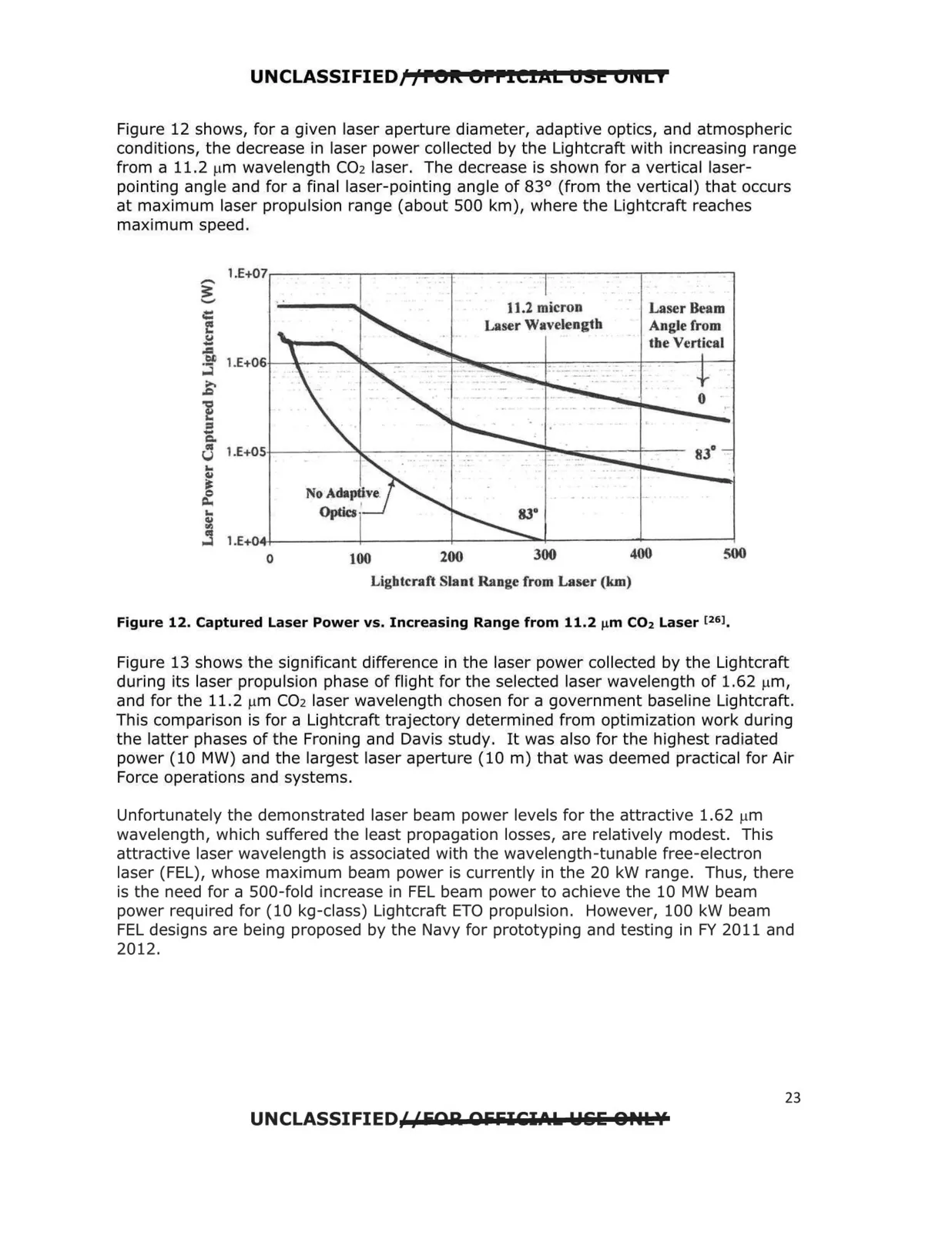
UNCLASSIFIED/,'rOR: orrlCIJ!tL USE 014Lf Figure 12 shows, for a given laser aperture diameter, adaptive optics, and atmospheric conditions, the decrease in laser power collected by the Lig htcraft with increasing range from a 11.2 µm wavelength CO2 laser. The decrease is shown for a vertical laser pointing angle and for a final laser-pointing angle of 83° (from the vertical) that occurs at maximum laser propulsion range (about 500 km), where the Lightcraft reaches maximum speed. 1.E+07---------.-------,-------r------, i- .:= 11.2 micron Laser Wavelength f J:! -:i La er Beam Angle from the Vertical :i 1.E+06-l--½--- ~a:----=-----F""-..::-------:c:-+.,-------::----:---+------t----t 300 400 500 0 100 200 Ligbtcraft Slant Range from Laser (km) Figure 12. Captured Laser Power vs. Increasing Range from 11.2 µm CO2 Laser 1261. Figure 13 shows the significant difference in the laser power collected by the Lightcraft during its laser propulsion phase of flight for the selected laser wavelength of 1.62 µm, and for the 11.2 µm CO2 laser wavelength chosen for a government baseline Lightcraft. This comparison is for a Lightcraft trajectory determined from optimization work during the latter phases of the Froning and Davis study. It was also for the highest radiated power (10 MW) and the largest laser aperture (10 m) that was deemed practical for Air Force operations and systems. Unfortunately the demonstrated laser beam power levels for the attractive 1.62 µm wavelength, which suffered the least propagation losses, are relatively modest. This attractive laser wavelength is associated with the wavelength-tunable free-electron laser (FEL), whose maximum beam power is currently in the 20 kW range. Thus, there is the need for a 500-fold increase in FEL beam power to achieve the 10 MW beam power required for (10 kg-class) Lightcraft ETO propulsion. However, 100 kW beam FEL designs are being proposed by the Navy for prototyping and testing in FY 2011 and 2012. £ l ! Q,U 1.E+OS-1----- ~ ---,---+-:,--------:----'=l'--..-.::::----f-- ._ i ... ~ ,:! l .E+OA+----~e-------1-----=---1-----------1 UNCLASSIFIED//FOR 061ilCl.li.k W&& 8Ptl'l 23