AAWSAP DIRD, Laser Lightcraft Nanosatellites, November 2010
DOW-UAP-D143 · page 56 of 77
Text
This text came with the file. It may have mistakes. When the text and the image disagree, the image is right.
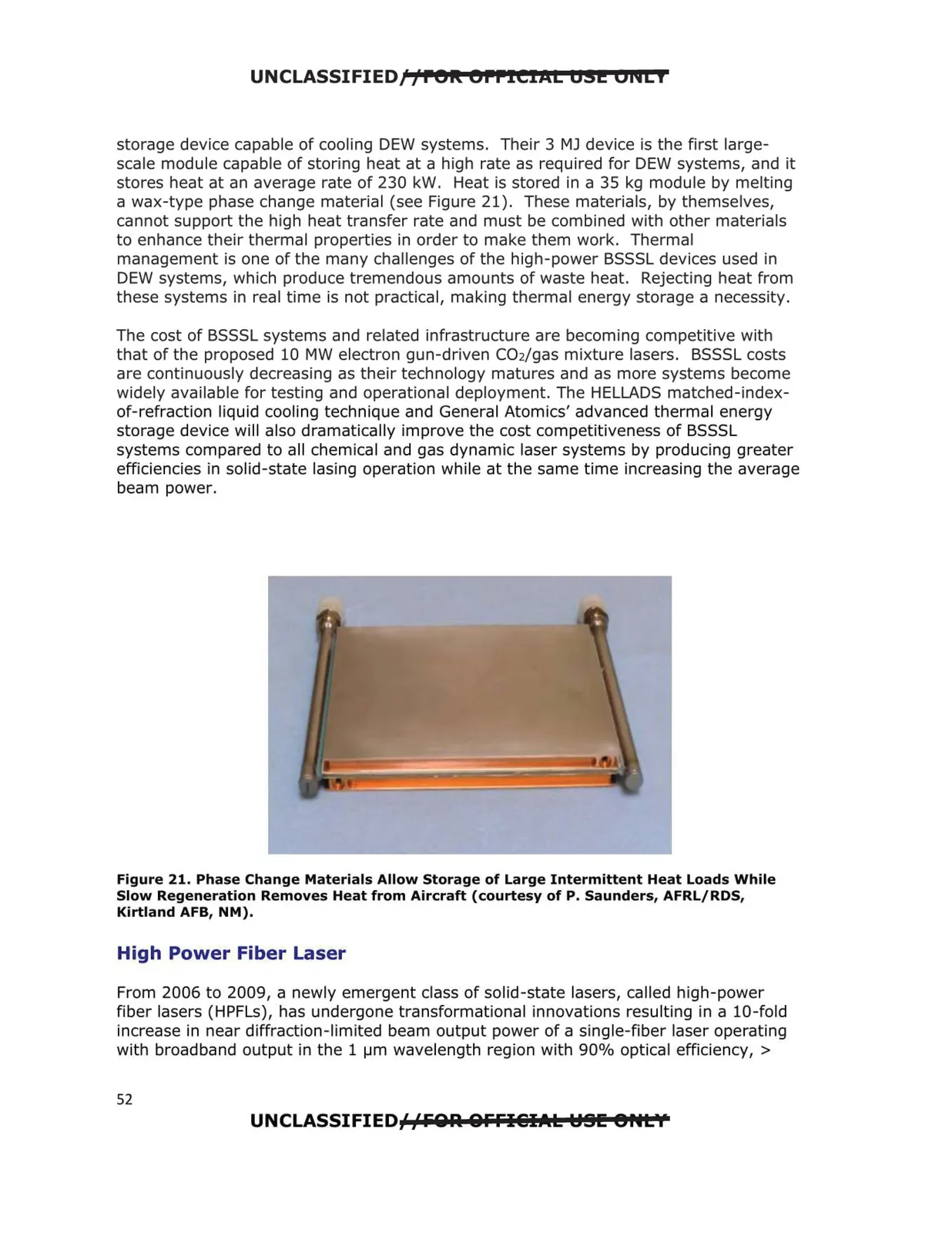
UNCLASSIFIED//rOR: orrlCIAL USE 014Lf storage device capable of cooling DEW systems. Their 3 MJ device is the first large scale module capable of storing heat at a high rate as required for DEW systems, and it stores heat at an average rate of 230 kW. Heat is stored in a 35 kg module by melting a wax-type phase change material (see Figure 21). These materials, by themselves, cannot support the high heat transfer rate and must be combined with other materials to enhance their thermal properties in order to make them work. Thermal management is one of the many challenges of the high-power BSSSL devices used in DEW systems, which produce tremendous amounts of waste heat. Rejecting heat from these systems in real time is not practical, making thermal energy storage a necessity. The cost of BSSSL systems and related infrastructure are becoming competitive with that of the proposed 10 MW electron gun-driven CO2/gas mixture lasers. BSSSL costs are continuously decreasing as their technology matures and as more systems become widely available for testing and operational deployment. The HELLADS matched-index of-refraction liquid cooling technique and General Atomics' advanced thermal energy storage device will also dramatically improve the cost competitiveness of BSSSL systems compared to all chemical and gas dynamic laser systems by producing greater efficiencies in solid-state lasing operation while at the same time increasing the average beam power. Figure 21. Phase Change Materials Allow Storage of Large Intermittent Heat Loads While Slow Regeneration Removes Heat from Aircraft (courtesy of P. Saunders, AFRL/RDS, Kirtland AFB, NM). High Power Fiber Laser From 2006 to 2009, a newly emergent class of solid-state lasers, called high -power fiber lasers (HPFLs), has undergone transformational innovations resulting in a 10-fold increase in near diffraction-limited beam output power of a single-fiber laser operating with broadband output in the 1 µm wavelength region with 90% optical efficiency, > UNCLASSIFIED/fFOA QFFH31AL ~81!! 8HLY 52