AAWSAP DIRD, Laser Lightcraft Nanosatellites, November 2010
DOW-UAP-D143 · page 63 of 77
Text
This text came with the file. It may have mistakes. When the text and the image disagree, the image is right.
UNCLASSIFIED/,'rOR: orrlCIJ!tL USE 014Lf
l ctron b am
undula.tor
r
on tor
mirror
y
1
0
z
A
0
z
0
z
l ctron
am pha
- spac
volut on
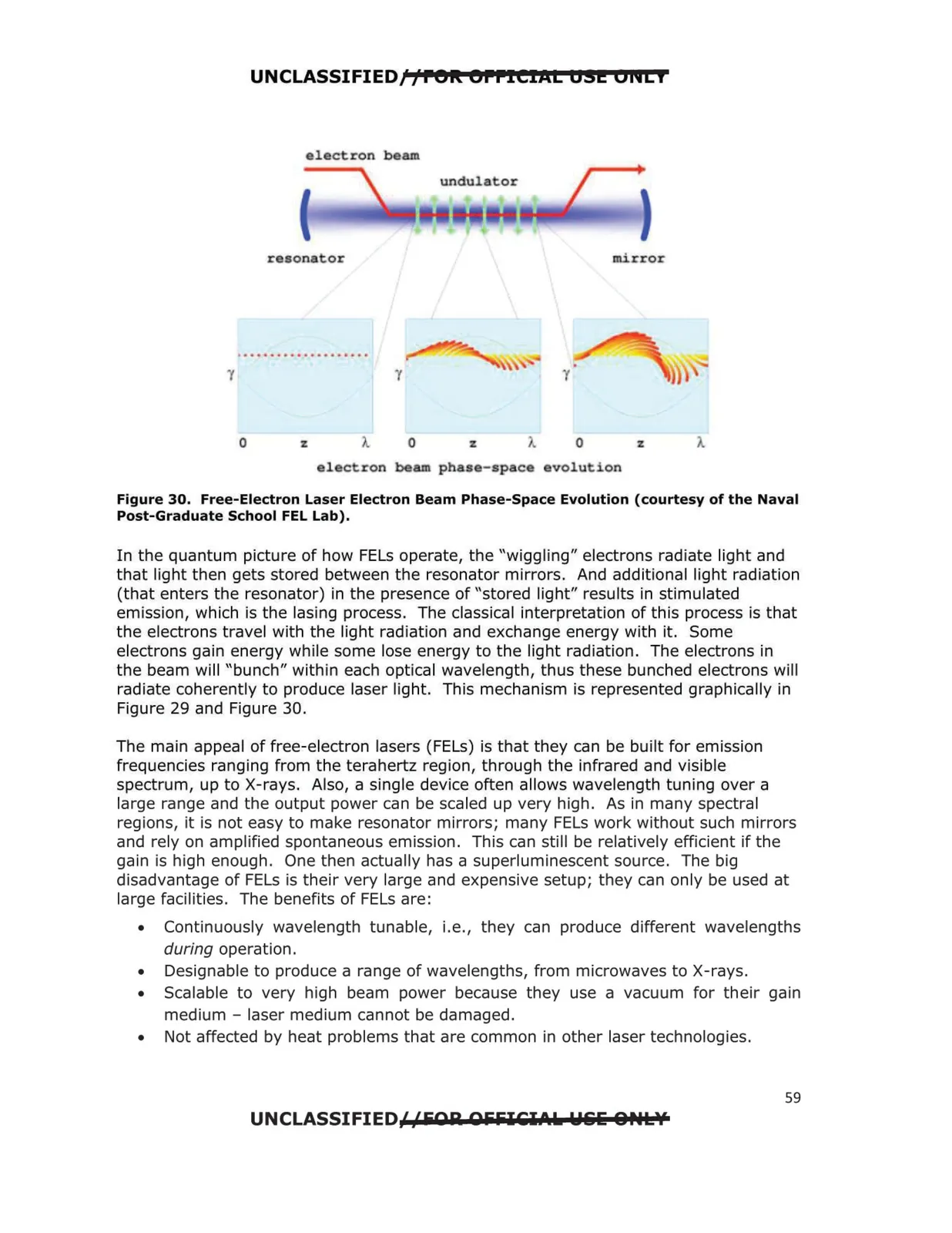
Figure 30. Free-Electron Laser Electron Beam Phase-Space Evolution (courtesy of the Naval
Post-Graduate School FEL Lab).
In the quantum picture of how FELs operate, the "wiggling" electrons radiate light and
that light then gets stored between the resonator mirrors. And additional light radiation
(that enters the resonator) in the presence of "stored light" results in stimulated
emission, which is the lasing process. The classical interpretation of this process is that
the electrons travel with the light radiation and exchange energy with it. Some
electrons gain energy while some lose energy to the light radiation. The electrons in
the beam will "bunch" within each optical wavelength, thus these bunched electrons will
radiate coherently to produce laser light. This mechanism is represented graphically in
Figure 29 and Figure 30.
The main appeal of free-electron lasers (FELs) is that they can be built for emission
frequencies ranging from the terahertz region, through the infrared and visible
spectrum, up to X-rays. Also, a single device often allows wavelength tuning over a
large range and the output power can be scaled up very high. As in many spectral
regions, it is not easy to make resonator mirrors; many FELs work without such mirrors
and rely on amplified spontaneous emission. This can still be relatively efficient if the
gain is high enough. One then actually has a superluminescent source. The big
disadvantage of FELs is their very large and expensive setup; they can only be used at
large facilities. The benefits of FELs are:
•
Continuously wavelength tunable, i.e., they can produce different wavelengths
during operation.
•
Designable to produce a range of wavelengths, from microwaves to X-rays.
•
Scalable to very high beam power because they use a vacuum for their gain
medium - laser medium cannot be damaged.
•
Not affected by heat problems that are common in other laser technologies.
UNCLASSIFIED//FOR 061ilCl.li.k W&& 8Ptl'l
59