AAWSAP DIRD, Cockpits in the Era of Breakthrough Flight, November 2010
DOW-UAP-D144 · page 14 of 57
Text
This text came with the file. It may have mistakes. When the text and the image disagree, the image is right.
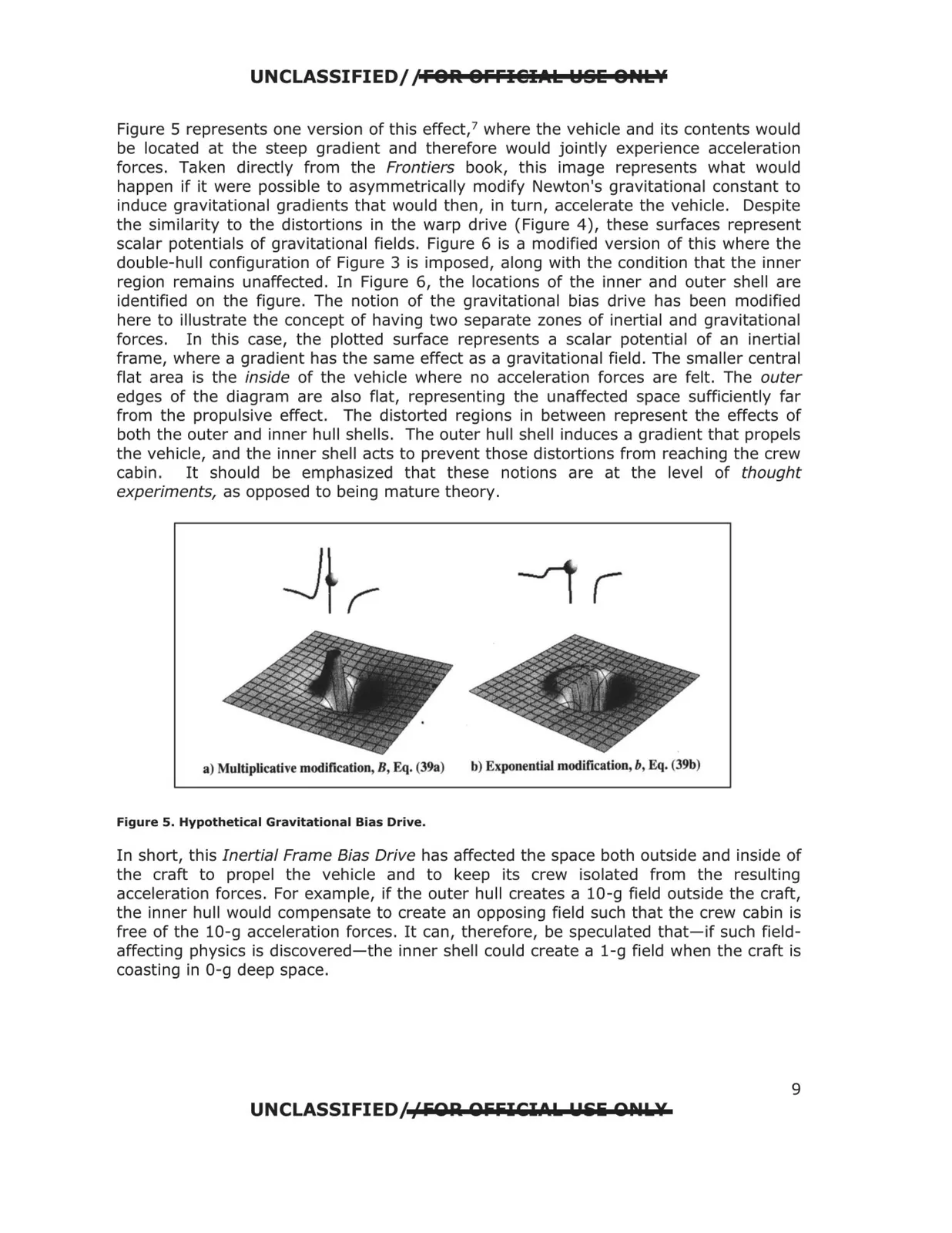
UNCLASSIFIED/fFOR OFFI@IAI:: HSE OPtl::Y Figure 5 represents one version of this effect/ where the vehicle and its contents would be located at the steep gradient and therefore would jointly experience acceleration forces. Taken directly from the Frontiers book, this image represents what would happen if it were possible to asymmetrically modify Newton's gravitational constant to induce gravitational gradients that would then, in turn, accelerate the vehicle. Despite the similarity to the distortions in the warp drive (Figure 4), these surfaces represent scalar potentials of gravitational fields. Figure 6 is a modified version of this where the double-hull configuration of Figure 3 is imposed, along with the condition that the inner region remains unaffected. In Figure 6, the locations of the inner and outer shell are identified on the figure. The notion of the gravitational bias drive has been modified here to illustrate the concept of having two separate zones of inertial and gravitational forces. In this case, the plotted surface represents a scalar potential of an inertial frame, where a gradient has the same effect as a gravitational field. The smaller central flat area is the inside of the vehicle where no acceleration forces are felt. The outer edges of the diagram are also flat, representing the unaffected space sufficiently far from the propulsive effect. The distorted regions in between represent the effects of both the outer and inner hull shells. The outer hull shell induces a gradient that propels the vehicle, and the inner shell acts to prevent those distortions from reaching the crew cabin. It should be emphasized that these notions are at the level of thought experiments, as opposed to being mature theory. a) Multiplicative modification, B, Eq. (39a) b) Exponential modification, b, Eq. (39b) Figure 5. Hypothetical Gravitational Bias Drive. In short, this Inertial Frame Bias Drive has affected the space both outside and inside of the craft to propel the vehicle and to keep its crew isolated from the resulting acceleration forces. For example, if the outer hull creates a 10-g field outside the craft, the inner hull would compensate to create an opposing field such that the crew cabin is free of the 10-g acceleration forces. It can, therefore, be speculated that-if such field affecting physics is discovered-the inner shell could create a 1-g field when the craft is coasting in 0-g deep space. UNCLASSIFIED/fFOA. OFFICIO ls. Plili Olhlls.¥ 9