AAWSAP DIRD, Cockpits in the Era of Breakthrough Flight, November 2010
DOW-UAP-D144 · page 18 of 57
Text
This text came with the file. It may have mistakes. When the text and the image disagree, the image is right.
UNCLASSIFIED/ ,'FOR OFFI@IAI:: WSE ONl::Y
Crew Size Considerations
The last aspect to take into account as a consequence of mixed operational regimes is
that of the crew size. For short-duration missions (less than a few hours), it is
reasonable to conceive of vehicles with only one pilot. For more complex missions,
additional crew will be required, and thus additional displays and controls specific to
their tasks will be required . Finally, for long-duration missions, sufficient crew will be
required to carry out its mission and maintain optimal vehicle performance. These
changes-for accommodating the roles and responsibilities of crew in relation to the
overall mission-are likely to be the same as those distinctions in traditional vehicles
(e.g. , cars versus cruise ships). Those changes typically include a hierarchical
organization, which is independent of the issues of propulsion physics.
Essential elements will include monitoring and controlling the 1-g internal life-support
environment as well as ensuring the long-term health of the crew.
Full Span of Speeds
In addition to inertial effects previously addressed, the implications due to high speed
remain.
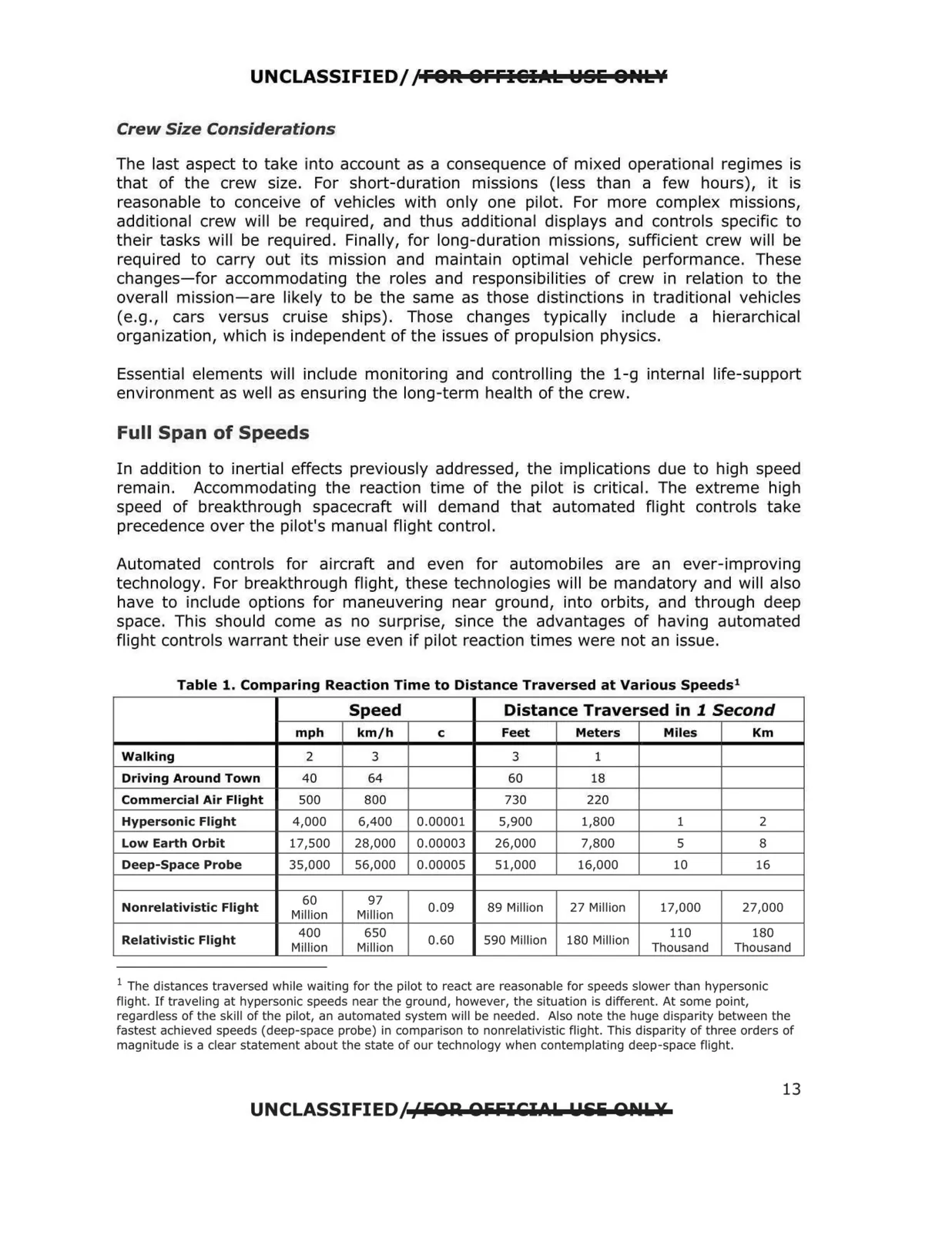
Accommodating the reaction time of the pilot is critical. The extreme high
speed of breakthrough spacecraft will demand that automated flight controls take
precedence over the pilot's manual flight control.
Automated controls for aircraft and even for automobiles are an ever-improving
technology. For breakthrough flight, these technologies will be mandatory and will also
have to include options for maneuvering near ground, into orbits, and through deep
space. This should come as no surprise, since the advantages of having automated
flight controls warrant their use even if pilot reaction times were not an issue.
Table 1. Comparing Reaction Time to Distance Traversed at Various Speeds1
Speed
Distance Traversed in l Second
mph
km/h
C
Feet
Meters
Miles
Km
Walking
2
3
3
1
Driving Around Town
40
64
60
18
Commercial Air Flight
500
800
730
220
Hypersonic Flight
Low Earth Orbit
4,000
17,500
6,400
28,000
0.00001
0.00003
5,900
26,000
1,800
7,800
1
5
2
8
Deep-Space Probe
35,000
56,000
0.00005
51,000
16,000
10
16
Nonrelativistic Flight
60
Million
97
Million
0.09
89 Million
27 Million
17,000
27,000
Relativistic Flight
400
Million
650
Million
0.60
590 Million
180 Million
110
Thousand
180
Thousand
1 The distances traversed while waiting for the pilot to react are reasonable for speeds slower than hypersonic
fl ight. If traveling at hypersonic speeds near the ground, however, the situation is different. At some point,
regardless of the skill of the pilot, an automated system will be needed. Also note the huge disparity between the
fastest achieved speeds (deep-space probe) in comparison to nonrelativistic flight. This disparity of three orders of
magnitude is a clear statement about the state of our technology when contemplating deep-space flight.
UNCLASSIFIED/fFOA. OFFICIO ls. Plili ONls.¥
13