AAWSAP DIRD, Cockpits in the Era of Breakthrough Flight, November 2010
DOW-UAP-D144 · page 25 of 57
Text
This text came with the file. It may have mistakes. When the text and the image disagree, the image is right.
UNCLASSIFIED/ ,'FOR OFFI@IAL WSE QptLY
Fields of View
There is a difference between what humans are physically capable of seeing and where
they naturally concentrate their attention.
Using a reference point that is straight
ahead and level with the eyes, the normal full field of view extends laterally (left/right)
±100°, upward about +60°, and downward about -75°. Of course, turning the head
can extend the lateral reach directly behind, but that rearward view would be in the
edge of periphery vision. This full span, however, is not where humans normally direct
their attention.
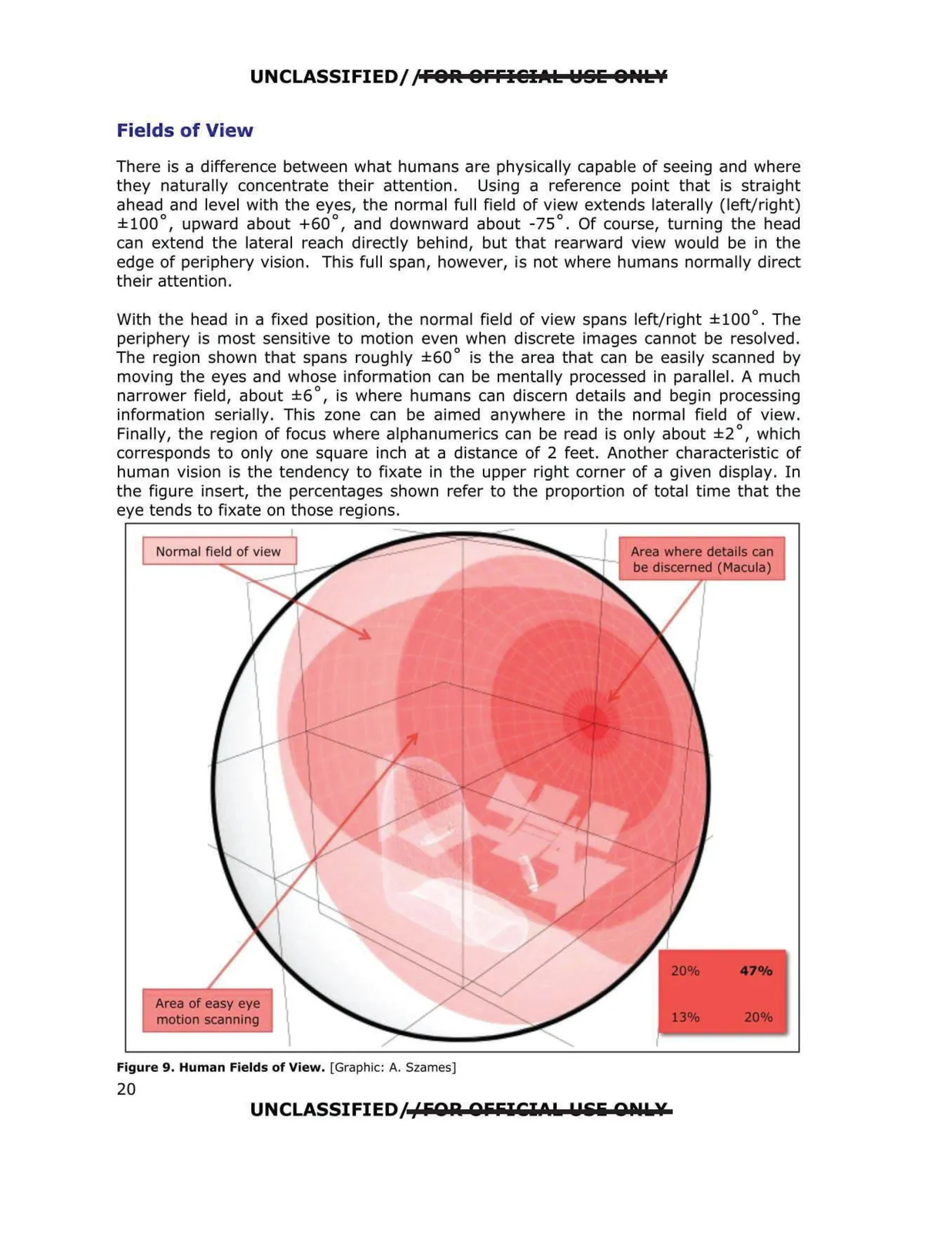
With the head in a fixed position, the normal field of view spans left/right ±100°. The
periphery is most sensitive to motion even when discrete images cannot be resolved.
The region shown that spans roughly ±60° is the area that can be easily scanned by
moving the eyes and whose information can be mentally processed in parallel. A much
narrower field, about ±6°, is where humans can discern details and begin processing
information serially. This zone can be aimed anywhere in the normal field of view.
Finally, the region of focus where alphanumerics can be read is only about ±2°, which
corresponds to only one square inch at a distance of 2 feet. Another characteristic of
human vision is the tendency to fixate in the upper right corner of a given display. In
the figure insert, the percentages shown refer to the proportion of total time that the
eye tends to fixate on those regions.
Figure 9. Human Fields of View. [Graphic: A. Szames]
UNCLASSIFIED/fFOA: OFFICIO la Plili Oralla¥
20