AAWSAP DIRD, Cockpits in the Era of Breakthrough Flight, November 2010
DOW-UAP-D144 · page 3 of 57
Text
This text came with the file. It may have mistakes. When the text and the image disagree, the image is right.
UNCLASSIFIED/,'FOR OFFI@IAL WSE ONLY
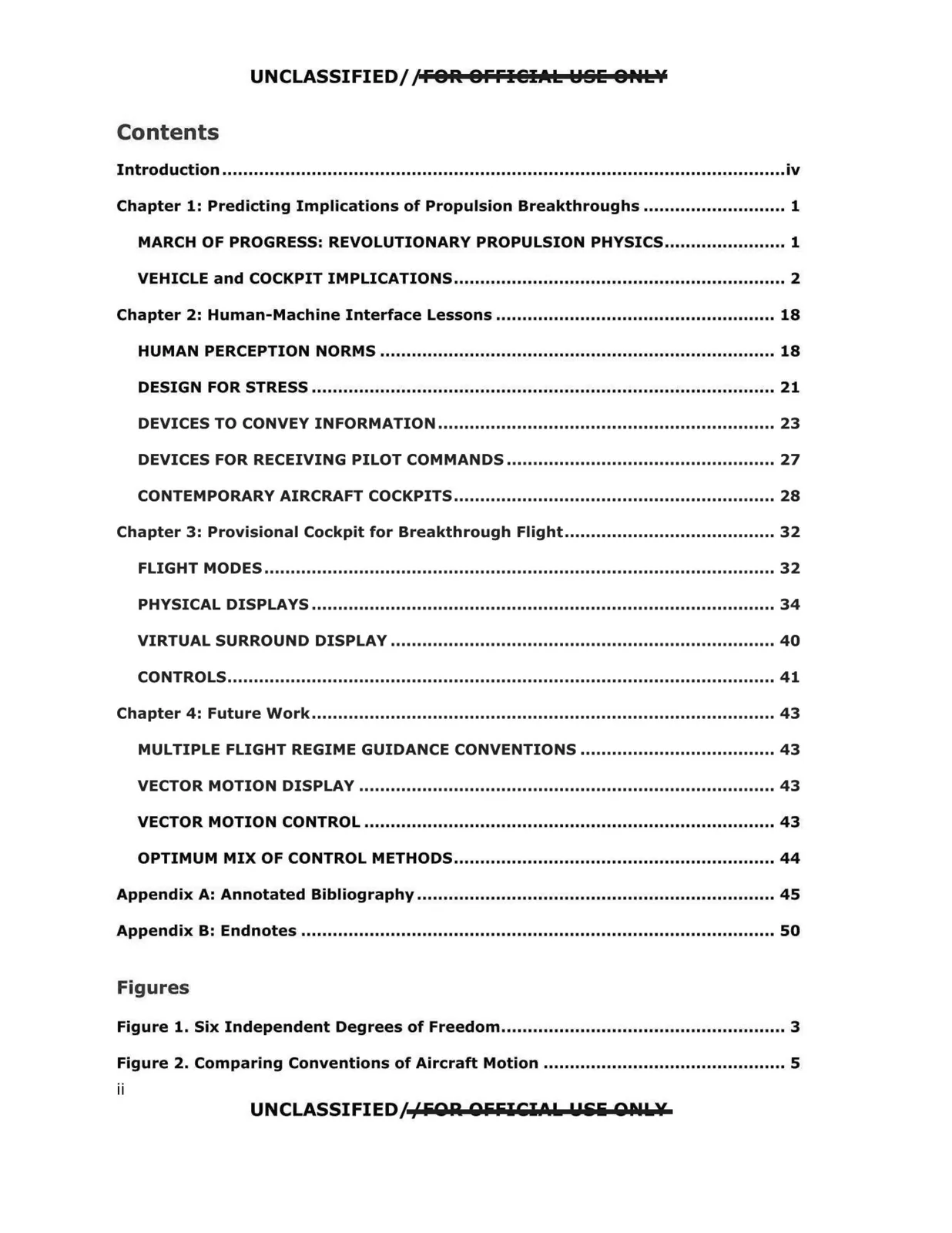
Contents
Introduction ...........................................................................................................iv
Chapter 1: Predicting Implications of Propulsion Breakthroughs ........................... 1
MARCH OF PROGRESS: REVOLUTIONARY PROPULSION PHYSICS....................... 1
VEHICLE and COCKPIT IMPLICATIONS............................................................... 2
Chapter 2: Human-Machine Interface Lessons ..................................................... 18
HUMAN PERCEPTION NORMS ........................................................................... 18
DESIGN FOR STRESS ............................................ ................................................. 21
DEVICES TO CONVEY INFORMATION ................................................................ 23
DEVICES FOR RECEIVING PILOT COMMANDS ................................................... 27
CONTEMPORARY AIRCRAFT COCKPITS............................................................. 28
Chapter 3: Provisional Cockpit for Breakthrough Flight........................................ 32
FLIGHT MODES ................................................................................................. 32
PHYSICAL DISPLAVS ........................................................................................ 34
VIRTUAL SURROUND DISPLAY ......................................................................... 40
CONTROLS ........................................................................................................ 41
Chapter 4: Future Work ........................................................................................ 43
MULTIPLE FLIGHT REGI ME GUIDANCE CONVENTIONS ..................................... 43
VECTOR MOTION DISPLAY ............................................................................... 43
VECTOR MOTION CONTROL .............................................................................. 43
OPTIMUM MIX OF CONTROL METHODS ............................................................. 44
Appendix A: Annotated Bibliography .................................................................... 45
Appendix B: Endnotes .......................................................................................... SO
Figures
Figure 1. Six Independent Degrees of Freedom...................................................... 3
Figure 2. Comparing Conventions of Aircraft Motion .............................................. 5
UNCLASSIFIED/ fFOA. OFFICIO Is. flili Ol'lls.¥
ii