AAWSAP DIRD, Cockpits in the Era of Breakthrough Flight, November 2010
DOW-UAP-D144 · page 39 of 57
Text
This text came with the file. It may have mistakes. When the text and the image disagree, the image is right.
UNCLASSIFIED/ ,'FOR OFFI@IAI:: WSE ONl::Y
Interactive Assist
This is a further automated augmentation of the prior flight mode.
In this case,
following commands from the pilot (voice, gesture, or thought), the pilot can request
for the flight assistant to fly the vehicle as desired. In this mode, it is most likely that
the pilot will not be touching the joysticks, but rather issuing "drive to" commands to
the automated system .
Fully Autonomous
In the event that the pilot is incapacitated or performing non-flight tasks, the fully
autonomous mode flies the vehicle in whatever flight command mode was last entered.
This means that the system follows through with previously entered commands,
including a selection of preset emergency responses, such as "returning to base" or
"flying to the nearest medical facility." These emergency response fu nctions may have
a dedicated physical panel.
PHYSICAL DISPLAYS
In keeping with human-factors lessons, particularly the use of physical analogies of
human perception, the critica l displays and controls will be anchored in physical
hardware in fixed locations. The primary reason for providing an actual physical set of
displays and controls is to minimize errors during stressful situations.
This includes
tunnel vision, mode errors, and keyhole errors.
The controls also include tactile
feedback.
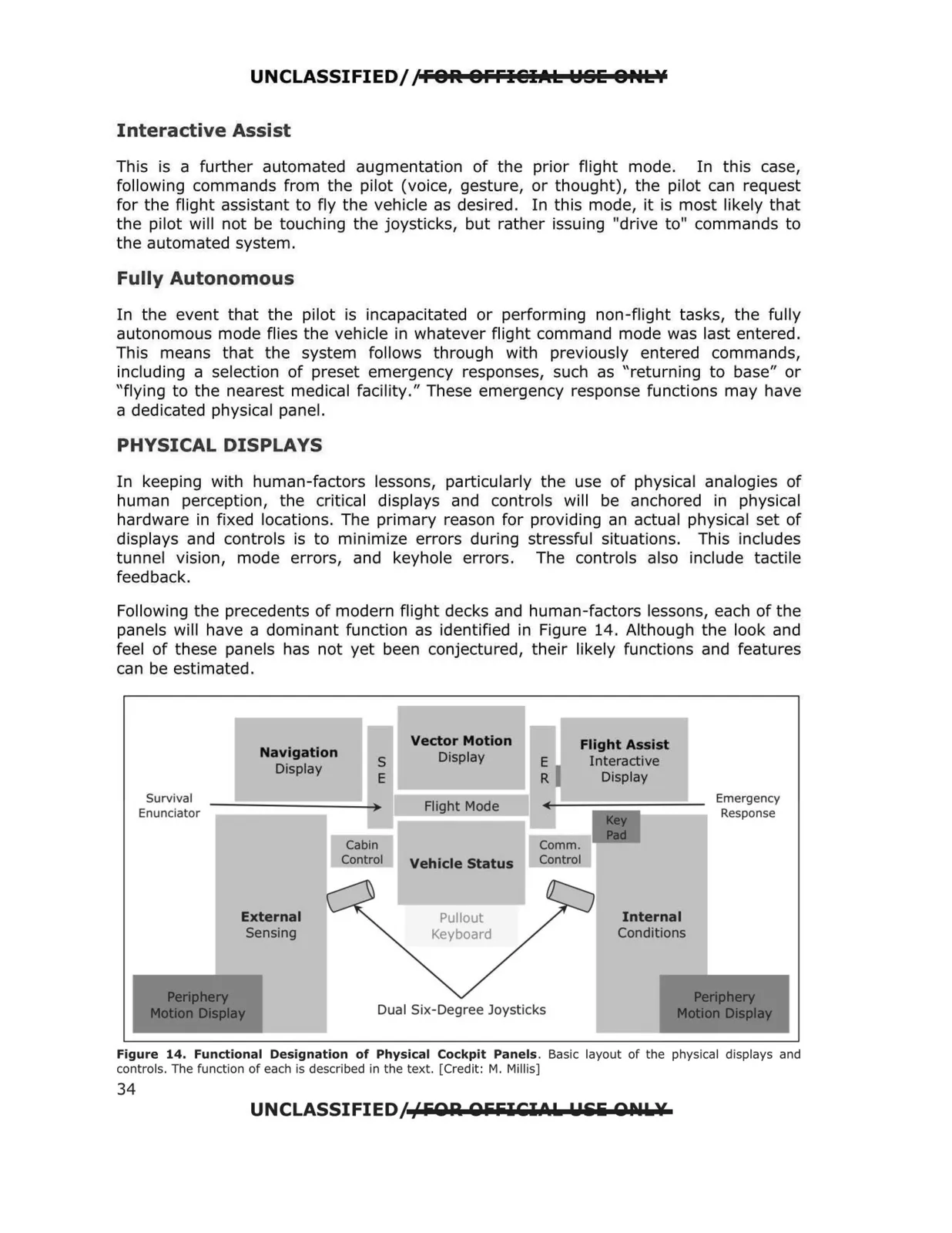
Following the precedents of modern flight decks and human-factors lessons, each of the
panels will have a dominant function as identified in Figure 14. Although the look and
feel of these panels has not yet been conjectured, their likely functions and features
can be estimated.
Vector Motion
Flight Assist
Navigation
Display
s
E
Interactive
Display
E
R
Display
Survival
Emergency
Flight Mode
Enunciator
Response
Cabin
Comm.
Control
Control
Vehicle Status
External
Pullout
Internal
Sensing
Conditions
Keyboard
Dual Six-Degree Joysticks
Figure 14. Functional Designation of Physical Cockpit Panels. Basic layout of the physical displays and
controls. The function of each is described in the text. [Credit: M. Millis]
UNCLASSIFIED/fFOA. OFFICIO ls. Plili ONls.¥
34