AAWSAP DIRD, Aneutronic Fusion Propulsion I, November 2010
DOW-UAP-D145 · page 16 of 50
Text
This text came with the file. It may have mistakes. When the text and the image disagree, the image is right.
UNCLASSIFIED//POR. Offl@IAI:: ~S& Qptk\f
Long-duration spaceflights will require copious amounts of water for the crew, and
water can be used to provide some shielding from neutrons for the astronauts.
Shielding material for gamma rays presents a weight problem. Lead is one of the best
shielding materials for gamma, but at a cost of about $10,000/lb to launch material into
space, lead shielding is expensive to use.
The International Space Station and other spacecra~ designed for long-term human
habitation usually have a small area that is heavily shielded to prevent excessive
radiation exposure to the crew during solar events.
In addition to the dangers of natural sources of radiation in space that can endanger
human health and safety, the propulsion techniques of nuclear fusion and fission
generate large fluxes of radiation.
Neutron production is of special concern because
neutrons can penetrate metals and the structural material of space habitats.
The general equations that govern radiation shielding can help develop spacecraft
designs that will minimize radiation exposure.
The intensity of gamma rays will
attenuate according to the following equation:
A..()-A..
- µI'
( 1.17)
'f-' r
-
'f-'i11irial e
In equation 1.17, the flux of gamma rays or neutrons, given in particles per unit area
per unit time, is represented by <P(r); ¢ 1n1t1a1 represents the initial flux without the
shielding; and µ is the linear attenuation coefficient, a function of the gamma ray or
neutron energy and the type of shielding material. The thickness of the material is
represented by r.
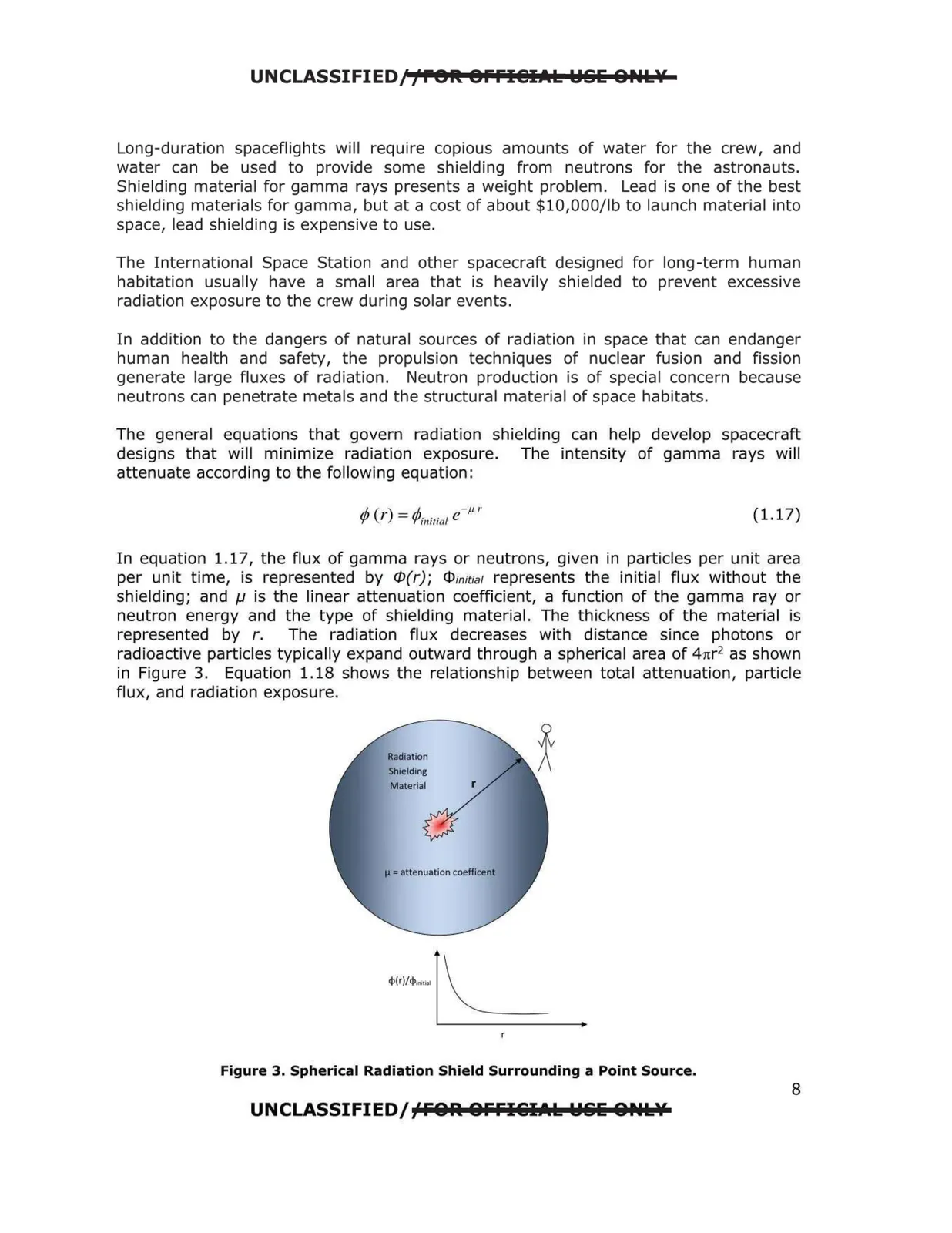
The radiation flux decreases with distance since photons or
radioactive particles typically expand outward through a spherical area of 4rcr2 as shown
in Figure 3.
Equation 1.18 shows the relationship between total attenuation, particle
flux, and radiation exposure.
Figure 3. Spherical Radiation Shield Surrounding a Point Source.
UNCLASSIFIED/fF&A &FFI€il.t.k W&& Qptk\f
8