AAWSAP DIRD, Aneutronic Fusion Propulsion I, November 2010
DOW-UAP-D145 · page 21 of 50
Text
This text came with the file. It may have mistakes. When the text and the image disagree, the image is right.
UNCLASSIFIED//POlt Offl@IAL HS& QptkY
Chapter 2: Nuclear Fusion Rocket Design
CLASSIC NUCLEAR FUSION SCHEMES
Nuclear fusion, which powers the Sun and the stars, begins with the collision of two
lightweight atomic nuclei to create two new particles with the release of energy. As an
example, if two specific isotopes of hydrogen (tritium and deuterium) were to collide,
the reaction would produce a neutron plus an alpha particle (ionized helium nucleus).
(2.1)
The 17.6 MeV of energy is split between the kinetic energy of the neutron (14.1 MeV)
and the helium nucleus (3.5 MeV) based on conservation of energy and conservation of
momentum. The kinetic energy is eventually converted into heat in a fusion reactor.
The 14.1-MeV neutron will penetrate far into lead or steel shielding and can cause
considerable material damage. The ionized helium nucleus, however, will not go very
far through any material without being absorbed and dissipating its energy as heat.
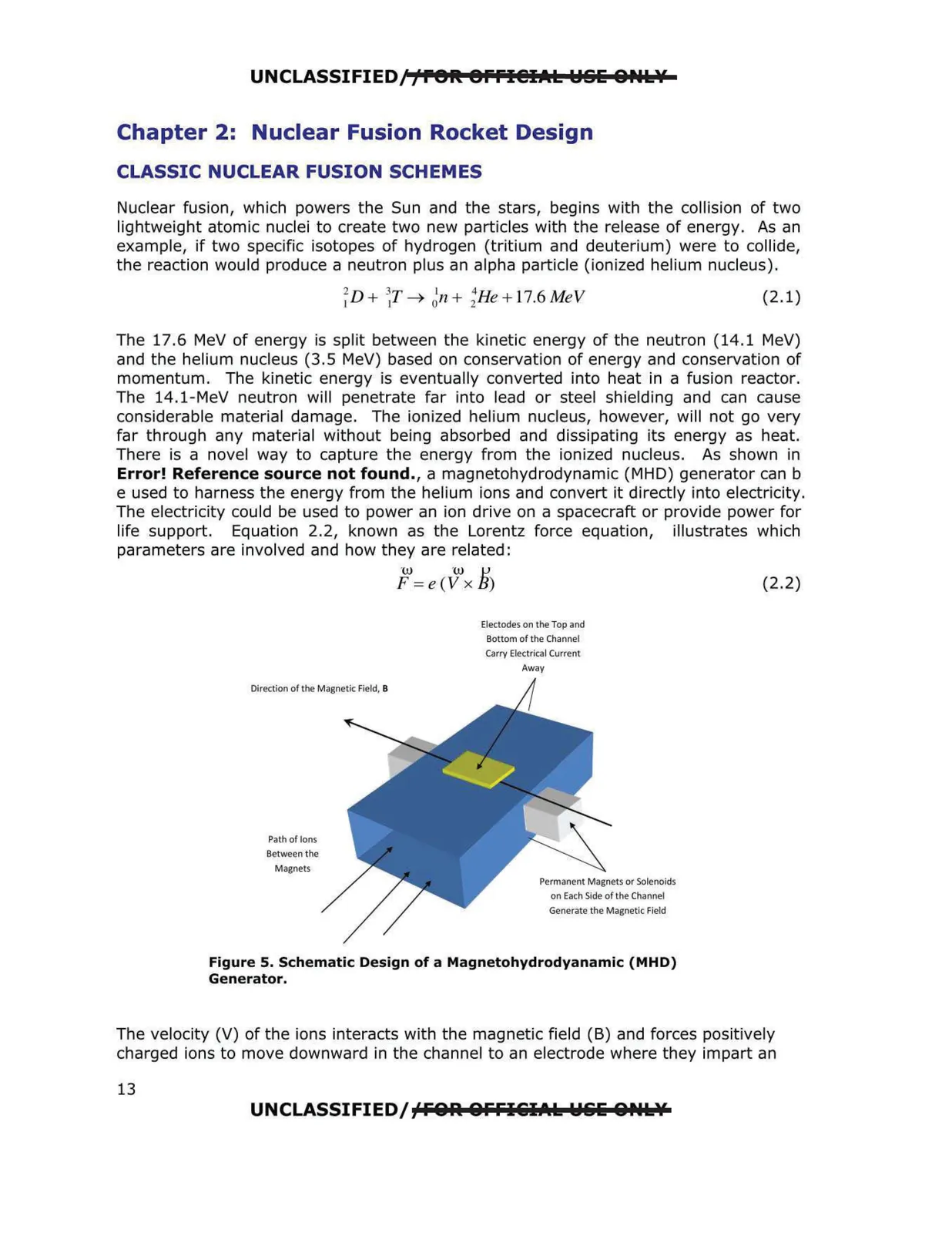
There is a novel way to capture the energy from the ionized nucleus.
As shown in
Error! Reference source not found., a magnetohydrodynamic (MHD) generator can b
e used to harness the energy from the helium ions and convert it directly into electricity.
The electricity could be used to power an ion drive on a spacecraft or provide power for
life support.
Equation 2.2, known as the Lorentz force equation,
illustrates which
parameters are involved and how they are related:
F =e(Vx B)
(2.2)
Electodes on the Top and
Bottom of the Channel
Carry Electrical Current
Away
Di rection of the Magnetic Field, B
Path of Ions
Between the
Magnets
Generate the Magnetic Field
Figure 5. Schematic Design of a Magnetohydrodyanamic (MHD)
Generator.
The velocity (V) of the ions interacts with the magnetic field (B) and forces positively
charged ions to move downward in the channel to an electrode where they impart an
UNCLASSIFIED/fF&A 9FFI€il.t.k Y&li QptkY
13