AAWSAP DIRD, Aneutronic Fusion Propulsion I, November 2010
DOW-UAP-D145 · page 23 of 50
Text
This text came with the file. It may have mistakes. When the text and the image disagree, the image is right.
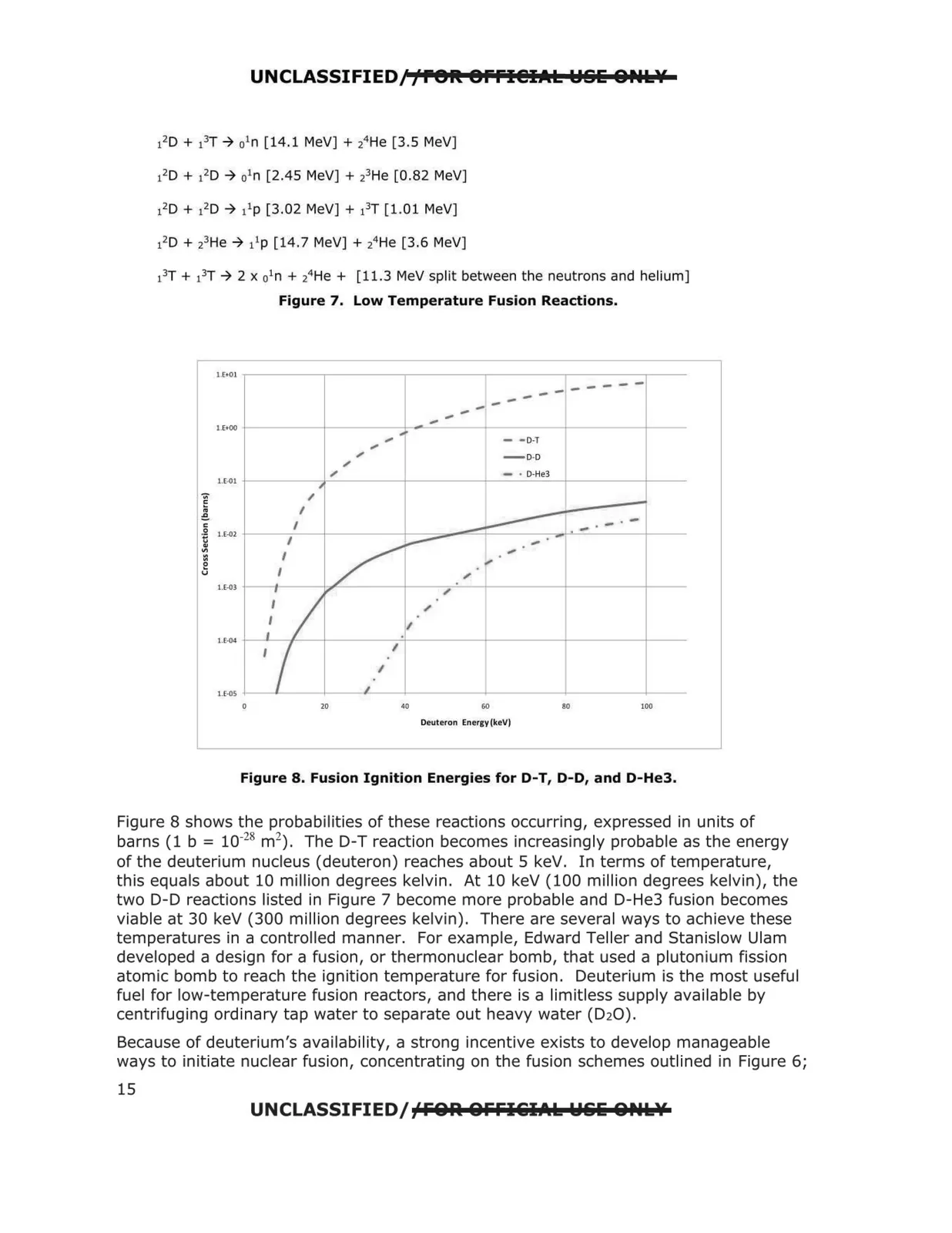
---- --- UNCLASSIFIED/ /PO lt Offl@IAL WS& &NkY i2D + i3T ➔ 01n [14.1 MeV] + 24He [3.5 MeV] i2D + /D ➔ 0 1n [2.45 MeV] + 23He [0.82 MeV] i3T + i3T ➔ 2 x o1n + 24He + [11.3 MeV split between the neutrons and helium] Figure 7. Low Temperature Fusion Reactions. l E+-OJ ---------------------- 1.E+OO +-----1-------'---------,....-----+----+- , 1 - - D-T ... ,,,, - D·D ,,,, ,,,, - • D-He3 1.E--01 +-----+-----+----------+------+- I C ! ~ C 0 -· ~ 1.E-02 e ~ V 1.E-04 -~ --+-----1_,_______________ 1 l .E-0.5 ,.___.__ I I · ' . ,,,, ,,,, " I,.,, . I - 20 40 60 80 100 Deuteron Energy(keVI Figure 8. Fusion Ignition Energies for D-T, D-D, and D-He3. Figure 8 shows the probabilities of these reactions occurring, expressed in units of barns (1 b = 10-28 m2). The D-T reaction becomes increasingly probable as the energy of the deuterium nucleus (deuteron) reaches about 5 keV. In terms of temperature, this equals about 10 million degrees kelvin. At 10 keV (100 million degrees kelvin), the two D-D reactions listed in Figure 7 become more probable and D-He3 fusion becomes viable at 30 keV (300 million degrees kelvin). There are several ways to achieve these temperatures in a controlled manner. For example, Edward Teller and Stanislaw Ulam developed a design for a fusion, or thermonuclear bomb, that used a plutonium fission atomic bomb to reach the ignition temperature for fusion. Deuterium is the most useful fuel for low-temperature fusion reactors, and there is a limitless supply available by centrifuging ordinary tap water to separate out heavy water (D2O). Because of deuterium's availability, a strong incentive exists to develop manageable ways to initiate nuclear fusion, concentrating on the fusion schemes outlined in Figure 6; UNCLASSIFIED/fF&A &FFI&I:.l.k W&li &NkY 15