AAWSAP DIRD, Aneutronic Fusion Propulsion I, November 2010
DOW-UAP-D145 · page 27 of 50
Text
This text came with the file. It may have mistakes. When the text and the image disagree, the image is right.
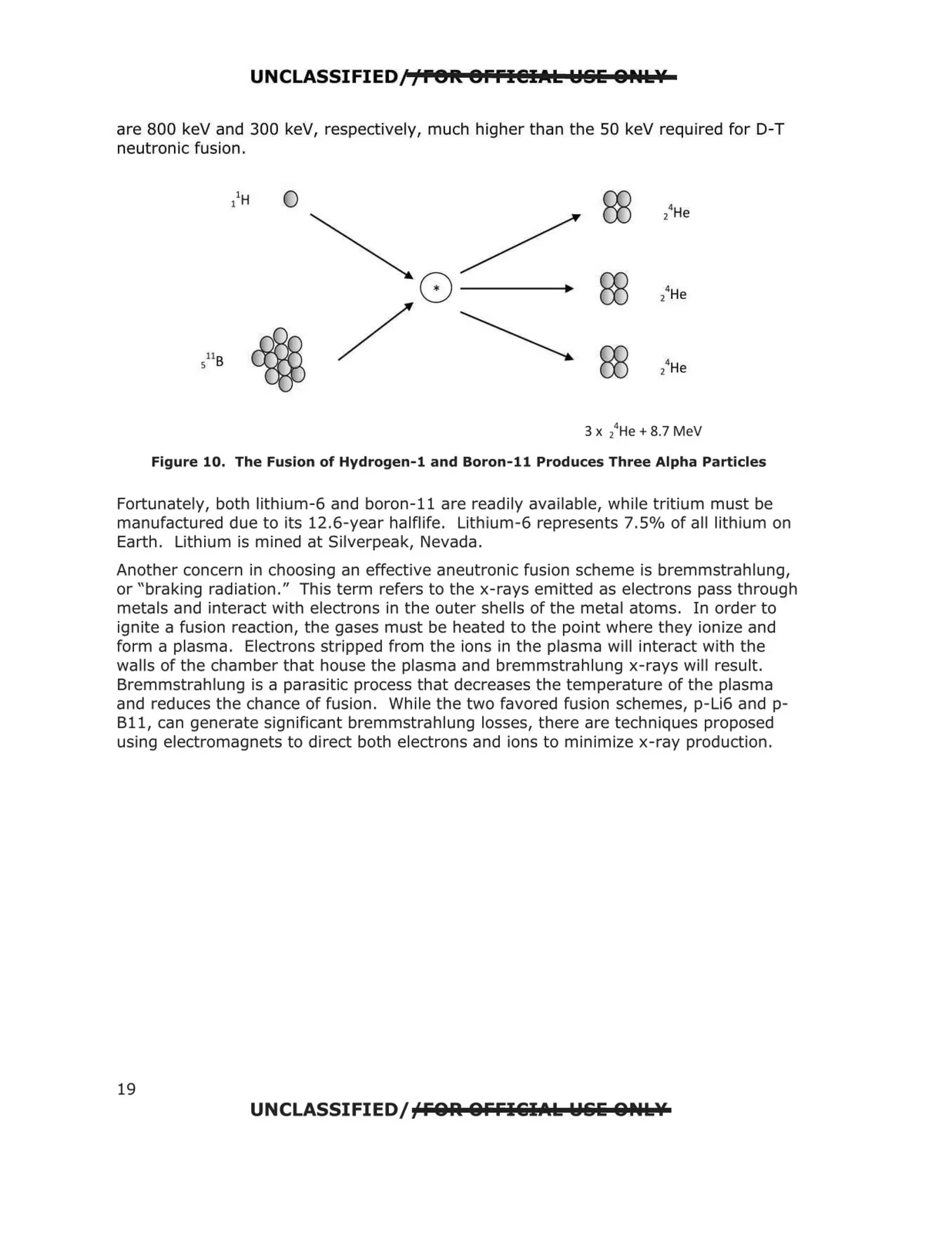
UNCLASSIFIED/ /PO lt Of f l@IAL WS& &NkY are 800 keV and 300 keV, respectively, much higher than the 50 keV required for D-T neutronic fusion. /H 0 m /He ~ 0 / ffi /He /1B @ / ~ m /He 3x /He+8.7MeV Figure 10. The Fusion of Hydrogen-1 and Boron-11 Produces Three Alpha Particles Fortunately, both lithium-6 and boron-11 are readily available, while tritium must be manufactured due to its 12.6-year halflife. Lithium-6 represents 7.5% of all lithium on Earth. Lithium is mined at Silverpeak, Nevada. Another concern in choosing an effective aneutronic fusion scheme is bremmstrahlung, or "braking radiation." This term refers to the x-rays emitted as electrons pass through metals and interact with electrons in the outer shells of the metal atoms. In order to ignite a fusion reaction, the gases must be heated to the point where they ionize and form a plasma. Electrons stripped from the ions in the plasma will interact with the walls of the chamber that house the plasma and bremmstrahlung x-rays will result. Bremmstrahlung is a parasitic process that decreases the temperature of the plasma and reduces the chance of fusion. While the two favored fusion schemes, p-Li6 and p B11, can generate significant bremmstrahlung losses, there are techniques proposed using electromagnets to direct both electrons and ions to minimize x-ray production. UNCLASSIFIED/fF&A &FFI&I:.l.k W&li &NkY 19