AAWSAP DIRD, Aneutronic Fusion Propulsion I, November 2010
DOW-UAP-D145 · page 29 of 50
Text
This text came with the file. It may have mistakes. When the text and the image disagree, the image is right.
UNCLASSIFIED//POlt Offl@IAL WS& &NkY
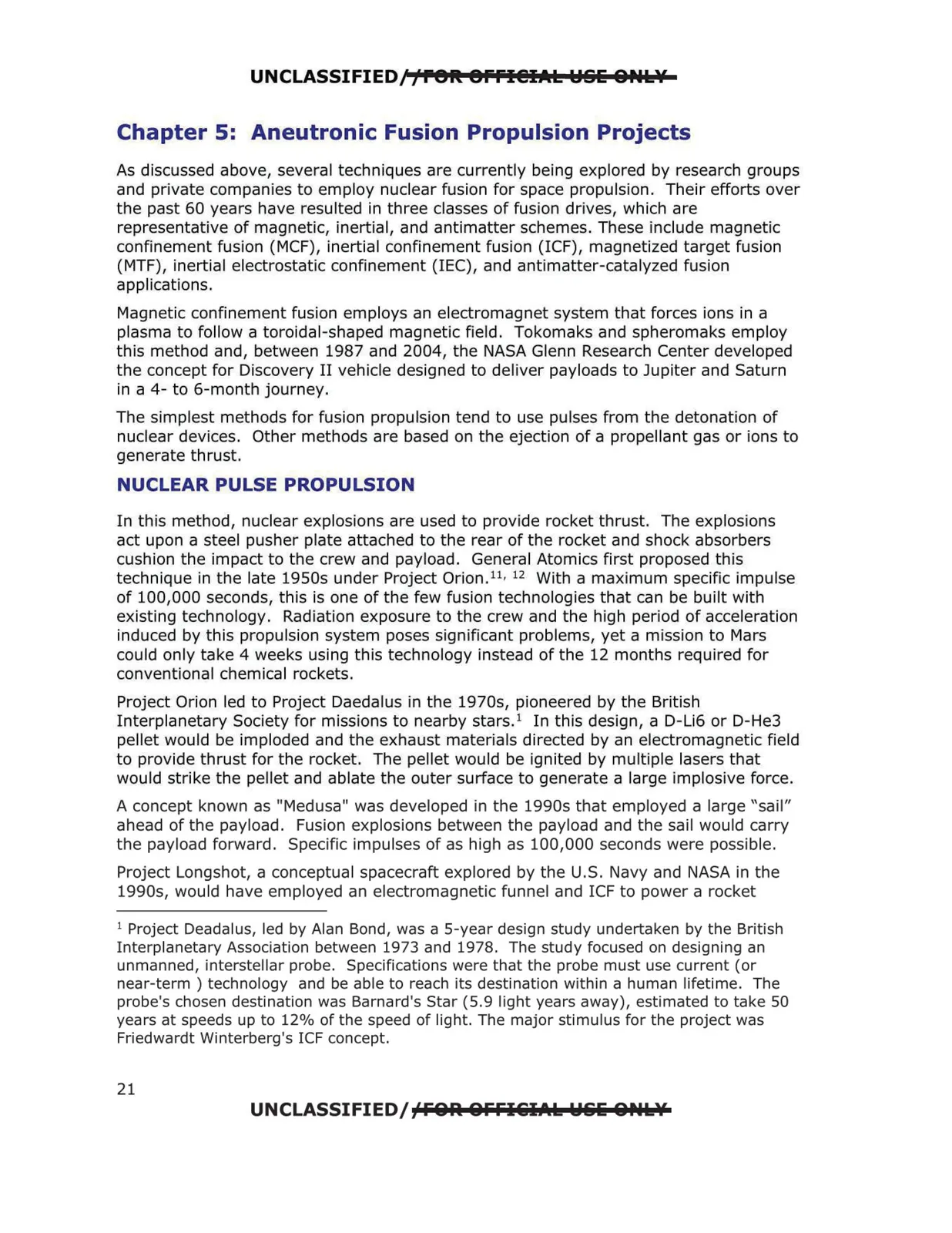
Chapter 5: Aneutronic Fusion Propulsion Projects
As discussed above, several techniques are currently being explored by research groups
and private companies to employ nuclear fusion for space propulsion. Their efforts over
the past 60 years have resulted in three classes of fusion drives, which are
representative of magnetic, inertial, and antimatter schemes. These include magnetic
confinement fusion (MCF), inertial confinement fusion (ICF), magnetized target fusion
(MTF), inertial electrostatic confinement (IEC), and antimatter-catalyzed fusion
applications.
Magnetic confinement fusion employs an electromagnet system that forces ions in a
plasma to follow a toroidal-shaped magnetic field. Tokomaks and spheromaks employ
this method and, between 1987 and 2004, the NASA Glenn Research Center developed
the concept for Discovery II vehicle designed to deliver payloads to Jupiter and Saturn
in a 4- to 6-month journey.
The simplest methods for fusion propulsion tend to use pulses from the detonation of
nuclear devices. Other methods are based on the ejection of a propellant gas or ions to
generate thrust.
NUCLEAR PULSE PROPULSION
In this method, nuclear explosions are used to provide rocket thrust. The explosions
act upon a steel pusher plate attached to the rear of the rocket and shock absorbers
cushion the impact to the crew and payload. General Atomics first proposed this
technique in the late 1950s under Project Orion. 11 • 12 With a maximum specific impulse
of 100,000 seconds, this is one of the few fusion technologies that can be built with
existing technology. Radiation exposure to the crew and the high period of acceleration
induced by this propulsion system poses significant problems, yet a mission to Mars
could only take 4 weeks using this technology instead of the 12 months required for
conventional chemical rockets.
Project Orion led to Project Daedalus in the 1970s, pioneered by the British
Interplanetary Society for missions to nearby stars. 1 In this design, a D-Li6 or D-He3
pellet would be imploded and the exhaust materials directed by an electromagnetic field
to provide thrust for the rocket. The pellet would be ignited by multiple lasers that
would strike the pellet and ablate the outer surface to generate a large implosive force.
A concept known as "Medusa" was developed in the 1990s that employed a large "sail"
ahead of the payload. Fusion explosions between the payload and the sail would carry
the payload forward. Specific impulses of as high as 100,000 seconds were possible.
Project Longshot, a conceptual spacecraft explored by the U.S. Navy and NASA in the
1990s, would have employed an electromagnetic funnel and ICF to power a rocket
1 Project Deadalus, led by Alan Bond, was a 5-year design study undertaken by the British
Interplanetary Association between 1973 and 1978. The study focused on designing an
unmanned, interstellar probe. Specifications were that the probe must use current (or
near-term ) technology and be able to reach its destination within a human lifetime. The
probe's chosen destination was Barnard's Star (5.9 light years away), estimated to take 50
years at speeds up to 12% of the speed of light. The major stimulus for the project was
Friedwardt Winterberg's ICF concept.
UNCLASSIFIED/fF&A &FFI&I:.l.k W&li &NkY
21