AAWSAP DIRD, Aneutronic Fusion Propulsion I, November 2010
DOW-UAP-D145 · page 42 of 50
Text
This text came with the file. It may have mistakes. When the text and the image disagree, the image is right.
UNCLASSIFIED//POR. Offl@IAI:: ~S& Qptk\f
shorter trips to the stars. Figure 14 shows how much time is required for the trip (one
way) based on the required acceleration. These equations are independent of the
specific impulse of the rocket. The mission cannot be less than 4.22 years in duration,
since the spacecraft cannot exceed the speed of light. If a 10-year mission were
chosen, the fuel usage would be tremendous, but the vehicle could attain an
acceleration of 0.20 g. At this acceleration, time on the rocket would pass at 72% of
the rate of time on Earth.
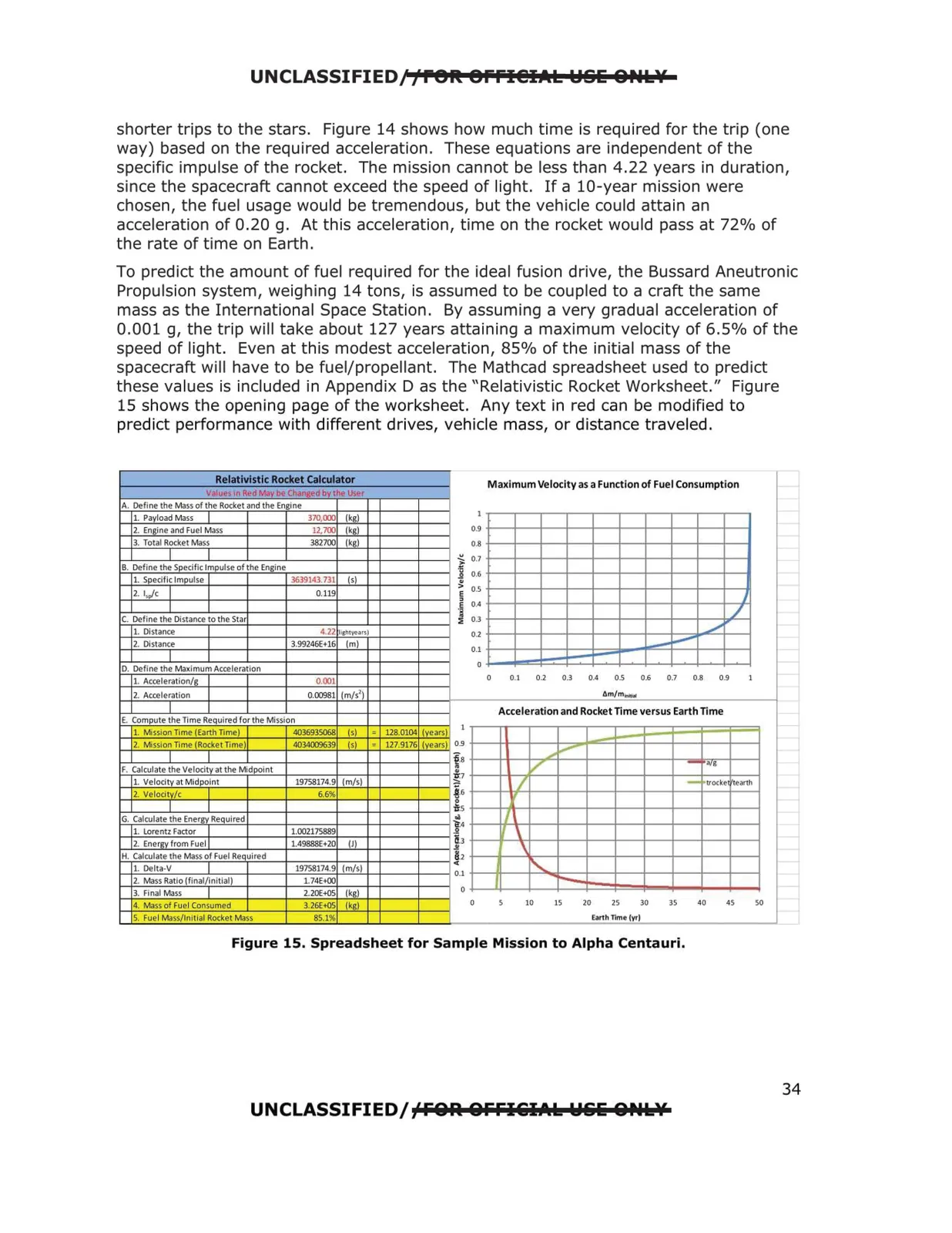
To predict the amount of fuel required for the ideal fusion drive, the Bussard Aneutronic
Propulsion system, weighing 14 tons, is assumed to be coupled to a craft the same
mass as the International Space Station. By assuming a very gradual acceleration of
0.001 g, the trip will take about 127 years attaining a maximum velocity of 6.5% of the
speed of light. Even at this modest acceleration, 85% of the initial mass of the
spacecraft will have to be fuel/propellant. The Mathcad spreadsheet used to predict
these values is included in Appendix D as the "Relativistic Rocket Worksheet." Figure
15 shows the opening page of the worksheet. Any text in red can be modified to
predict performance with different drives, vehicle mass, or distance traveled.
Relatlvlstlc Rocket calculator
Maximum Velocity as aFunction of Fuel Consumption
Value!> m Rt-d May be Ch~nged by :he Uwr
A. Define the Mass of the Rocket and the Engine
1. Pav load Mass
I
370,000
(kg)
1
2. Engine and Fuel Mass
12,700
(kg )
0.9
3. Total ~ocke1 Mass
382700
(kg)
O.ll
I
I
~ 0.7
8. Define the Specific Impulse of the Engine
-s
1. Sp ecific Impulse I
.3639143.731
(sl
.S'!
0.6
:::
2. 1,,jc I
I
0.119
~
0.5
I
I
E 0.4
/
C. Define the Distance to the Star
j 0.3
l . Dist ance
I
4.22 llghtveaa )
~
0.2
2. Dist ance
I
3.99246EH 6
(m)
---
0.1
I
I
D. Define the Max imu m Acceleration
0
l . Acceleration/g I
O.OOJ
0
0.1
0.2
0.3
o.•
0.5
0.6
0.7
O.ll
0.9
1
2. Acceleration
I
0.00981 (m/ s' )
6m/minltill
I
I
Acceleration and Rocket Time versus Earth Time
E. Co mpute the Time Required for the Mission
l
1. Mission Time (Earth nme}
4036935068
(s)
=
128.0104 (years)
12. Mission nme (Rocket nme)I
4034009639
(s)
=
127.9176 (vears
0.9
I
I
la
~-
F. Calculate the Velodtv at the Midpoint
V
.,.
1. Velocity at Mid point
(m/s)
'a'.7
/
19758174.9
::,
-
troc ke tearth
I2. Velocitv/c
I
6.6%
i 6
I
I
I
, 5
G. Calculate the Energy Re quired
..
\
-a.
1. Lorentz Factor I
1.002175889
.2
I
\
12. EnerllV from Fuel I
L49888E•20
(J)
! 1
\
H. Calculate the Mass of Fuel Re oulred
l 2
l. Dell a-V
I
19758174.9 (m/s)
.,
I'..
0.1
-
2. Mass Ratio (flnal/initial)
L 74E.OO
I
3. Final Mass
I
2.20E-+-05
(kg)
0
4. Mass of Fu el Consumed
3.26E>-05
(kg)
0
5
10
15
20
25
30
35
40
45
50
5. Fue l Mass/lnltlal Rocket Mass
85.1%
Eilrtti Time lyrl
Figure 15. Spreadsheet for Sample Mission to Alpha Centauri.
34
UNCLASSIFI ED/ fF&A &FFI€il.t.k W&& Qptk\f