AAWSAP DIRD, Aneutronic Fusion Propulsion II, November 2010
DOW-UAP-D146 · page 6 of 36
Text
This text came with the file. It may have mistakes. When the text and the image disagree, the image is right.
UNCLASSIFIED//FOR OfifilCIAk Wlili &P•kY
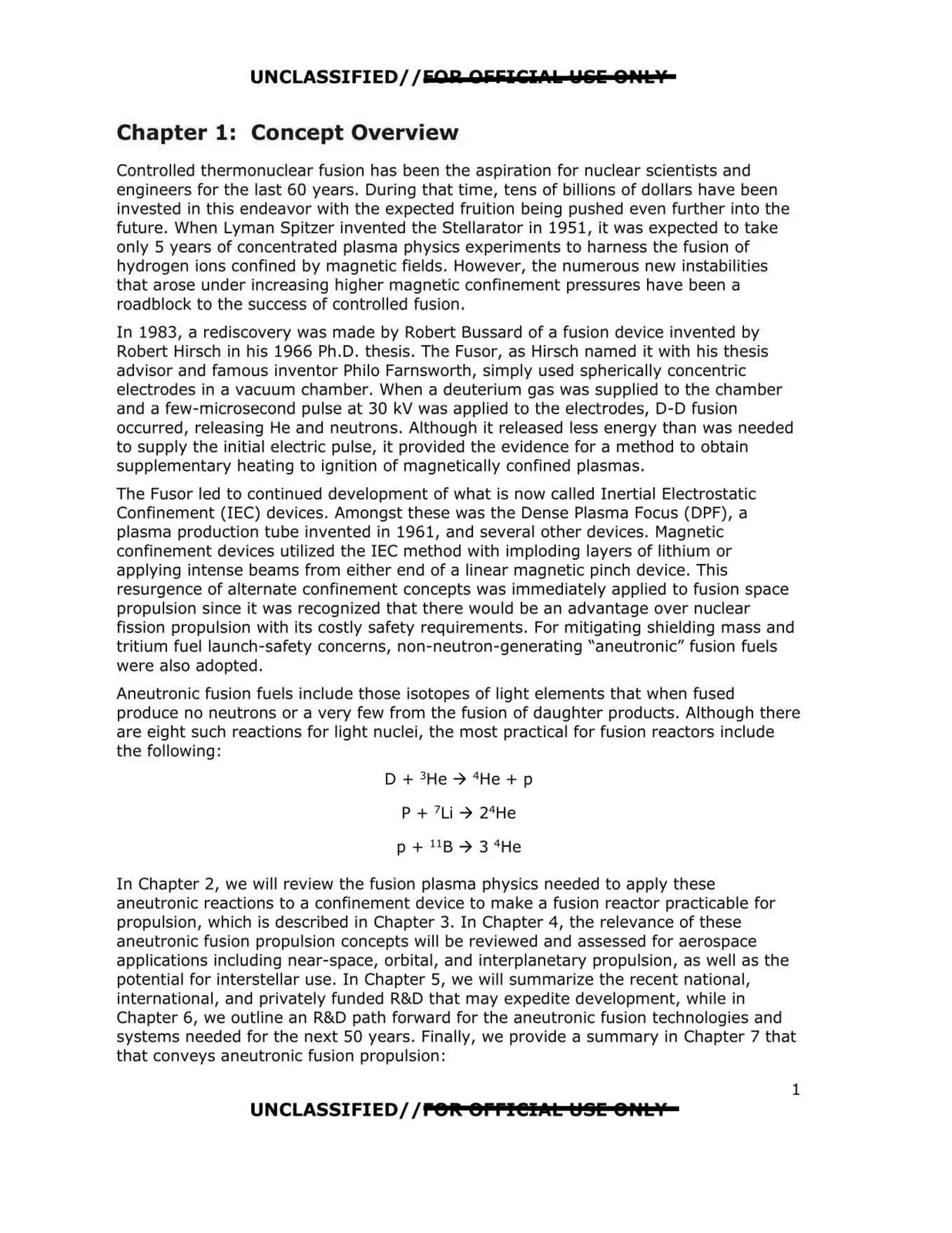
Chapter 1: Concept Overview
Controlled thermonuclear fusion has been the aspiration for nuclear scientists and
engineers for the last 60 years. During that time, tens of billions of dollars have been
invested in this endeavor with the expected fruition being pushed even further into the
future. When Lyman Spitzer invented the Stellarator in 1951, it was expected to take
only 5 years of concentrated plasma physics experiments to harness the fusion of
hydrogen ions confined by magnetic fields. However, the numerous new instabilities
that arose under increasing higher magnetic confinement pressures have been a
roadblock to the success of controlled fusion.
In 1983, a rediscovery was made by Robert Bussard of a fusion device invented by
Robert Hirsch in his 1966 Ph.D. thesis. The Fusor, as Hirsch named it with his thesis
advisor and famous inventor Philo Farnsworth, simply used spherically concentric
electrodes in a vacuum chamber. When a deuterium gas was supplied to the chamber
and a few-microsecond pulse at 30 kV was applied to the electrodes, D-D fusion
occurred, releasing He and neutrons. Although it released less energy than was needed
to supply the initial electric pulse, it provided the evidence for a method to obtain
supplementary heating to ignition of magnetically confined plasmas.
The Fusor led to continued development of what is now called Inertial Electrostatic
Confinement (IEC) devices. Amongst these was the Dense Plasma Focus (DPF), a
plasma production tube invented in 1961, and several other devices. Magnetic
confinement devices utilized the IEC method with imploding layers of lithium or
applying intense beams from either end of a linear magnetic pinch device. This
resurgence of alternate confinement concepts was immediately applied to fusion space
propulsion since it was recognized that there would be an advantage over nuclear
fission propulsion with its costly safety requirements. For mitigating shielding mass and
tritium fuel launch-safety concerns, non-neutron-generating "aneutronic" fusion fuels
were also adopted.
Aneutronic fusion fuels include those isotopes of light elements that when fused
produce no neutrons or a very few from the fusion of daughter products. Although there
are eight such reactions for light nuclei, the most practical for fusion reactors include
the following:
D + 3He ➔ 4He + p
P + 7Li ➔ 24He
In Chapter 2, we will review the fusion plasma physics needed to apply these
aneutronic reactions to a confinement device to make a fusion reactor practicable for
propulsion, which is described in Chapter 3. In Chapter 4, the relevance of these
aneutronic fusion propulsion concepts will be reviewed and assessed for aerospace
applications including near-space, orbital, and interplanetary propulsion, as well as the
potential for interstellar use. In Chapter 5, we will summarize the recent national,
international, and privately funded R&D that may expedite development, while in
Chapter 6, we outline an R&D path forward for the aneutronic fusion technologies and
systems needed for the next 50 years. Finally, we provide a summary in Chapter 7 that
that conveys aneutronic fusion propulsion:
UNCLASSIFIED//POlt orr1e1s1tt 1!181! 8HL1/
1