AAWSAP DIRD, Ultracapacitors as Energy and Power Storage Devices, November 2010
DOW-UAP-D147 · page 19 of 34
Text
This text came with the file. It may have mistakes. When the text and the image disagree, the image is right.
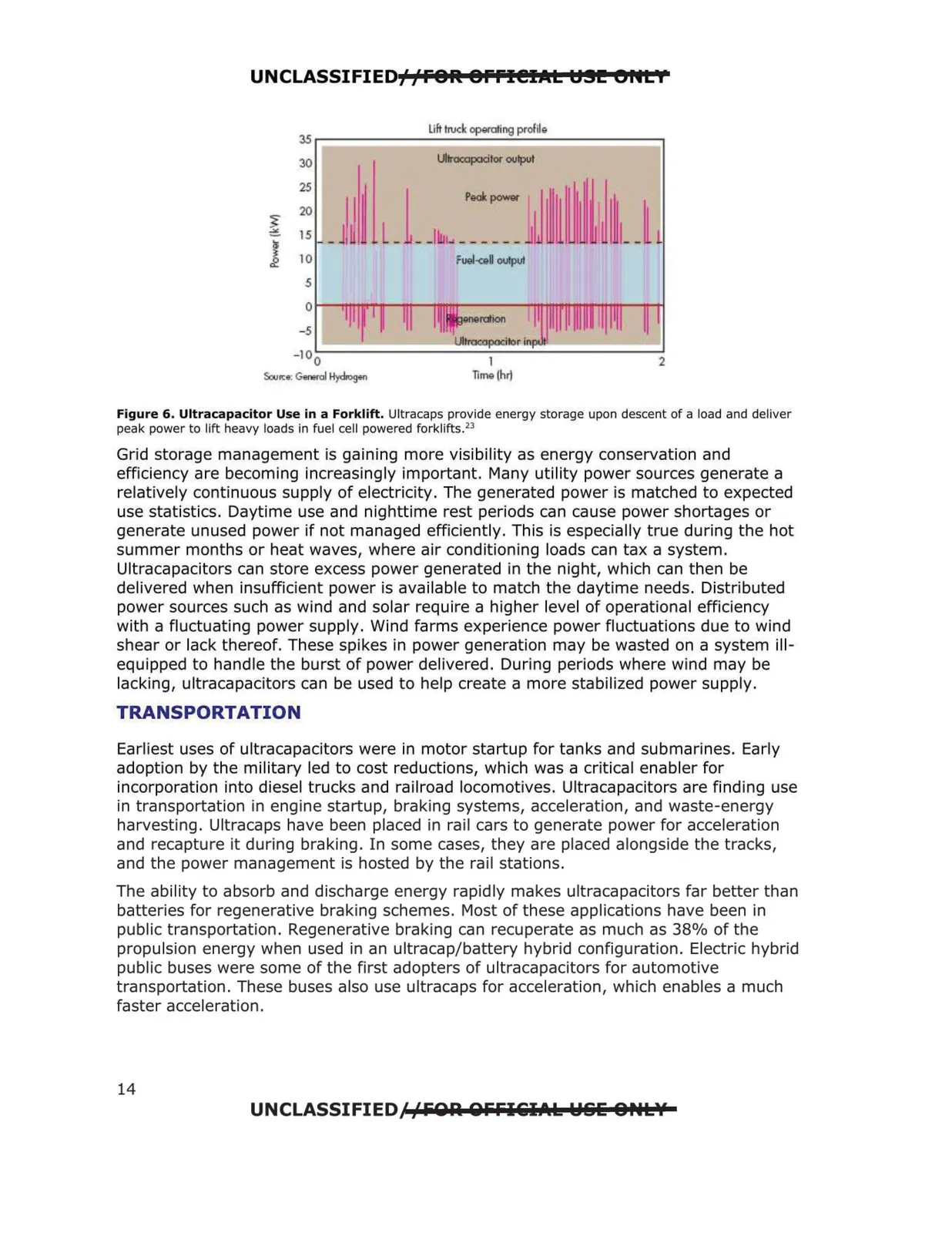
UNCLASSIFIED1/FOR 8ffl@IAL tt91! e"t I Ult truck opercrtl ng profile 35 ~ ::.::.-=--=--=--=--=- --------~~===--=- ~ f ~ JJI - - -'~ ~~ ~ J [~~ J1L J! l 0 Fuel-<.ell output 5 0 t--""ffltTft''Mt---itlr--"'fflltM----,-m-rimr,,,_"'""rrm--tt-,-i - 5 - 100 l 2 Scuru : G IHydrogen lime (hr) Figure 6. Ultracapacitor Use in a Forklift. Ultracaps provide energy storage upon descent of a load and deliver peak power to lift heavy loads in fuel cell powered forklifts. 23 Grid storage management is gaining more visibility as energy conservation and efficiency are becoming increasingly important. Many utility power sources generate a relatively continuous supply of electricity. The generated power is matched to expected use statistics. Daytime use and nighttime rest periods can cause power shortages or generate unused power if not managed efficiently. This is especially true during the hot summer months or heat waves, where air conditioning loads can tax a system. Ultracapacitors can store excess power generated in the night, which can then be delivered when insufficient power is available to match the daytime needs. Distributed power sources such as wind and solar require a higher level of operational efficiency with a fluctuating power supply. Wind farms experience power fluctuations due to wind shear or lack thereof. These spikes in power generation may be wasted on a system ill equipped to handle the burst of power delivered. During periods where wind may be lacking, ultracapacitors can be used to help create a more stabilized power supply. TRANSPORTATION Earliest uses of ultracapacitors were in motor startup for tanks and submarines. Early adoption by the military led to cost reductions, which was a critical enabler for incorporation into diesel trucks and railroad locomotives. Ultracapacitors are finding use in transportation in engine startup, braking systems, acceleration, and waste-energy harvesting. Ultracaps have been placed in rail cars to generate power for acceleration and recapture it during braking. In some cases, they are placed alongside the tracks, and the power management is hosted by the rail stations. The ability to absorb and discharge energy rapidly makes ultracapacitors far better than batteries for regenerative braking schemes. Most of these applications have been in public transportation. Regenerative braking can recuperate as much as 38% of the propulsion energy when used in an ultracap/battery hybrid configuration. Electric hybrid public buses were some of the first adopters of ultracapacitors for automotive transportation. These buses also use ultracaps for acceleration, which enables a much faster acceleration. UNCLASSIFIEO/fFOA OFFI&I:.l.b YS& ONLY 14