AAWSAP DIRD, Ultracapacitors as Energy and Power Storage Devices, November 2010
DOW-UAP-D147 · page 31 of 34
Text
This text came with the file. It may have mistakes. When the text and the image disagree, the image is right.
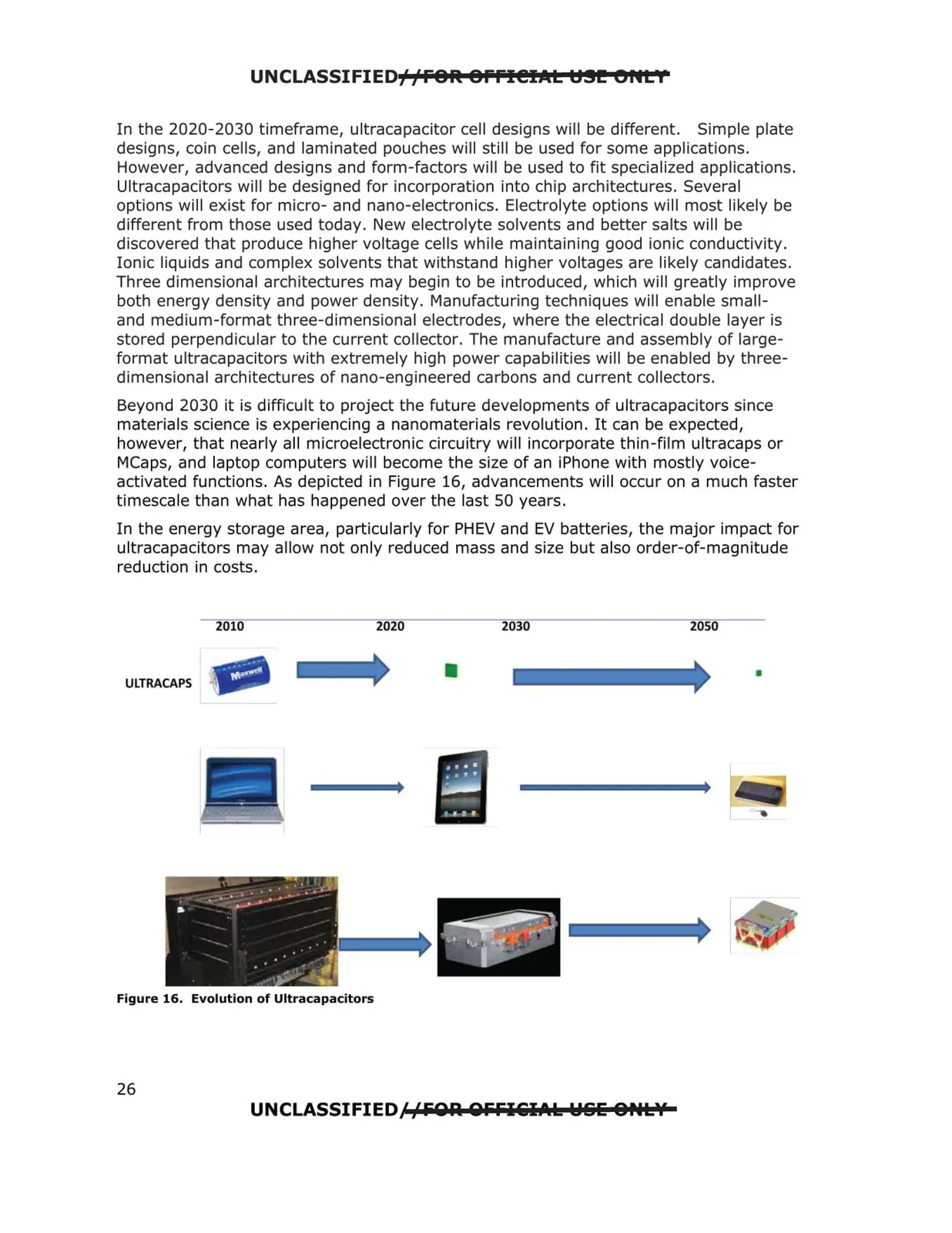
UNCLASSIFIED1fFOR 8ffl@IAL tt.!! e"t I In the 2020-2030 timeframe, ultracapacitor cell designs will be different. Simple plate designs, coin cells, and laminated pouches will still be used for some applications. However, advanced designs and form-factors will be used to fit specialized applications. Ultracapacitors will be designed for incorporation into chip architectures. Several options will exist for micro- and nano-electronics. Electrolyte options will most likely be different from those used today. New electrolyte solvents and better salts will be discovered that produce higher voltage cells while maintaining good ionic conductivity. Ionic liquids and complex solvents that withstand higher voltages are likely candidates. Three dimensional architectures may begin to be introduced, which will greatly improve both energy density and power density. Manufacturing techniques will enable small- and medium-format three-dimensional electrodes, where the electrical double layer is stored perpendicular to the current collector. The manufacture and assembly of large format ultracapacitors with extremely high power capabilities will be enabled by three dimensional architectures of nano-engineered carbons and current collectors. Beyond 2030 it is difficult to project the future developments of ultracapacitors since materials science is experiencing a nanomaterials revolution. It can be expected, however, that nearly all microelectronic circuitry will incorporate thin-film ultracaps or MCaps, and laptop computers will become the size of an iPhone with mostly voice activated functions. As depicted in Figure 16, advancements will occur on a much faster timescale than what has happened over the last 50 years. In the energy storage area, particularly for PHEV and EV batteries, the major impact for ultracapacitors may allow not only reduced mass and size but also order-of-magnitude reduction in costs. 010 2020 2030 2050 ■ • ULTRACAPS ► Figure 16. Evolution of Ultracapacitors UNCLASSIFIEO/fFOA QFFI€il.t.le YSE O,.LY 26