AAWSAP DIRD, Detection and High-Resolution Tracking of Vehicles at Hypersonic Velocities, November 2010
DOW-UAP-D148 · page 20 of 46
Text
This text came with the file. It may have mistakes. When the text and the image disagree, the image is right.
UNCLASSIFIED/fFOR. QFFIEl.t.L: U&i QD:I! X
ionized wake. This technique for detecting hypersonic meteors is not fully developed and
appears to be employed only by hobbyists.
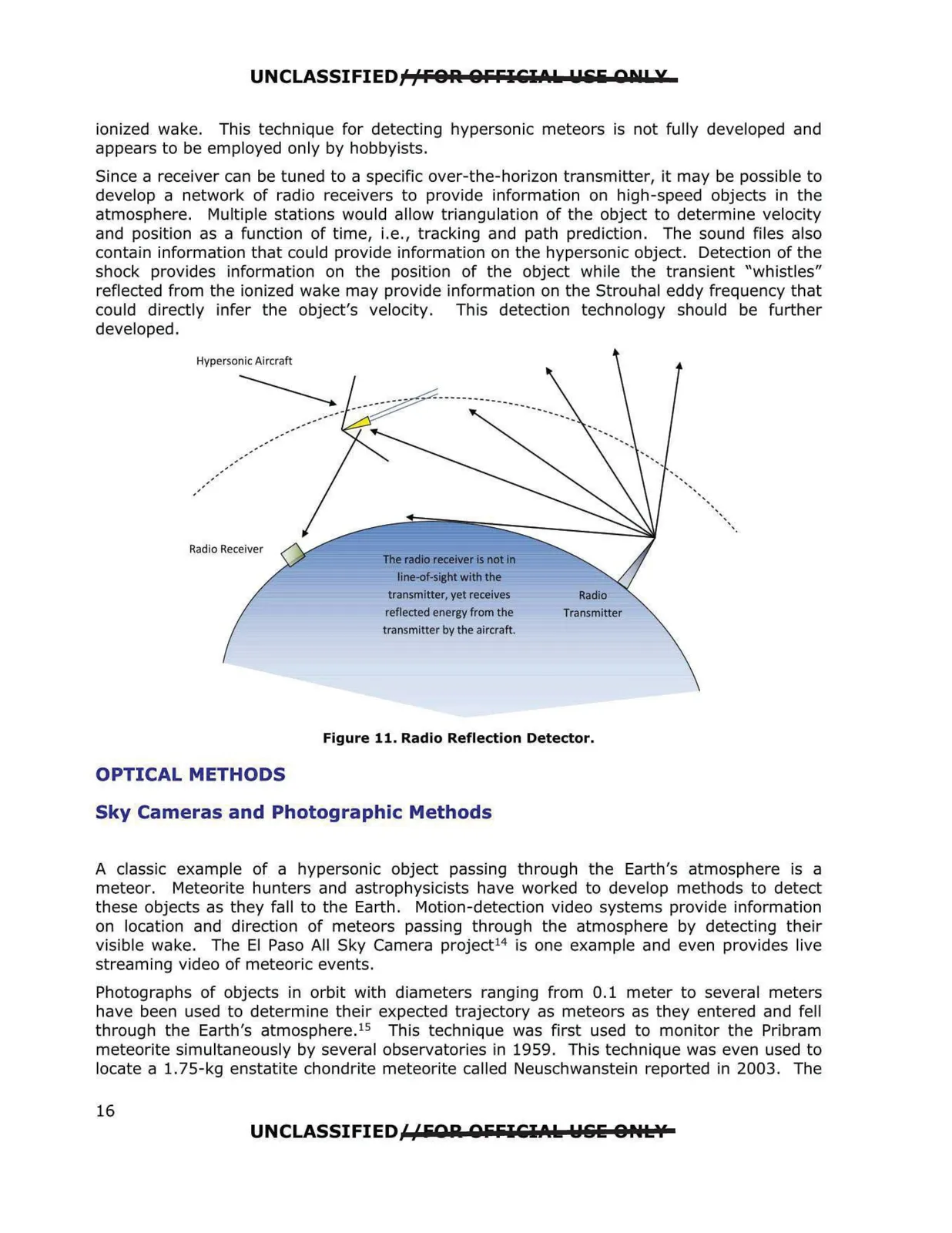
Since a receiver can be tuned to a specific over-the-horizon transmitter, it may be possible to
develop a network of radio receivers to provide information on high-speed objects in the
atmosphere. Multiple stations would allow triangulation of the object to determine velocity
and position as a function of time, i.e., tracking and path prediction. The sound files also
contain information that could provide information on the hypersonic object. Detection of the
shock provides information on the position of the object while the transient "whistles"
reflected from the ionized wake may provide information on the Strouhal eddy frequency that
could directly infer the object's velocity.
This detection technology should be further
developed.
Hypersonic Aircraft
Radio Receiver
The radio receiver is not in
line-of-sight with the
transmitter, yet receives
reflected energy from the
Transmitter
transmitter by the aircraft.
Figure 11. Radio Reflection Detector.
OPTICAL METHODS
Sky Cameras and Photographic Methods
A classic example of a hypersonic object passing through the Earth's atmosphere is a
meteor.
Meteorite hunters and astrophysicists have worked to develop methods to detect
these objects as they fa ll to the Earth. Motion-detection video systems provide information
on location and direction of meteors passing through the atmosphere by detecting their
visible wake. The El Paso All Sky Camera proj ect14 is one example and even provides live
st reaming video of meteoric events.
Photographs of objects in orbit with diameters ranging from 0.1 meter to several meters
have been used to determine their expected trajectory as meteors as they entered and fell
through the Earth's atmosphere. 15
This technique was first used to monitor the Pribram
meteorite simultaneously by several observatories in 1959. This technique was even used to
locate a 1. 75-kg enstatite chondrite meteorite called Neuschwanstein reported in 2003. The
UNCLASSIFIED//FQlil QlifilEIAL: Wlili O,.L'l
16